What a discharge summary typically contains
A discharge summary is the clinical account of an inpatient stay, assembled by the discharging clinician (or a resident or hospitalist writing on their behalf) once the stay is effectively over. The shape is fairly consistent from hospital to hospital, even though the exact headings vary:
- Reason for admission — why the patient came in, in the hospital's own clinical language.
- Findings — what tests, imaging, and evaluation turned up during the stay.
- What was done — the treatment, procedures, or surgery performed, and how the patient responded.
- The medicine list on leaving — what the patient is being sent home on, which is meant to already reconcile against what they were taking at home and what they were given in the hospital.
- Follow-up appointments — what's been arranged, and with whom.
- What to watch for — the warning signs that call for a return visit, stated for the next clinician's reference rather than as a plain-language patient handout.
Who it's actually written for
This is the detail that explains most of the frustration people describe with this document: a discharge summary is written primarily for the next clinician — the primary care doctor picking up follow-up care, a specialist, or the rehab or nursing facility receiving the patient — not for the family reading it at home. It's written in clinical shorthand, assumes clinical background, and is organized the way a clinician needs it organized rather than the way a worried family member would want it explained. That's a legitimate reason it can look impenetrable on the page; it isn't a sign that something was hidden or done wrong.
When it's usually available
Don't assume the summary is finished on the day of discharge. A fuller version is often dictated or completed in the days after the patient has already gone home, once the stay is wrapped up — while what's handed over at the door on discharge day is a shorter, different document (see below). There is an outer bound: the medical-records condition of participation, 42 CFR 482.24(c)(4)(viii), requires a participating hospital to complete the medical record "within 30 days following discharge" — which is a deadline for the record, not a promise about any particular day. Turnaround inside that window varies by hospital and by unit, which is the point: if nobody has said when the summary itself will exist, that's a reasonable thing to ask before leaving the floor, rather than something to assume has already happened.
How to ask for a copy, and why
Asking is simple and direct: "I'd like a copy of my discharge summary once it's completed, and I'd like to confirm it's being sent to my primary care doctor." If it isn't ready before discharge, ask how and when you can get it — through a patient portal, by mail, or with a follow-up call to the hospital's medical records department.
Having your own copy closes a real gap: the summary is what the next clinician reads before they see the patient, so if it hasn't reached that office — or hasn't been written yet — the family holding a copy is often the fastest way to make sure the follow-up appointment starts from an accurate account of the stay rather than from memory.
On timing, the HHS Office for Civil Rights describes a HIPAA Right of Access, set out at 45 CFR 164.524: a provider generally has to act on a request from a patient or their personal representative within 30 days — provide the record, or deny it — with one further 30-day extension possible, and a denial has to be given in plain language with an explanation of how to complain. That's an outer limit on how long a records request can take. It doesn't say when a discharge summary itself gets written, and it governs the request for the record rather than the document's contents.
Discharge summary vs. discharge instructions vs. after-visit summary
These three get used almost interchangeably by families, and they are not the same document:
- Discharge instructions — the shorter paper (or printout) handed over at the door on the day of discharge: medicines to take, activity limits, and warning signs, written for the patient rather than the next clinician.
- Discharge summary — the fuller clinical account described above, written for the next clinician, and frequently completed after the patient has already left.
- After-visit summary — the patient-facing recap generated at the end of a clinic or emergency-department visit, not an inpatient stay. It's a similar idea applied to a shorter encounter, and it's often what a portal shows first — which is part of why it gets confused with the inpatient discharge summary.
A family that's only ever handed the discharge instructions at the door — read aloud, quickly, by someone who is tired and on new medication, with nothing written down to refer back to later — is describing a real and common gap. Written instructions matched against a written summary is what closes it; a verbal recitation, however clear it felt in the moment, is easy to lose track of by the next morning.
What the request actually depends on
What a family can ask for is shaped by two things that vary — which hospital you are in, and which state you are in:
- The hospital's discharge-planning duty. The Centers for Medicare & Medicaid Services' discharge-planning condition of participation, 42 CFR 482.43, is a condition of a hospital's participation in Medicare. A hospital that participates has to meet it as a matter of how it runs discharge planning — it isn't switched on or off by how one patient's stay happens to be billed. How it is applied on a particular unit is still worth asking about.
- Caregiver-notification laws. A number of states have adopted a law modeled on the CARE Act — it goes by different names and is not in force everywhere — asking hospitals to record a designated family caregiver's name and offer them instruction in post-discharge tasks. Whether one applies here, and what it requires, depends on the state.
Because those vary, and because rules change, the reliable move is to ask the discharge planner or case manager what applies to this stay, rather than treating anything read in general as settled for your situation.
One thing worth keeping separate: a hospital discharge and a later coverage decision — whether a rehab or skilled-nursing stay continues to be covered, for instance — run on different notices with different deadlines. The end of skilled-nursing coverage is not the same notice, or the same clock, as leaving the hospital. Asking about one doesn't surface the other; each is worth asking about on its own terms.
More on a hospital stay
If you are working through a discharge right now, three companion pages go deeper than a definition: what to ask before a hospital discharge walks the six domains and the questions in each; medication reconciliation explains the three-list comparison behind the medicine list above; and a printable kit versus the patient portal covers what the portal will and won't hold for you.
Where to start
Start with the free One-Page Patient Summary — no email, no signup. It's built for the opposite end of a stay: the one page to carry on arrival, with conditions, current medications, allergies, devices, and who decides if the patient can't.
For the stay itself and the door on the way out, the Hospital Stay & Discharge Field Kit doesn't draft the discharge summary for you, but its medication-reconciliation sheet compares what was taken at home against what's being sent home on, and its discharge-readiness ledger counts what's still open — equipment, follow-ups, warning signs, transport, home setup — before anyone signs the paperwork.
For afterwards — the ongoing medicine list, and the bills when they start arriving — the caregiver templates hub has the rest of the set.
Templates that implement this
Hold your own copy of the record
3 templates
A print-and-carry kit and a fillable working set for comparing the medicine list and tracking what's still open before anyone signs the discharge paperwork — plus the free one-page summary to carry on arrival.
- $12.95 PDF
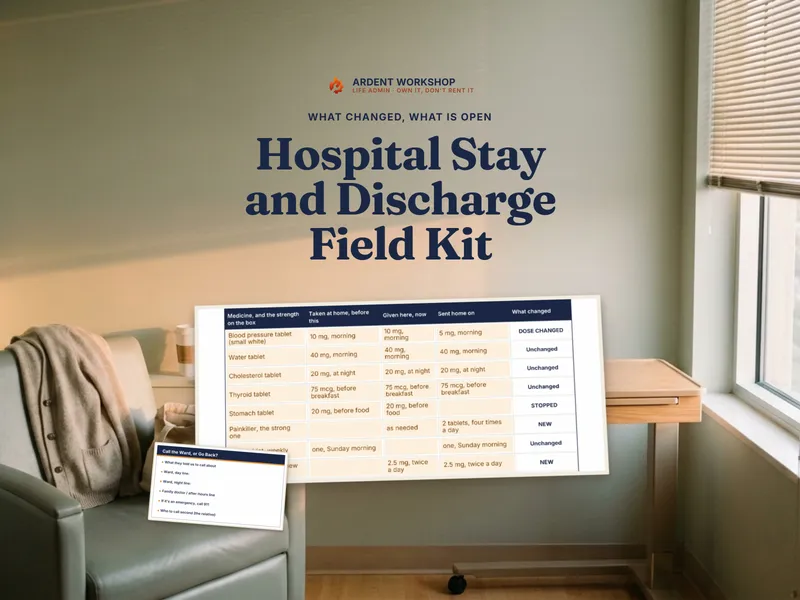
Hospital Stay & Discharge Field Kit — Print-and-Carry Pages, Cut-Out Cards, and a Fillable PDF That Compares the Medicine List and Counts What Is Still Open Before Discharge
A hospital stay and discharge kit that compares the medicine list for you — new, stopped, dose changed — and counts what is still open before you leave.
Life AdminView details - $18.95 Spreadsheet
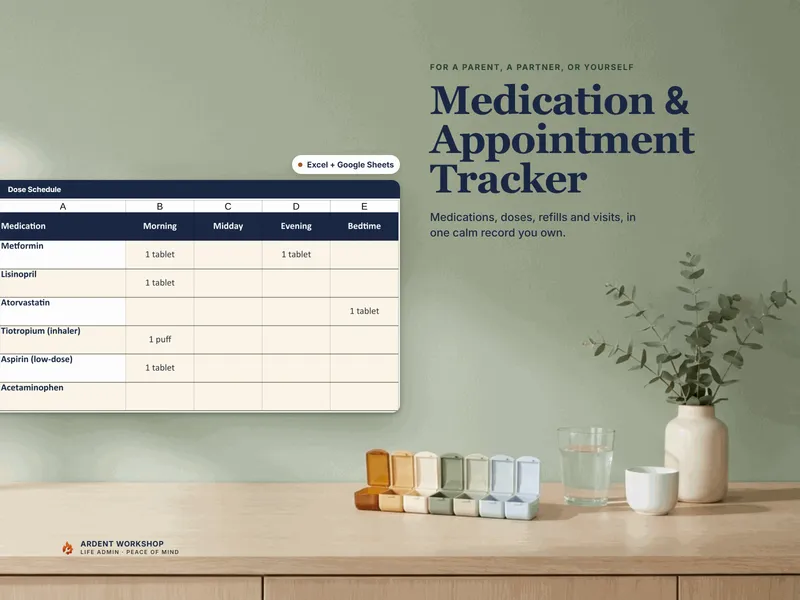
Medication & Appointment Tracker — Medication List, Dose Schedule, Refill & Appointment Organizer (Excel + Google Sheets)
A medication and appointment tracker to organize medications, doses, refills, and upcoming appointments in one file you own (Excel + Google Sheets).
Life AdminView details - $21.95 Spreadsheet
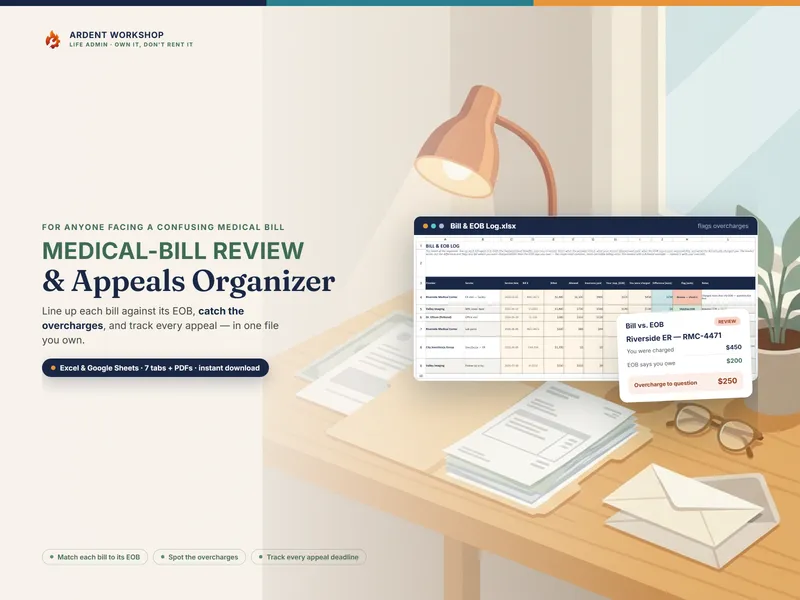
Medical-Bill Review & Appeals Organizer — EOB Matching, Denial & Appeal Tracker for Excel & Google Sheets
A medical-bill review & appeals organizer for Excel & Sheets — match bills to EOBs, catch overcharges, and track every denial and appeal you own.
Life AdminView details
Frequently asked questions
- Who is the discharge summary actually written for?
- The next clinician, not the family — the primary care doctor, the rehab facility, or whoever sees the patient next. It's written clinician-to-clinician, in clinical shorthand, which is exactly why it can read as impenetrable to the person holding a printed copy at home. Asking for it doesn't mean you're expected to translate it yourself; it means the next clinician has it, and so do you.
- When is the discharge summary usually ready?
- Often not on the day of discharge — though turnaround varies by hospital and by unit, so it's worth asking rather than assuming. It may be dictated or finalized in the days afterward, sometimes after the patient is already home. What's handed over at the door — the discharge instructions — is a different, shorter document, and its existence on discharge day doesn't mean the fuller summary exists yet.
- How do I ask for a copy of the discharge summary?
- Ask the discharging clinician or the unit's medical records office directly: "I'd like a copy of my discharge summary once it's completed, and I'd like to know it's being sent to my primary care doctor." If it isn't ready before you leave, ask how and when you can get it — by patient portal, by mail, or by a follow-up call to records. Under the HIPAA Right of Access, described by the HHS Office for Civil Rights, a provider generally has to act on a records request from a patient or their personal representative — provide the record, or deny it in writing — within 30 days, with one further 30-day extension possible. That is an outer limit on the request itself, not a promise about when the summary gets written.
- Is the discharge summary the same as the discharge instructions?
- No. The discharge instructions are the paper handed over at the door — a shorter document meant for the patient, covering medicines, activity limits, and warning signs. The discharge summary is the fuller clinical account of the stay, meant for the next clinician, and it can take longer to produce. A related document, the after-visit summary, is the patient-facing recap generated at a clinic or ED visit rather than an inpatient stay. All three can exist for the same episode of care and answer different questions.