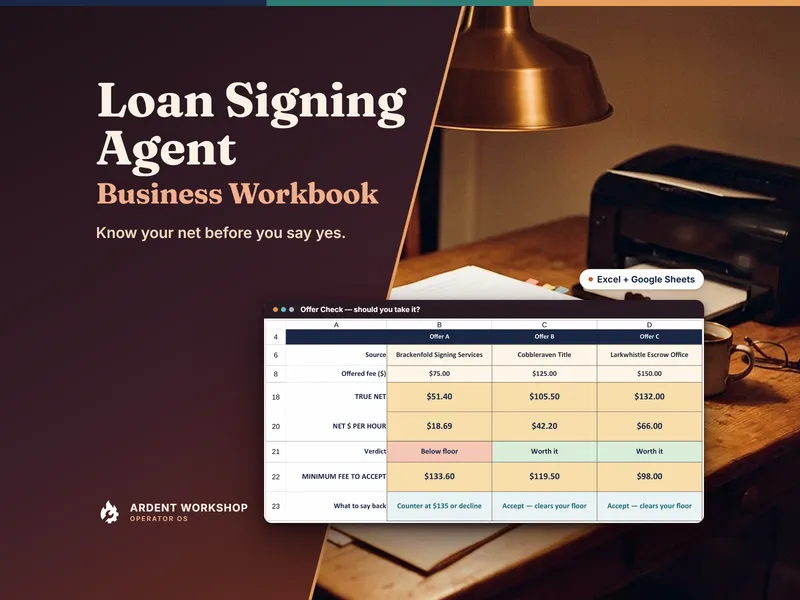
Picture a mobile notary — call her Dana, an illustrative composite, with the offers, pages and times below invented for the example — sitting in her car outside a print shop at 7:40 on a Tuesday morning. Three signing offers came in overnight. One pays $150, one pays $125, and one pays $200. Dana’s instinct, like that of anyone who reads the fee first, is to take the $200.
That instinct is wrong, and the reason is the whole subject of this post. Loan signing agent income per signing is not the fee. It is what is left after the printing, the driving and any platform’s cut, and it only means something next to the hours the signing really takes. In Dana’s worked example, the three offers net between about $98 and $113 each before tax, and pay between about $25 and $75 an hour. Her $200 offer is her worst job of the week and the $125 one is her best.
The fee is the only number on the order, and the costs arrive later and scattered: toner in one month, gas in another, scan-back time nobody writes down. So the math often never gets run. If you’d rather not build the tracking yourself, the Notary & Loan-Signing Agent Business Workbook nets every signing as you log it and checks each offer against your floor before you accept. Here is how the math works either way.
What is true net per signing?
True net per signing is the fee minus every cost the signing creates (printing, mileage and any platform cut), and true net per hour is that figure divided by every minute the signing takes, from the first page printed to the last scan-back. It is the number that tells you whether a job is worth taking. The fee alone never does.
Four inputs drive it:
- The fee, after any cut a signing platform or app keeps.
- Print cost: pages times your cost per page (paper plus toner, worked out from what you actually pay).
- Mileage: round-trip miles times what your car really costs per mile.
- Time: printing, driving, the signing itself, scan-back and drop-off. Not just the hour at the table.
If you are new to the role itself, what a loan signing agent does covers the job. This post is about what the job pays.
Loan signing agent income per signing: three offers, netted
Here is the scenario in full. Every figure below is illustrative: invented for the worked example, not survey data or typical market rates. Dana pays about 6 cents a page for paper and toner. She prices her miles at the IRS’s 2026 business standard mileage rate of 72.5 cents per mile (opens in new tab) as a stand-in for what her car really costs, though your own cost per mile may run higher or lower.
- Offer A, $150 from a signing service. A purchase package: 150 pages, a 40-mile round trip, and about 3 hours 5 minutes all in (25 minutes printing, 70 driving, an hour at the table, 30 minutes on scan-back and drop-off).
- Offer B, $125 from a local title company. A refinance: 60 pages, a 12-mile round trip, 90 minutes all in.
- Offer C, $200 through an app that keeps a 20% cut. A large package across town: 180 pages, a 70-mile round trip, four hours all in.
| Line item | Offer A | Offer B | Offer C |
|---|---|---|---|
| Fee | $150.00 | $125.00 | $200.00 |
| Platform cut | $0.00 | $0.00 | $40.00 |
| Printing | $9.00 | $3.60 | $10.80 |
| Mileage | $29.00 | $8.70 | $50.75 |
| True net | $112.00 | $112.70 | $98.45 |
| Hours, door to scan-back | 3.08 | 1.50 | 4.00 |
| True net per hour | $36.32 | $75.13 | $24.61 |
The $125 job nets more money than the $150 one, in half the time. The $200 job, the one Dana’s gut reached for, nets the least of the three and pays under $25 an hour once the drive and the cut come out.
That is the whole lesson of the scenario: the fee ranks offers in nearly the reverse order of what they pay. A larger fee usually means a larger package, a longer drive or a middleman, and each of those is a cost the fee does not show.
How to work out your minimum fee before you accept
Your minimum fee is the lowest fee at which a signing still pays your hourly floor after its costs. The formula:
Minimum fee = (printing + mileage + hourly floor × hours) ÷ share of the fee you keep
The share you keep is 100% for a direct title-company job and 80% when an app takes 20%. Say Dana’s floor is $40 an hour (again illustrative; set your own from what your time is worth to you):
- Offer A: ($9.00 + $29.00 + $40 × 3.08) ÷ 1.00 = about $161. At $150 she is below her floor, so she counters at $165.
- Offer B: ($3.60 + $8.70 + $40 × 1.50) ÷ 1.00 = $72.30. At $125 it clears comfortably, so she accepts.
- Offer C: ($10.80 + $50.75 + $40 × 4.00) ÷ 0.80 = about $277. At $200 it is nowhere close. A counter that large will not land, so she declines.
Notice what the division does in Offer C. A percentage cut doesn’t just take its share of the fee. It also takes a share of the money that was meant to cover your gas and paper, so the fee needed to break even rises faster than the costs do.
This is the same reasoning trades businesses use to price a service call: time and travel are part of the job, so they belong in the price.
Why the notarial part of the fee matters at tax time
Fees for notarial acts are excluded from self-employment tax; the rest of a loan signing fee is not. The IRS lists “Fees received for services performed as a notary public” among the income not included in net earnings from self-employment, in the Instructions for Schedule SE (opens in new tab). The signing-agent portion (your time, travel, printing and document handling) is not on that list, so it counts toward self-employment earnings like any other business income, and the self-employment tax rate is 15.3% (opens in new tab).
So every fee has two parts, and it pays to record them separately on the day:
- The notarial portion: the number of notarial acts times your per-act fee, capped at your state’s legal maximum per act if your state sets one.
- The signing-agent portion: everything else.
Back to Dana’s Offer B. Suppose the package carries 4 notarizations and her state caps the fee at $10 per act (an illustrative cap; the real one varies by state, and some states set none). That makes $40 of the $125 notarial and $85 signing-agent. Allocating her costs in the same proportion (85/125 of $112.70), about $76.64 of the true net counts toward self-employment earnings, and a rough set-aside of 15.3% of that comes to about $11.73. Federal income tax comes on top and depends on her bracket, so it isn’t modeled here.
| Offer B, illustrative | Amount |
|---|---|
| True net before tax | $112.70 |
| Rough self-employment tax set-aside | $11.73 |
| Net after self-employment tax | $100.97 |
| Per hour (1.5 hours) | $67.31 |
An agent who never splits the fee pays self-employment tax on the notarial portion too, because nothing on their books shows which part was exempt. Over a year of signings that adds up. For how platform income shows up on the return, see how to report a 1099-K on Schedule C.
What Dana changes after running the numbers
The scenario’s resolution is undramatic, which is the point. Dana doesn’t need more offers. She needs to stop accepting the wrong ones. After a month of netting every signing, three habits stick:
- She checks every offer against her minimum fee before replying. Counter or decline, never “sure” on reflex.
- She ranks her sources by net per hour, not by fee or volume. The service that sends the most orders may be the one paying the least per hour once its packages and distances are counted.
- She logs the notarial acts and the fee split the same day. Reconstructing them at tax time from memory is how the exclusion gets lost.
None of this needs software. A sheet with the four inputs and the formula above will do it. The free Loan-Signing Profit Calculator runs the math on one signing in your browser, with nothing to download. When you want it running across every signing, every source and the whole tax year, the Notary & Loan-Signing Agent Business Workbook was built for exactly this. Its Offer Check puts three offers side by side with the counter figure, its Signing Log splits the notarial fee on every row and flags anything over your state cap, and its Tax Summary carries both onto Schedule C lines. It is a file you buy once and keep. There’s no monthly subscription and no app taking a cut of your fees.
Common questions about loan signing agent income
How much does a loan signing agent make per signing?
The fee is the wrong number to quote. In the worked example above, three offers of $125, $150 and $200 all netted roughly $98 to $113 before tax, and their real hourly pay ran from about $25 to $75. What an agent makes per signing is the true net, and it depends on pages, miles, minutes and any platform cut, not on the fee alone.
Are loan signing fees subject to self-employment tax?
Partly. The IRS excludes fees for services performed as a notary public from self-employment tax. The rest of a loan signing fee, which pays for your time, travel, printing and handling, is not on that list of exclusions. Splitting the two on every signing is what lets you claim the exclusion, and a tax professional can tell you how to document the split.
What is a good minimum fee for a loan signing?
There is no single number, because it depends on the job. Your minimum fee is your costs for that signing plus your hourly floor times the hours it takes, divided by whatever share of the fee you keep after any platform cut. In the illustrative example above, a short local refinance needs a fee of only about $72 to clear a $40 floor, while a large package through an app that keeps a 20% cut needs about $277.