
What a loan signing agent does
A loan signing agent is a notary public who handles the signing step of a loan closing. The title company, escrow office or lender needs a borrower's signatures on a stack of documents, witnessed and notarized, and sends an agent to do it where the borrower is. The agent does not decide the loan terms and does not advise the borrower about them; the job is to run the appointment correctly and get the package back.
- Receive and print the package. Most signings are printed by the agent, and a loan package is a lot of paper.
- Travel to the signing. Usually the borrower's home, an office or a public place.
- Verify identity and run the signing. Check the signer's ID, guide them through the documents, and perform the notarial acts.
- Return the documents. Scan back where asked, then drop off or ship the originals to the address on the order.
How a loan signing agent differs from a general notary
Every loan signing agent is a notary, but not every notary does loan signings. A general notary performs notarial acts, such as acknowledgments, jurats and oaths, on whatever documents a signer brings. A loan signing agent takes on the work around a loan package as well: the printing, the driving, the appointment and the scan-back and drop-off. Becoming one usually starts with a notary commission, and signing services and title companies may ask for a background screening on top. What your state requires, and what a given company asks for, varies, so confirm both for your own situation.
How a loan signing agent gets paid
The usual arrangement is a flat fee per signing. It comes from one of three places: a signing service that takes orders from lenders and passes them on, a title or escrow company that books you directly, or a direct client. The fee is generally agreed before you accept the order.
Getting paid is not the same as being paid on time. A fair fee can still arrive slowly, and the wait is a real cost. Two sources that both offer the same fee are not equal if one pays within a couple of weeks and the other takes two or three months.
Where the fee goes
The fee on the order is a gross number. What it leaves you is the fee minus four costs:
- Printing. Cost per page is paper plus toner. A 500-sheet ream at $10.00 is $0.020 a page, and a $90.00 toner cartridge rated for 3,000 pages is $0.030 a page, so $0.050 per printed page in this example. A 150-page package then costs $7.50 to print.
- Travel. Your own cost per mile for fuel, tires, maintenance and wear, applied to the round trip; this example uses $0.30 a mile. That is a decision figure for judging a signing, separate from the IRS standard mileage rate, which is a tax figure.
- Time. The whole job counts: printing, the drive, the table, scan-back and drop-off. Not just the hour with the signer.
- Any platform cut. Some signings carry a signing-service or platform fee, or a courier cost paid out of the fee.
Take a $125 refinance with a 150-page package, 40 miles round trip and 150 minutes all in. At the example rates above, printing is $7.50 and travel is $12.00, so the signing nets $105.50, which is $42.20 for each of the 2.5 hours. Run the same $125 on a 200-page package with 70 miles round trip and printing rises to $10.00 and travel to $21.00, so it nets $94.00 before any courier cost. Spread that over the longer drive and it can fall below the hourly rate you need. The fee never changed. The job did. (All figures here are illustrative; your paper, toner, vehicle and state are your own.)
Net per signing, and the minimum fee to accept
Two numbers turn the order into a decision. Net per hour is the true net divided by all-in hours, compared with the hourly floor you set for yourself. The minimum fee to accept is the fee at which a signing exactly meets that floor:
Minimum fee = floor × hours + print cost + travel cost + platform cut.
Costs go back on top because the fee has to cover them before any of it counts as your pay. When an offer comes in below that number, the gap is the negotiation: you counter with the arithmetic, the page count and the distance, not a request for a raise. You can try one signing right now in the free loan-signing profit calculator: enter the fee, pages, miles and time, and it returns the net per signing and net dollars per hour. The Notary & Loan-Signing Agent Business Workbook runs the same math on every signing, with an Offer Check tab that prices an offer before you reply.
Notarial-act fees vs signing-agent fees
Not every dollar of a signing fee is the same kind of income. The part you earn for the notarial acts themselves, meaning acknowledgments, jurats and oaths, is treated differently for self-employment tax from the part you earn for handling the signing: the package, the travel, the printing and the courier work.
- Notarial portion. The number of acts times your fee per act, held to your state's maximum per act where there is one, and never more than the total fee.
- Signing-agent portion. Everything left over.
Fees for notarial acts are excluded from self-employment tax under section 1402(c) of the Internal Revenue Code, and Treasury Regulation 1.1402(c)-2 names a notary public among the public offices it covers. The IRS Taxpayer Advocate Service has published a tax tip on the subject, and the Schedule SE instructions (2025) give two routes. If notary fees are your only self-employment income, you check box 3 and enter Exempt—Notary on Schedule 2 (Form 1040), line 4, and do not file Schedule SE. If you had other self-employment earnings of $400 or more, you enter Exempt—Notary and your net profit as a notary public on the dotted line to the left of Schedule SE line 3, and subtract it there. Signing-agent, travel, printing and courier fees are not covered by that exclusion. They are still income, and notarial fees are not exempt from income tax either.
States set the most a notary may charge per act, and the amounts differ a great deal; some states set no maximum at all. The National Notary Association publishes a notary fees by state chart, which is the place to find yours. Anything charged above your state's maximum is not a notarial fee, so it stays on the signing-agent side. Splitting a fee so that more of it looks notarial is not a bookkeeping choice; it is a mistake a preparer has to untangle.
Your state's journal comes first
Many states prescribe their own journal format, and some require a bound paper journal or an approved electronic journal with specific entries. A printable record of your acts does not replace a state-required journal. Keep the one your state requires exactly as your state says, and treat any other record as your business record of the acts behind each fee.
Common mistakes new loan signing agents make
- Judging a signing by its fee. A $95 signing with 70 pages and a short drive will often beat a $150 signing with 200 pages and an hour of driving each way. Compare net per hour, not the fee.
- Counting only the hour at the table. Printing, driving, scan-back and drop-off are unpaid time that belongs in the hours.
- Not tracking who pays slowly. A source that sends heavy packages and pays in two or three months looks fine until you rank it against the one that pays a fair fee within a couple of weeks.
- Mixing up the decision cost and the tax cost. The estimated print cost on a signing is for deciding which work to take; the receipts you keep are what you report. Counting both double-counts printing.
- Deducting gas on top of standard mileage. The IRS standard mileage rate covers the cost of operating the vehicle, and IRS Topic No. 510 treats it as a choice between that rate and actual expenses, so the actual costs of the same vehicle are not a second deduction. Look up the rate for your tax year on the IRS standard mileage rates page instead of relying on a remembered number.
Related templates and concepts
A loan signing agent is a one-person service business, so the same arithmetic applies as in profit margin and cost per service. If you would rather see when a spreadsheet is enough and when scheduling software earns its keep, read spreadsheet vs notary scheduling app, or browse every tool on the templates for notaries hub.
Templates that implement this
Tools that work out what a signing really nets
2 templates
A connected workbook that nets every signing after printing, miles, time and any platform cut, tells you the minimum fee to accept before you say yes, ranks your sources, and separates notarial-act fees from your signing-agent fee at tax time.
- $19.95 Spreadsheet
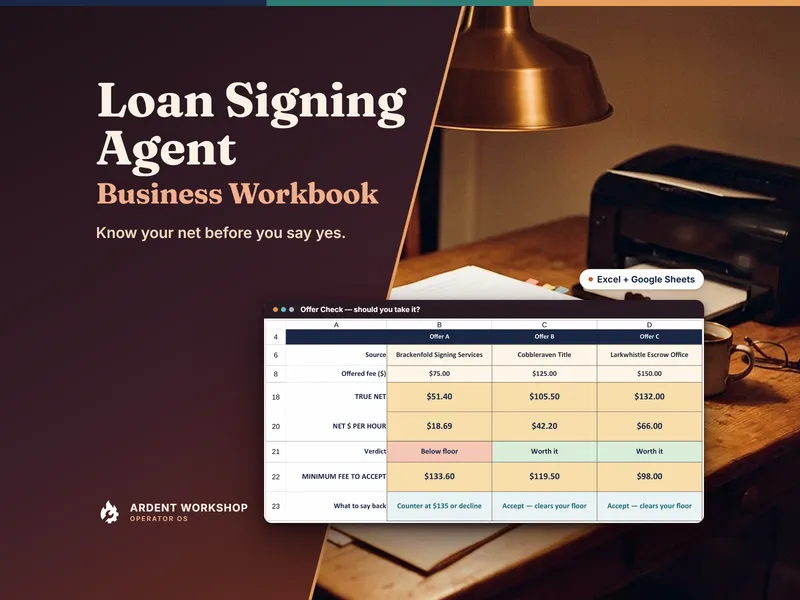
Notary & Loan-Signing Agent Business Workbook — True Net per Signing, Minimum Fee to Accept & Notarial Fee Split (Excel + Google Sheets)
A loan signing agent spreadsheet that nets every signing after print, gas and time, finds your minimum fee, and splits notarial fees for tax time.
Operator OSView details - $19.95 Spreadsheet

Gig-Driver Earnings & Mileage Workbook — True Hourly Rate, IRS Mileage Deduction & Schedule-C Expenses (Excel + Google Sheets)
A gig-driver workbook for Excel & Google Sheets — your true dollars per hour, an IRS-ready mileage deduction log, and Schedule-C expenses in one file.
Operator OSView details
Frequently asked questions
- What is a loan signing agent?
- A loan signing agent is a notary public who specializes in closing loan documents. They meet the borrower, confirm identity, guide the signing of the loan package, notarize the signatures that need it, and return the documents as instructed. The agent is a witness to the signing, not a loan officer, and does not advise the borrower about the loan terms.
- What is the difference between a notary and a loan signing agent?
- A notary performs notarial acts such as acknowledgments, jurats and oaths. A loan signing agent is a notary who also takes on the work around a loan signing: receiving and printing the package, travelling to the borrower, running the appointment, and scanning back and returning the documents. The notarial acts are one part of the job; the handling is the rest.
- How does a loan signing agent get paid?
- Usually a flat fee per signing, paid by a signing service, a title or escrow company, or a direct client. The fee is typically agreed before you accept the order. Payment can arrive weeks or months after the signing, so the wait is part of what a source really pays.
- What does a loan signing agent pay out of the fee?
- Printing (a loan package can run to well over a hundred pages), the cost of the miles driven, and the time the whole job takes, from printing and driving through the signing, scan-back and drop-off. Some signings also carry a platform or signing-service cut or a courier cost taken from the fee. Fixed costs such as a commission filing, bond, insurance and background screening sit on top.
- Are loan signing fees subject to self-employment tax?
- Part of them may not be. Fees for notarial acts are excluded from self-employment tax under section 1402(c) of the Internal Revenue Code, but signing-agent, travel, printing and courier fees are not covered by that exclusion, and all of it is still subject to income tax. How a fee is split, and how expenses are allocated between the two kinds of income, is something to confirm with a tax preparer. This is general information, not tax advice.
- Is there a limit on what a notary can charge per notarial act?
- Many states set a maximum fee per notarial act, and the amounts differ widely; some states set no maximum at all. The National Notary Association publishes a fee chart by state. Look up your own state's rule rather than assuming one. A fee above your state's maximum is not a notarial fee, so it cannot be counted as one.
- Does a printable record replace my state's notary journal?
- No. Many states prescribe their own journal, and some require a bound paper journal or an approved electronic journal with specific entries. Keep the journal your state requires exactly as your state says; any other record is only a business record of the acts behind each fee.