
What expectancy measures
Expectancy is what an average trade has returned. You can state it two ways, and both come from the same log of closed trades:
- Expectancy in dollars = total net P&L ÷ number of closed trades. The average dollar result of one trade, after fees.
- Expectancy in R = the average R-multiple per trade. Each trade's R-multiple is its net P&L divided by the risk you planned at entry, so this is the average result measured in units of risk.
Positive means the method has paid over the trades you logged. Negative means it has not. Note the wording: "has paid" describes the past sample, not a promise about the next trade.
Read expectancy in R before dollars
Dollars depend on how big you traded. A good method sized up for a few weeks and a poor one sized down can swap places in a dollar column. R removes sizing: a 125-share stock trade and a one-contract futures trade land on the same scale, so an average of +0.30R means the same thing whatever the account was doing. Look at expectancy in R first, then use the dollar figure to see what that edge was worth at the size you traded.
R needs a planned stop. A trade with no stop on record has no R, which is one more reason to write the stop down before you enter.
The win-rate trap
Here is a made-up month: ten trades, eight winners of $50 and two losers of $300. The win rate is 80%, and it feels great. But the wins total $400 and the losses total $600, so the month lost $200, or an average of $20 a trade. Expectancy is negative despite the 80%.
The reverse is just as true. A method that wins only a third of the time can pay if its winners are three times the size of its losers: over three trades that's one +3R and two −1R, which nets +1R, an average of about +0.33R per trade. Win rate and payoff size only mean something together, and expectancy is the number that puts them together.
Profit factor, beside expectancy
Profit factor = gross wins ÷ gross losses. Above 1 means your winners outweighed your losers; below 1 means they did not. In the example above it's $400 ÷ $600, well under 1. Profit factor and expectancy usually agree in sign. Neither is a verdict on its own: together with the win rate they describe the same trades from three angles.
Small samples fool everyone
Flip a fair coin six times and you will see five or more heads about one time in nine (7 out of 64, roughly 11%). Nothing special is going on; that's just how luck clusters. So a setup that won five of its first six trades may have simply had a lucky week. Five trades is a start, not a proof.
Expectancy gets more trustworthy as the closed-trade count grows, and it gets less trustworthy the moment you slice it into groups too thin to mean anything. Treat a result from a handful of trades as a question to keep logging toward, not an answer to act on.
Common expectancy mistakes
- Reading win rate as performance. It's half the picture; the size of wins against losses is the other half.
- Leaving fees out. Expectancy is a net number. A thin edge can vanish after commissions.
- Judging dollars before R. A change in position size can make a flat method look better or worse in dollars.
- Trusting a tiny sample. Six trades can flatter or punish any method.
- Logging only the trades you liked. Skipped or buried losers inflate every figure. Expectancy is only as honest as the log.
See it on a sample log
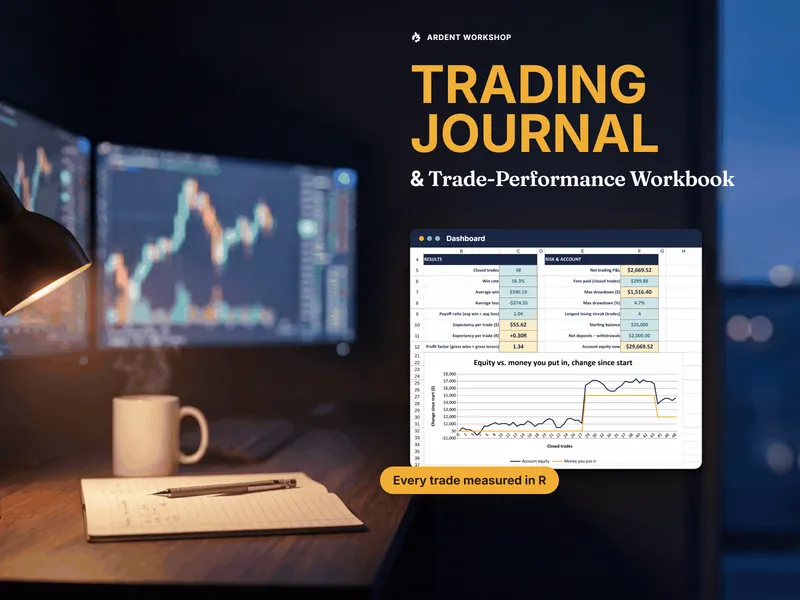
The sample data in the paid workbook is fictional, but it shows how the figures sit together: 48 closed trades, a 56.3% win rate, an expectancy of +0.30R (+$55.62 a trade), a profit factor of 1.34, and a maximum drawdown of $1,516.40 (4.7%). Those numbers belong to made-up trades, not to any real account or any promise of results.
To try it on your own trades, the free trading journal trade log is a one-tab, ungated log pre-filled with sample trades. It computes net P&L, planned risk and the R-multiple for each row, plus a running win rate. The Trading Journal & Trade-Performance Workbook goes further and works out expectancy, R-multiple and profit factor by setup, symbol, weekday and side. Both are files you own and keep, with no brokerage login and no subscription.
Not advice: this page explains a calculation and is not investment, trading or tax advice. It gives no trade signals, and past results from a log don't predict future ones.
Related templates and concepts
Expectancy is built from the R-multiple of each trade, and it belongs with profit margin among the numbers that tell you whether the work pays after costs. Choosing where to log your trades? See the trading journal spreadsheet vs. journaling app comparison.
Templates that implement this
A trade journal that computes expectancy for you
1 template
A one-time-purchase workbook that works out expectancy, R-multiple and profit factor by setup, symbol, weekday and side from your own trade log. It records and measures your trades; it does not tell you what to trade.
Frequently asked questions
- How do you calculate trading expectancy?
- In dollars, divide total net profit or loss by the number of closed trades. In R, take the average R-multiple per trade, where each trade's R is its net P&L divided by the risk you planned. A positive expectancy means the method has paid over the trades you logged; a negative one means it has not.
- Can a high win rate still lose money?
- Yes. Ten trades with eight winners of $50 and two losers of $300 is an 80% win rate, but the winners total $400 and the losers $600, so the method lost $200. Its profit factor is 400 ÷ 600, below 1, and its expectancy is negative.
- What is the difference between expectancy and profit factor?
- Expectancy is what an average trade has returned, in dollars or in R. Profit factor is gross wins divided by gross losses; above 1 means the winners outweigh the losers. They usually agree in sign, and reading them together with win rate and trade count tells you more than any one of them alone.
- How many trades do you need before expectancy means anything?
- More than most people think. Flip a fair coin six times and you will see five or more heads about one time in nine, so a setup that won five of six trades may just have had a lucky week. Treat a positive expectancy on a handful of trades as a lead to keep watching, not a conclusion.