
Yield is whole pieces, not area
The temptation is to divide areas: a 126.5-square-inch sheet, a 9-square-inch sticker, so fourteen stickers. Real yield never works that way, because you cannot sell three-quarters of a sticker. It is two whole-number counts multiplied together:
- Across — how many whole pieces fit along the printable width, each piece occupying its finished width plus the bleed on both edges plus the gutter to its neighbor.
- Down — the same count down the printable length.
- One gutter is added back to the sheet's own width and length before dividing, because the last piece in a row needs no gap after it.
Pieces per sheet = across × down. A 3-inch round with a sixteenth of bleed and an eighth of a gutter occupies a 3.25-inch pitch, so on 11.5 by 11 inches of printable area it fits 3 across and 3 down — nine pieces, not fourteen. Because both counts step in whole numbers, yield does not decline smoothly as a sticker grows. It drops in steps, and the step edges are where the money is.
The three losses, and why the shortcut is wrong
- The printer cannot reach the edges. A nominal 12-inch square sheet is nearer 11.5 by 11 inches of printable area. Everything outside that is bought and unusable, so measure a real full-bleed print rather than trusting the manufacturer's figure.
- Bleed and gutters make every piece bigger than it looks. Bleed is extra artwork past the cut line so a slightly wandering cut still lands inside the design; the gutter is the deliberate gap that stops the blade clipping a neighbor. Both consume sheet.
- Some of what you cut will never sell. Misprints, a lifted corner, a mis-registered pass. Your cost is the sheet divided by the pieces you can sell, not by the pieces you produced.
So the number worth pricing from is cost per good piece = (stock + ink + laminate) ÷ (pieces per sheet × (1 − spoilage)). On that illustrative 3-inch round — a $1.67 loaded sheet, nine pieces, 3% spoilage — that is $0.1913, against the $0.1856 the shortcut gives you. Small per sticker; not small across a few thousand.
A round wastes more than a square
Trim waste is the share of a bought sheet that never becomes product. It is easy to understate, because a die-cut round does not fill the square it occupies on the sheet — a circle covers only π/4, about 79%, of its bounding box. Count the box as product and that 3-inch round looks like 36% waste; count only the area the sticker actually covers and it is 49.7%. Half the sheet.
| Cut (illustrative) | Per sheet | Never product | $ / good piece |
|---|---|---|---|
| 3 in die-cut round, 1/8 in gutter | 9 | 49.7% | $0.1913 |
| 2 in die-cut round, 1/8 in gutter | 20 | 50.3% | $0.0932 |
| 2 in die-cut round, 1/16 in gutter | 25 | 37.9% | $0.0746 |
| 2 in kiss-cut on a 2.6 in backing, 0.1 in gutter | 12 | 35.9% | $0.1554 |
Row 1 is matte vinyl at a $1.67 loaded sheet cost and 3% spoilage; rows 2–4 are glossy vinyl at $1.79 and 4%, so their per-piece costs are not comparable to row 1's. Within rows 2–4 the stock and the spoilage are identical, so those three are comparable to each other.
Compare rows 2 and 3: halving the gutter on the 2-inch round buys a fifth row — 25 pieces from the same sheet at the same cost, a fifth off the cost per good piece, permanently. Then compare rows 2 and 4: the same sticker kiss-cut onto a backing card, on the same stock at the same spoilage, fits only 12 to the sheet, so it costs two-thirds more to make for a sticker a buyer cannot tell apart in a photograph. Figures are illustrative — material prices, printable areas and reject rates vary by supplier and machine, so measure your own.
You can work any single cut with the free Sticker Yield & Cost-Per-Sticker Calculator — no signup — to see the pieces per sheet and the cost per good piece without the arithmetic.
One convention to state out loud
There is more than one way to impose a sheet, and the choice moves the number. The convention above gives every piece its own bleed on every edge on top of the gutter, so neighboring artwork never touches — the safe assumption if you are cutting from printed registration marks. If your cut file instead nests the bleed into the gutter, so neighbors share it, set bleed to zero and let the gutter carry it: you will fit more per sheet. Either is defensible. Quoting a yield without saying which one you used is not.
Why yield is not the same as material being expensive
Here is the counterintuitive part: on a small sticker, material is the smallest cost you have. On an illustrative $3.75 die-cut single the vinyl is 19 cents — while your own hands are 73 cents and postage plus the marketplace take about 40% of the order. Yield still matters enormously, but not because vinyl is dear. It matters because it is the foundation every price above it is stacked on: get the cost per good piece wrong and every price, every discount, and every wholesale quote downstream of it is wrong in the same direction.
Related templates and concepts
Material yield feeds COGS and therefore profit margin; it is the print-shop cousin of recipe costing. To decide when a workbook is enough and when print-shop software earns its keep, read spreadsheet vs print-shop software, learn the whole method in how to price stickers, or browse every tool on the templates for craft sellers or templates for Etsy sellers hubs.
Templates that implement this
Tools that compute your yield for you
3 templates
A connected workbook that turns a sheet of stock into a real cost per good piece and carries it through to profit per design — plus the wider pricing tools behind a maker's shop.
- $19.95 Spreadsheet

Sticker & Print-Shop Profit & Production Workbook — Cost per Sticker, Stickers per Sheet Yield, Break-Even Discounts & Profit per Design (Excel + Google Sheets)
A sticker and print-shop costing workbook for Excel & Google Sheets — pieces per sheet, the real cost of one good sticker, and profit per design.
Operator OSView details - $19.95 Spreadsheet
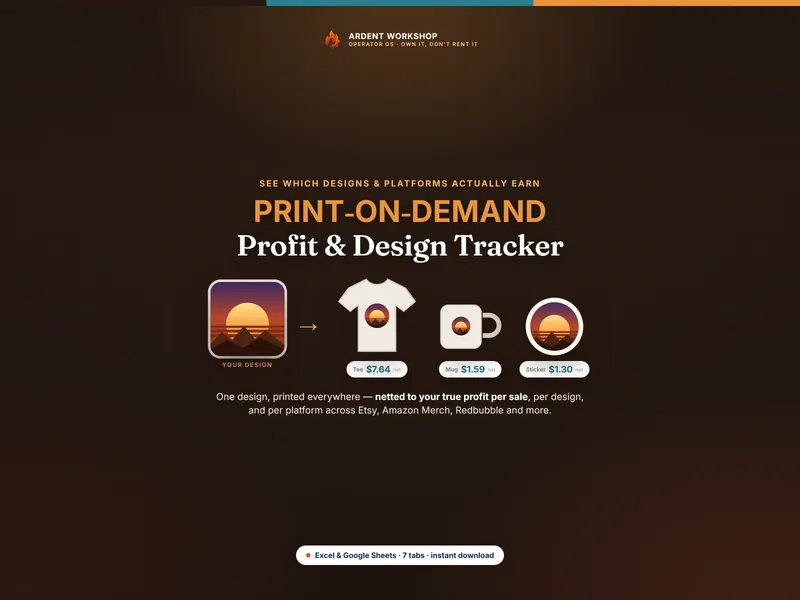
Print-on-Demand Profit & Design Tracker — POD Profit per Design, Platform Fees & Pricing for Etsy, Printful, Amazon Merch & Redbubble (Excel + Google Sheets)
A print-on-demand profit tracker for Excel & Google Sheets — net your profit per sale and per design across Etsy, Printful, Amazon Merch & Redbubble.
Operator OSView details - $24.95 Spreadsheet
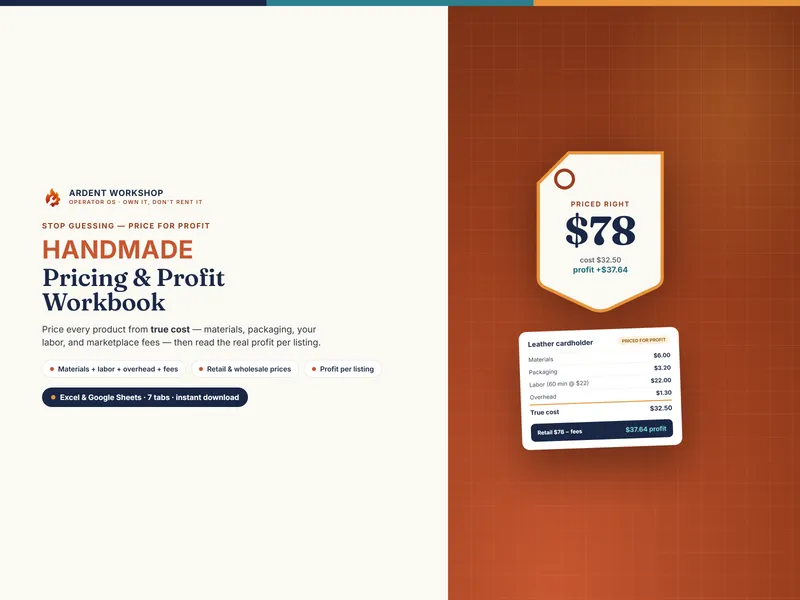
Handmade-Seller Pricing & Profit Workbook — Price Your Craft from True Cost, Markup vs Margin, Marketplace Fees & Wholesale (Excel + Google Sheets)
A handmade pricing workbook for Excel & Google Sheets — price every product from true cost (materials, labor, overhead, fees) and see the real profit on each.
Operator OSView details