
What detention pay is
Detention pay is money for time a truck spends waiting at a shipper or receiver beyond an agreed amount of free time. It is a line on a load, like linehaul or fuel surcharge, and it exists only if your agreement puts it there. It is easy to lose because the wait happens at a dock gate, hours before anyone sits down to do paperwork.
Your rate con decides it
Some rate confirmations (rate cons) give free time and a detention rate, some give less, and some say nothing. This page deliberately states no standard free time and no standard hourly figure, because none applies to every load. Check these six terms on each rate con:
- Free time, the wait that goes unpaid.
- Detention rate, usually per hour.
- When the clock starts: arrival, appointment, or whichever is later.
- Billing increment, if time is counted in blocks rather than minutes.
- Claims contact, the person or address to send it to.
- Claim deadline, if one is stated.
If a term is not written down, ask the broker or dispatcher to confirm it in an email before you roll, and write down what they said.
How to work out a detention claim
The arithmetic runs in steps, each from your own paperwork:
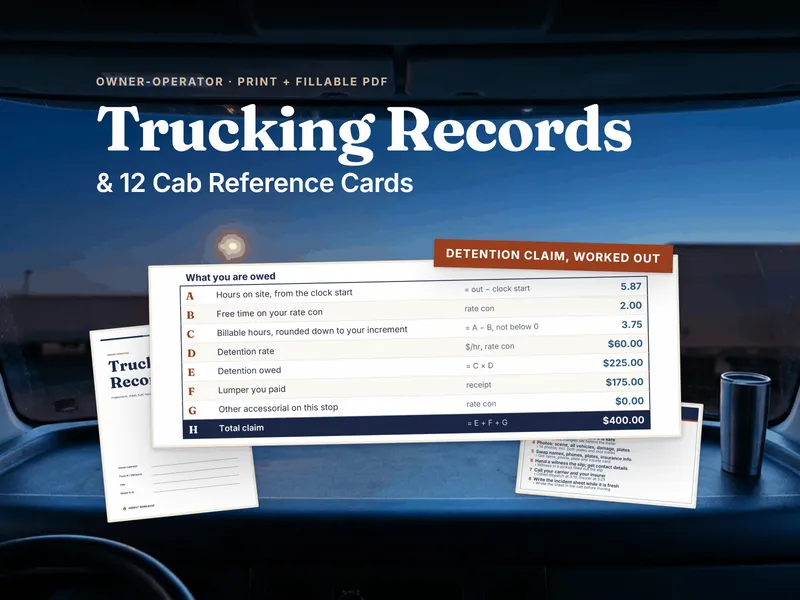
- Hours on site, counted from when the rate con says the clock starts to when you checked out.
- Less free time, never going below zero.
- Round down to the increment, if your rate con uses one.
- Times the detention rate gives the detention amount.
- Add the lumper you paid and any other accessorials to reach one total claim.
A worked example (fictional)
This is an invented example, with terms assumed for illustration, not typical ones. Suppose that load's rate con gives 2 hours of free time, a $60 hourly detention rate and a 0.25-hour increment. The driver was on site from 07:00 to 12:52.
- 07:00 to 12:52 is 5.87 hours on site.
- Less 2 hours of free time leaves 3.87 hours.
- Rounded down to the 0.25-hour increment, that is 3.75 hours.
- 3.75 hours at $60 an hour is $225.
- Plus a $175 lumper receipt makes a $400 claim.
What to record at the dock
A claim is only as good as the times behind it. Write each of these as it happens, with how you could prove it:
- Appointment time.
- Arrived at the gate.
- Checked in.
- Doors or dock assigned.
- Loaded or unloaded.
- Paperwork signed.
- Checked out.
Proof can be a bill of lading stamp, a gate log entry or a dated photo. A time with nothing behind it is your word against the facility's. Writing these on paper in the cab, at the time, works with no signal and needs no login, which is where a printed record has an edge over memory or a phone note you meant to type up later.
Detention and lumper fees on the same claim
A lumper is the unloading crew a facility requires you to pay. It is a separate charge from waiting time, but the two often turn up on the same stop, so they share one claim. Keep the lumper receipt, write its number down with how you paid it, and file the original with that load's paperwork. If the facility or broker required prior approval, note who approved it and when. The full picture is in what a lumper fee is.
Common detention mistakes
- Assuming a free time. Use the number on this load's rate con, not the one you remember from the last.
- Starting the clock at the wrong moment. Arrival and appointment can give different hours.
- Rounding up by habit. If the rate con uses an increment, round the way it says; if it is silent, ask the broker. The worked example above rounds down.
- No proof for the times. Get the stamp or photo before you leave the dock.
- Waiting to write it down. Details fade by the time the settlement arrives.
Where to keep the records
You can start with a notebook, and a free printable trucking trip sheet adds miles, deadhead, rate, fuel, tolls and accessorials for each load. The Owner-Operator Trucking Records & Cab Reference Card Set adds a Detention & Lumper Claim Slip that does the arithmetic above and a Settlement Review Slip for checking each pay line afterward. It is printed paper you own, with no subscription. Trucking software such as TruckLogics or Rigbooks is good at running the business side as a service. This is a records-and-organization tool, not a log, inspection report or compliance advice.
Related concepts
Detention is one of the accessorials that changes what a load really paid. To judge that against your break-even, see cost per mile, and browse the templates for owner-operators hub. For the other papers in the cab, see what to keep in the truck for a roadside inspection.
Templates that implement this
Tools for recording and claiming detention
2 templates
A printed record set whose Detention & Lumper Claim Slip works out the claim from times you wrote at the dock, and a desk workbook for the settlements and cost per mile behind it.
- $12.95 PDF
Owner-Operator Trucking Records & Cab Reference Card Set — Printable + Fillable PDF
Printable trucker log book sheets and fillable PDF slips that work out your detention claim, settlement check and true rate per mile.
Operator OSView details - $24.95 Spreadsheet

Owner-Operator Trucking Ops Workbook — Cost-Per-Mile Calculator, IFTA Log, Load Profit & Settlements (Excel + Google Sheets)
An owner-operator trucking workbook for Excel & Google Sheets — your true cost-per-mile, IFTA log, per-load profit, and settlements in one file.
Operator OSView details
Frequently asked questions
- How much free time do I get before detention pay starts?
- Whatever your rate confirmation says. Some rate cons give free time and a detention rate, some give less, and some say nothing at all. There is no number to assume, so read the rate con before you roll, and if a term is missing, ask the broker or dispatcher to confirm it in an email and write down what they said.
- When does the detention clock start?
- The rate con should say: at arrival, at the appointment time, or whichever is later. Because the rule changes the hours you can claim, write the rule on your claim slip before you reach the dock rather than working it out afterward.
- What proof do I need for a detention claim?
- Times with something behind them: a stamp on the bill of lading, a gate log entry, or a dated photo. A time with nothing behind it is your word against the facility's. Record the appointment, arrival at the gate, check-in, dock assigned, loaded or unloaded, paperwork signed and check-out.
- Is a lumper fee part of detention pay?
- No, they are separate lines. A lumper fee is what you paid the unloading crew a facility required, and whether you are reimbursed depends on your rate con and usually on a receipt. It can ride on the same claim as detention, but it is added to the total, not counted as waiting time.
- Does a record sheet guarantee I get paid detention?
- No. Whether you are paid depends on your rate con and carrier or broker agreement. What a written record does is make the claim specific and provable instead of a recollection. This page is about record-keeping, not legal or compliance advice.