
What a lumper is
A lumper is the unloading crew a facility requires you to pay. Some receivers won't let drivers touch the freight; they use their own crew or an outside one, and the charge often lands on whoever is standing at the dock. That can be you, with the truck, before you are released.
Who pays, and how reimbursement works
Paying the lumper and being reimbursed for it are two different events. Whether you get the money back depends on your rate confirmation (rate con) and usually on a receipt. The terms come from your rate con or your carrier agreement, so read them before you roll, not after you have paid.
- The rate con. It says whether lumper charges are reimbursed, and on what conditions. If a term is not written down, ask the broker or dispatcher to confirm it in an email, and write down what they said.
- The receipt. Keep the lumper receipt, write its number on your claim slip along with how you paid it, and put the original in the envelope for that load.
- Prior approval. If the facility or broker required approval before you paid, write down who approved it and when. A reimbursement that depended on an approval you can't name is hard to collect.
Why a lumper is a pass-through, not revenue
When the broker reimburses a lumper, you are being handed back money you already spent. You didn't earn it by moving freight. If it goes into "revenue you earned," your rate per mile and your margin both look better than the trip really was.
Here is a fictional example. With a $175 lumper kept out of revenue, the trip falls $295.00 short of the driver's own break-even. Count the $175 as revenue and the same trip shows only $120.00 short. The honest number is the one without it. The reimbursement shows up on the cash line, where it belongs, and nowhere else. This is the same discipline as using the same mile base on both sides of the comparison: see cost per mile for how your break-even is built.
What to record for every lumper
- The load it belongs to, the facility, and the date.
- The amount, the receipt number, and how you paid it.
- Who approved it and when, if approval was required.
- The original receipt, in the envelope for that load, with a photo if you like.
- The amount you were later reimbursed, so you can see whether it matched.
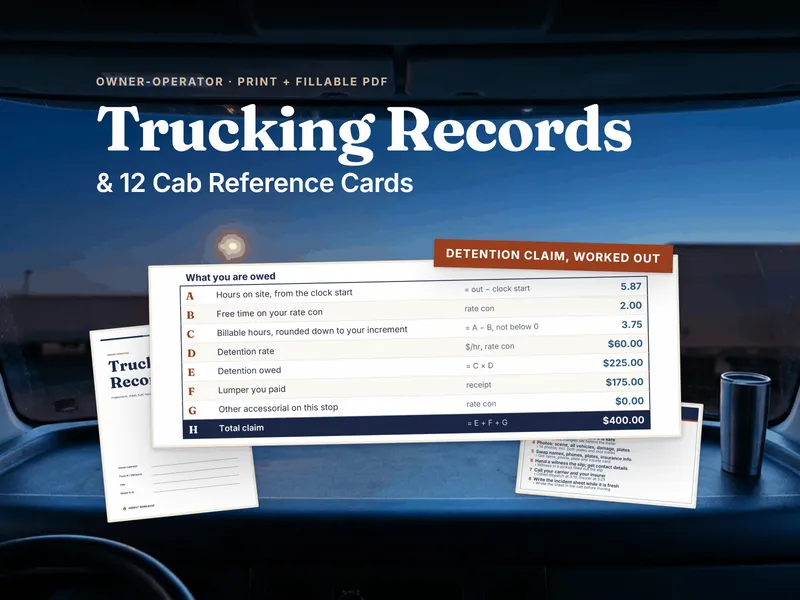
A claim slip that adds the lumper to any detention you are owed gives you one total to raise. In another fictional example, detention (paid waiting time) of 3.75 billable hours at $60 an hour is $225, and with a $175 lumper the claim is $400. How those billable hours are worked out is covered in what is detention pay.
The free printable trucking trip sheet is a one-page PDF with a pre-filled example that records the load, miles, deadhead, rate, fuel, tolls and accessorials, including a lumper, in one place. For the claim itself, the printed Owner-Operator Trucking Records & Cab Reference Card Set includes a Detention & Lumper Claim Slip and a Settlement Review Slip. You keep those on paper, with no signal needed.
Common lumper mistakes
- Paying without checking the rate con. You find out it wasn't reimbursable after the cash is gone.
- No receipt. A reimbursement usually depends on one.
- No approval on record. If one was required, note who gave it and when.
- Counting it as revenue. It makes a thin load look healthy.
- Not checking the settlement. Compare the lumper reimbursement line against what the rate con promised.
Related templates and concepts
Lumper fees sit beside detention pay as the two accessorials drivers most often have to chase. To record lumpers and detention for every load, browse the templates for owner-operators hub, or see how a desk workbook handles settlements in the Owner-Operator Trucking Ops Workbook. For keeping the rest of the cab's papers in order, see what to keep in the truck for a roadside inspection.
Templates that implement this
Tools for recording and claiming lumper fees
2 templates
A printed record set with a claim slip for the lumper you paid, plus the desk workbook for the business side of the truck.
- $12.95 PDF
Owner-Operator Trucking Records & Cab Reference Card Set — Printable + Fillable PDF
Printable trucker log book sheets and fillable PDF slips that work out your detention claim, settlement check and true rate per mile.
Operator OSView details - $24.95 Spreadsheet

Owner-Operator Trucking Ops Workbook — Cost-Per-Mile Calculator, IFTA Log, Load Profit & Settlements (Excel + Google Sheets)
An owner-operator trucking workbook for Excel & Google Sheets — your true cost-per-mile, IFTA log, per-load profit, and settlements in one file.
Operator OSView details
Frequently asked questions
- What is a lumper fee?
- A lumper fee is what you pay the unloading crew a warehouse or receiver requires you to use. The facility sets the charge, and drivers often pay it at the dock before they are released.
- Who pays the lumper fee?
- The driver often pays at the dock, and whether you are reimbursed depends on your rate confirmation or carrier agreement and, in most cases, on a receipt. Read the terms before you roll, and ask the broker or dispatcher to confirm in an email if they are not written down.
- Do I need approval before I pay a lumper?
- If the broker or facility requires prior approval, get it first and write down who approved it and when. Check your rate con for what it says; if it is silent, ask and keep the answer in writing.
- Is a lumper reimbursement part of my revenue?
- No. It is a pass-through: money you paid out and are getting back. Counting it as revenue you earned inflates your rate per mile and your margin, so keep it on the cash line and out of the revenue line.
- What should I keep for a lumper claim?
- The lumper receipt, its number, how you paid it, who approved it if approval was required, and the load it belongs to. Put the original in the envelope for that load and write the details on your claim slip.