Step 1 — Write your own list of papers
Start with a blank page and the driver’s seat. Picture someone asking you for a paper, and write down every one you would reach for. A starting list might include:
- Registration and proof of insurance for the truck
- Permits and authority paperwork your operation uses
- The current load’s paperwork, such as the rate confirmation and bill of lading
- Anything your carrier has told you in writing to keep on board
- A card with emergency and carrier contact numbers
That is a starting point, not a checklist handed down from anywhere. Papers drivers commonly keep within reach vary with how and where you run, so build the list from your own operation. The point of writing it down is that you see the whole set at once.
Step 2 — Confirm the list with your carrier
Take the list to your carrier, or to whoever handles compliance for you, and ask what applies to your operation. Cross off what does not apply and add what you missed. If they answer by phone, write down the name and the date next to the change.
This step is what makes the list yours and keeps it honest. A list copied from a forum or a friend is a guess. A list your carrier has reviewed is a better starting point, and the rules that apply to you still come from them, not from the list.
Step 3 — Give each paper one place
Now assign a home to every item. Keep it simple:
- Papers you hand over often go where you can reach them without leaving the seat.
- Papers for the current load go in one folder or envelope that travels with that load.
- Papers you rarely need go in a binder pocket, labeled.
Write the location on the list. This is the idea behind a Document Location card (a cab card in the record set linked below): one line per paper saying where it lives in the cab, so you can reach the right one without digging. A second driver, a relief driver, or you at 2 a.m. can read it and find the paper.
Step 4 — Write the expiry date next to each paper
A paper that is in the cab but expired is a quiet problem, because nothing reminds you. For every document that renews, add the expiry date on the same line as its location:
| Paper | Where it lives | Expires |
|---|---|---|
| Truck registration | Visor pouch | Example: 03/31 |
| Proof of insurance | Visor pouch | Example: 06/30 |
| Current load paperwork | Door folder, this load's envelope | No expiry |
| Carrier contact card | Binder, front pocket | No expiry |
Then set a reminder a few weeks before each date, so the new copy is in the truck before the old one lapses, not after.
Step 5 — Check the cab on a schedule
A system that is only checked when something goes wrong drifts. Once a month, take five minutes: go down the list, put a hand on each paper, and confirm it is in its place and current. When a load is done, move that load’s paperwork out of the active folder and into its envelope for the files.
That last habit pays off beyond the cab. The trip’s rate confirmation, receipts, and delivery paperwork are the records you will want if a payment comes up short. A free printable trucking trip sheet gives each load one page to tie them together: load, miles, deadhead, rate, fuel, tolls, and extras, with a pre-filled example so you can see how it reads.
Doing this on paper, not a subscription
You can do all of this with an index card and a pen, and plenty of drivers do. A notebook works but tends to bury the list. Trucking software is good at invoicing, IFTA-style reporting, and bookkeeping, and it is often sold as a monthly subscription. A printed set sits in between: you own it, there is no subscription, and it works with no signal at the truck stop.
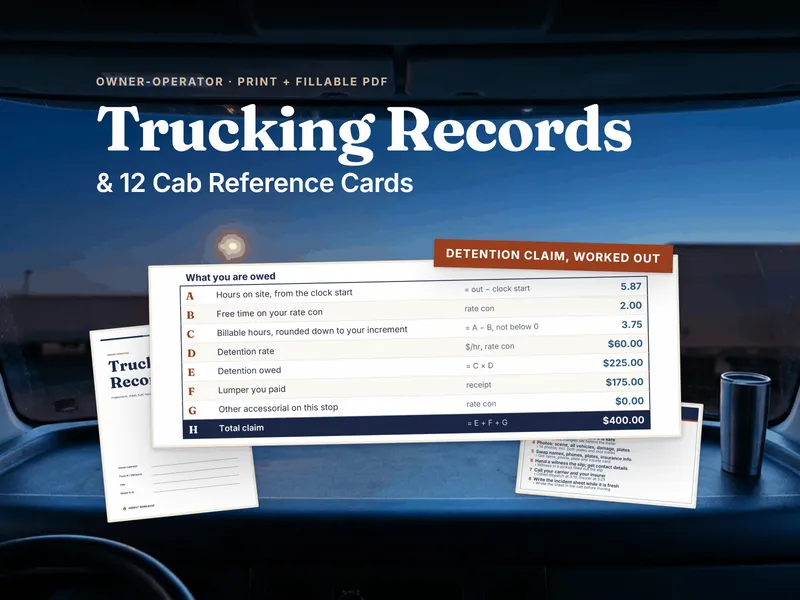
The Owner-Operator Trucking Records & Cab Reference Card Set prints this step as cut-out cab cards: a Document Location card for where each paper lives and when it expires, and a Roadside Docs card that is a list of papers drivers commonly keep within reach, which you confirm with your carrier and make your own. It also includes the trip sheet, the detention and lumper claim slip, and the settlement review slip, so the paper trail from the cab to the settlement lives in one binder.
If you want the business side of the truck as well, such as settlements and cost per mile at your desk, the Owner-Operator Trucking Ops workbook covers it, and what is cost per mile explains the number it builds on. More for drivers who run their own truck is on the owner-operator page.