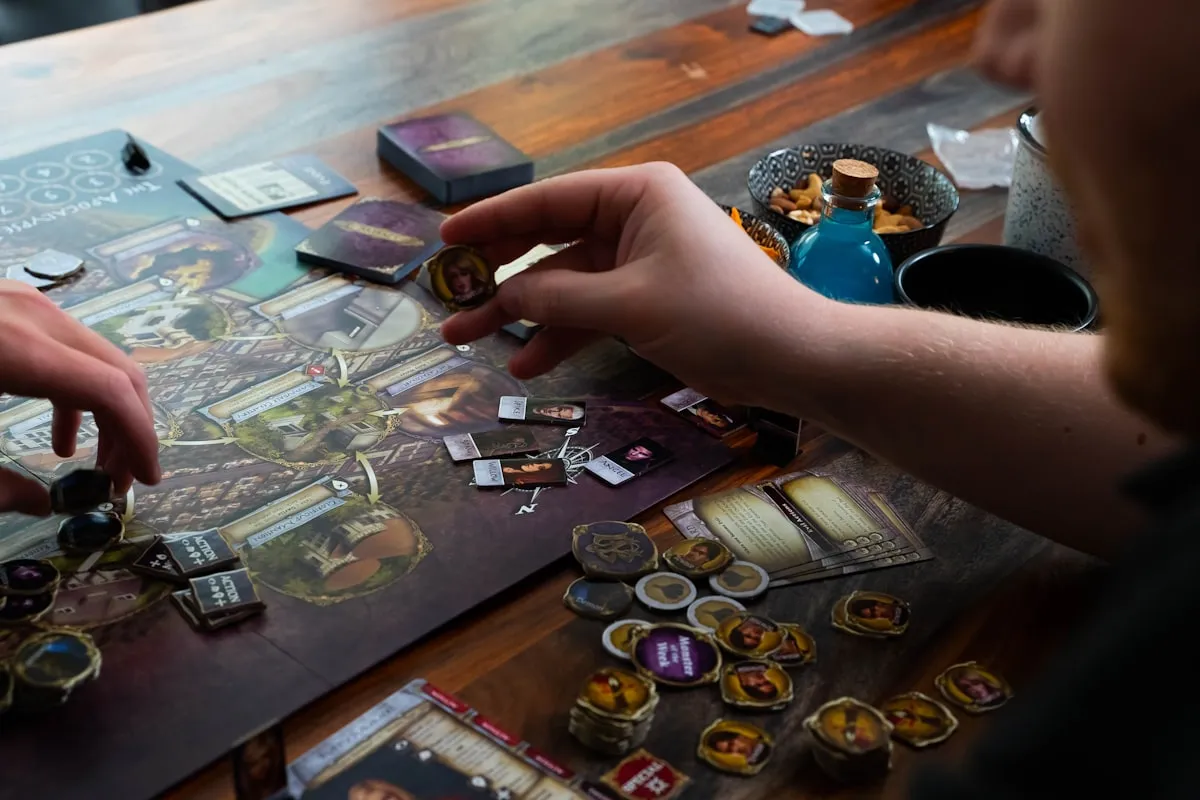
Board game vs. TTRPG: the core difference
Both are "tabletop" games, but they're shaped differently:
- A board game is self-contained. It comes in a box with everything you need, has a defined setup and a win condition, and finishes in one sitting — thirty minutes to a few hours. You play it, someone wins, the box goes back on the shelf.
- A TTRPG is open-ended. A rulebook (the "system") gives you the framework; a game master (GM) runs the world and the story; and the players guide their characters through it across many sessions — a campaign that can run for months or years. There's usually no "winner," just a story that continues.
Plenty of games blur the line — cooperative and legacy board games borrow campaign structure, and a one-shot TTRPG adventure can wrap in a single night — but the vocabulary of each hobby stays distinct.
Key TTRPG terms
- System. The rulebook and its ruleset — the engine the game runs on. A group might play several different campaigns on the same system, or the same setting across different systems.
- Campaign. An ongoing story played across many sessions, usually with a continuing cast of characters.
- Session. A single sitting at the table — one evening of play. Campaigns are measured in sessions.
- One-shot. A self-contained adventure meant to finish in a single session — the TTRPG closest in shape to a board game.
- Game master (GM). The player who runs the world, voices the non-player characters, and adjudicates the rules. Called a DM, Keeper, Storyteller, or Referee depending on the system.
- PC and NPC. A player character is run by a player; a non-player character is run by the GM. Your party is your PCs.
- Module / adventure. A published, ready-to-run story a GM can drop into a campaign instead of writing their own.
- Character sheet. The record of a single character — their abilities, gear, and history. The thing most worth keeping between sessions.
Key board-game terms
- Weight (complexity). How much thinking a game demands, usually rated 1 (light) to 5 (heavy). It's the shorthand that answers "how much brain does this need tonight?"
- Mechanic. The core system that makes a game work — worker placement, deck-building, area control, roll-and-write, and so on. Fans often shop by mechanic.
- Player count. The supported range, e.g. 2–4. The first question anyone asks before game night.
- Cooperative (co-op). A game where players win or lose together against the game itself, rather than against each other.
- Legacy game. A board game that changes permanently as you play a campaign — stickers, torn cards, an evolving board.
- Meeple. The little wooden player-piece figures, named as a blend of "my" and "people." A hobby mascot as much as a component.
Why a mixed collection needs one tracker
Most tabletop people are a bit of both — a shelf of board games and a stack of rulebooks, a regular game night and a long-running campaign. Trying to catalog that in a generic list falls apart fast: board games want player count, weight, and cost-per-play, while TTRPGs want system, campaign, and session count. A tracker built for the hobby holds both — the games and rulebooks you own on one tab, the plays on another, and your campaigns and characters on their own.
The most useful number it computes is cost-per-play: what you paid for a game divided by how many times you've actually played it. A ninety-dollar campaign game played fifteen times is six dollars a night; a shrink-wrapped box is infinite. It's the honest measure of whether a game earned its shelf.
Related templates and concepts
The Board Game & TTRPG Collection Tracker catalogs games, plays, campaigns, and characters in one owned file — and there's a free game-shelf starter to try first. For more ways to catalog what you love, see the full Trackers catalog or the free mini-tools and starters.
Templates that implement this
Track your board games and TTRPGs together
3 templates
Catalog the games on your shelf, log game night, and keep your campaigns and characters in one file — board games and tabletop RPGs alike.
- $6.95 Spreadsheet
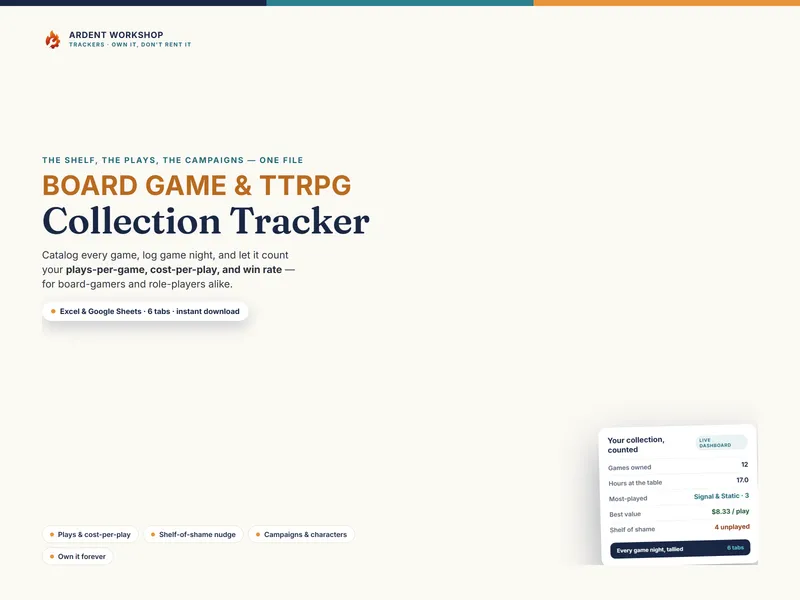
Board Game & TTRPG Collection Tracker — Excel & Google Sheets
A board game & TTRPG collection tracker for Excel & Google Sheets — catalog your shelf, log plays, and track cost-per-play, win rate, and campaigns.
TrackersView details - $4.95 Excel
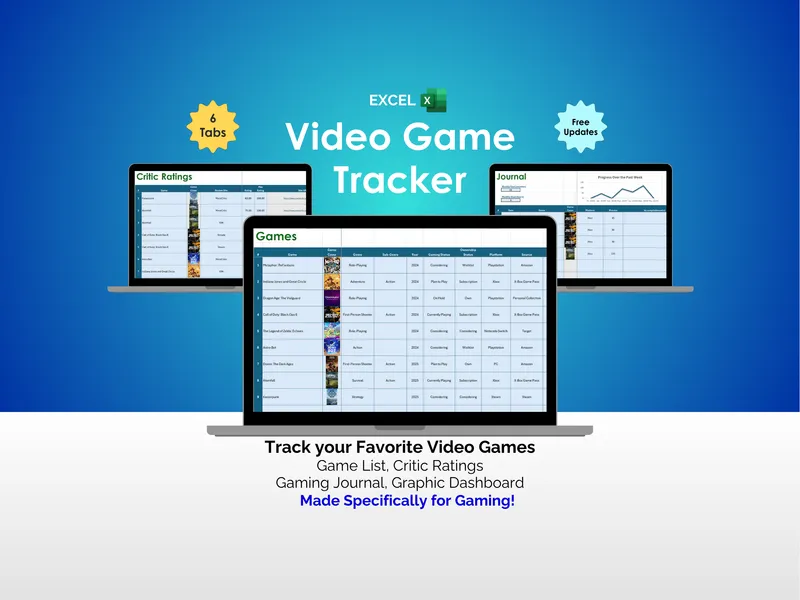
Video Game Tracker - Excel
You bought another game on sale, didn't you. This excel video game tracker logs 500 titles with personal ratings, critic scores, a play journal, and a dashboard.
TrackersView details - $4.95 Spreadsheet
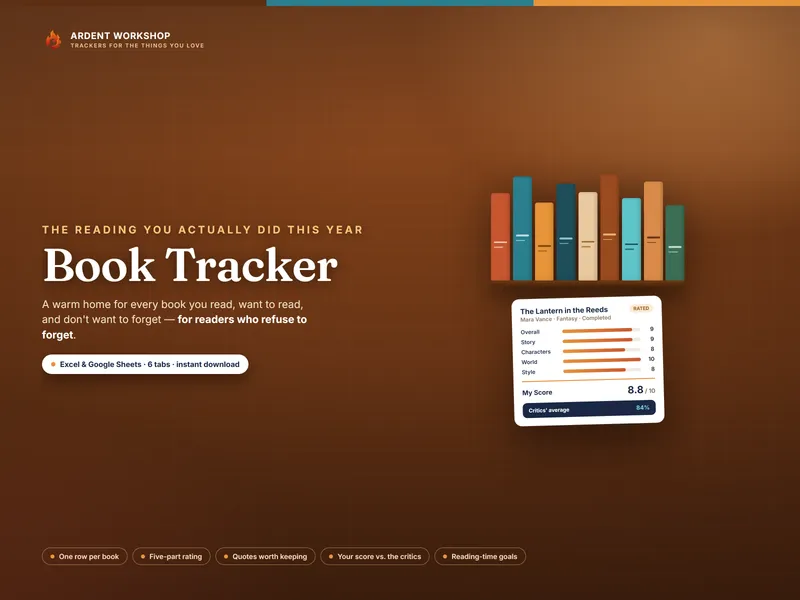
Book Tracker — Reading Log, Journal & Five-Part Ratings (Excel + Google Sheets)
A Book Tracker spreadsheet for Excel & Google Sheets — log every book, rate it five ways, save quotes, and see your reading year on a live dashboard.
TrackersView details