How it differs from a classic time capsule
The familiar version is a single sealed container: fill it, bury it or shelve it, and open it on one agreed date twenty years out. A time-capsule keepsake borrows the idea and drops the single date, because a family's meaningful moments don't arrive all at once. Four differences follow from that:
- It is opened in pieces, not once. Each letter and each object is tied to its own occasion — a birthday, a graduation, a wedding day, a hard week — so the keepsake keeps giving over decades rather than being spent in an afternoon.
- It is indexed, not sealed. Because it opens in pieces, someone has to know which envelope belongs to which moment. A written record of what exists and where it lives is part of the keepsake, not an afterthought.
- It grows. A buried capsule is closed the day you fill it. A keepsake is added to for years — one letter a year is a whole childhood's worth.
- It has a named handler. A capsule everyone remembers burying gets dug up. A box in a closet gets thrown out in a house clearance unless a specific person knows what it is.
The three parts of a time-capsule keepsake
The letters. Words written now for a moment that hasn't happened — most commonly from a parent or grandparent to a child. They are written in the present tense of the writer's life, which is exactly what makes them worth keeping: a letter written when the child was four says something no letter written twenty years later can.
The objects. The hospital bracelet, the knitted hat, the drawing where everyone has the wrong number of legs. An object handed over on its own is a curiosity; handed over with the letter that explains why it was kept, it becomes an heirloom. The difference is entirely whether the reason was written down while somebody still knew it.
The record. What exists, where it is kept, when each piece is meant to be opened, and who would hand it over. This is the part families skip and the part that decides whether any of the rest is ever delivered.
Why a time-capsule keepsake usually fails
Rarely because the letters are badly written. Three ordinary failures come up again and again:
- Nothing ever comes due. "Write letters for the big moments" has no deadline, so it loses to everything that does — week after week, for years. Attaching each letter to a year turns an open-ended intention into a task with a date.
- The envelopes aren't labeled. An unlabeled sealed envelope in a box is a mystery: it gets opened at the wrong moment, or not at all. The outside needs the child's full name, when it is to be opened in words, who it is from, and the date it was written.
- Nobody else knows. If the person who made the keepsake is the only person who knows where it is, the keepsake depends entirely on them being there — which is the one thing the "open this when I'm gone" letter assumes they won't be.
A keepsake is not a will
This matters enough to state plainly: a letter in a time-capsule keepsake does not direct who inherits anything, and it is not a guardianship nomination, a trust, a power of attorney, an advance directive, or a beneficiary designation. Requirements for those documents differ by country and by state. Keep binding wishes in the proper documents, prepared with a qualified professional where you live, store them somewhere other than the keepsake box, and use the letters for the part the paperwork can't carry — the reasons, the love, and the story behind a decision. And don't write account numbers, passwords, PINs, or where valuables are kept into a letter: a keepsake box is not a safe.
Where to start
Start with one letter rather than a plan for twenty-six — the free A Letter for One Day printable hands you the prompts for one and a label for the envelope. When you want the whole plan dated and tracked, the Letters & Milestone Time-Capsule Keepsake works out every milestone's year from the child's birth year and names the single next letter to write. For the method itself, see how to write milestone letters to your child. See also keepsake binder vs letter app, and the templates for grandparents and templates for family historians hubs. This is a keepsake and record-keeping approach — not legal, financial, or medical advice.
Templates that implement this
Build a time-capsule keepsake you own
3 templates
A workbook that dates all twenty-six milestone letters from the child's birth year, names the one to write next, and indexes the mementos that get handed over with them — plus the family-recipe and new-parent keepsakes that hold the rest of a childhood.
- $17.95 Spreadsheet

Letters & Milestone Time-Capsule Keepsake — 26 Milestone Letters to Your Child, Dated From One Birth Year (Excel + Google Sheets)
Write the letters you keep meaning to write. 26 milestones dated from one birth-year cell, 104 prompts, and a time-capsule index, for Excel & Sheets.
Life AdminView details - $19.95 Spreadsheet

Family Recipe Heritage Keepsake Binder — Preserve Handed-Down Recipes, Their Origins & "By Feel" Amounts (Excel + Google Sheets)
A family recipe keepsake binder for Excel & Google Sheets — preserve handed-down recipes, their origins, and the "by feel" amounts, in a file you own.
Life AdminView details - $19.95 Spreadsheet
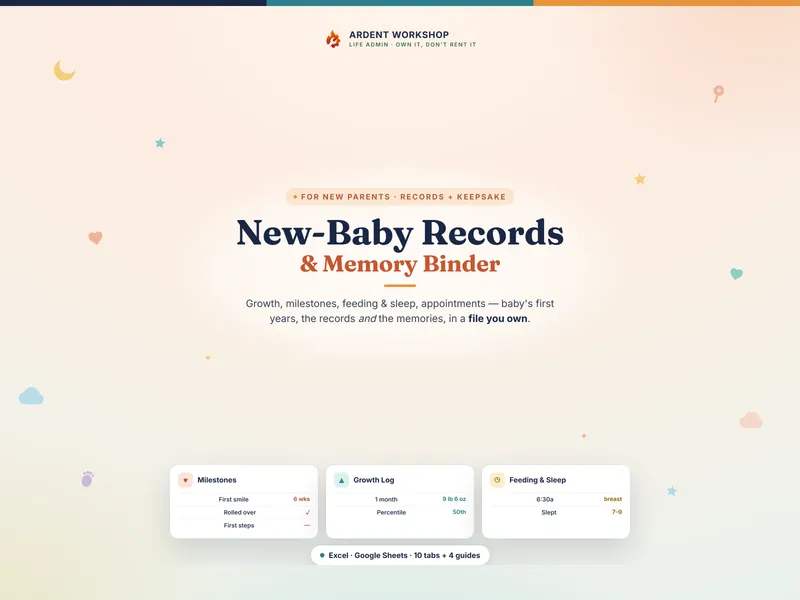
New-Baby & New-Parent Records Binder — Baby's First Years Growth, Milestone, Feeding & Sleep Tracker (Excel + Google Sheets)
A keepsake records binder for baby's first years — growth, milestones, feeding, sleep, and key documents in one file you own (Excel + Google Sheets).
Life AdminView details