
Why allowances exist
Many remodels are sold before the customer has picked the tile. The contractor needs a contract price; the customer needs six weekends of showrooms. An allowance bridges that: a budgeted figure per item, carried in the contract price, reconciled once the choice is made.
That is the whole mechanism. The trouble is entirely in how it is written down.
What a properly written allowance says
- The amount — the figure carried in the contract price for that item.
- What that amount is expected to buy — a specific, findable product, named as an example of the level rather than a requirement. Without this the number is meaningless to the person who has to shop against it.
- What the allowance covers. Normally the material only, delivered. It does not cover the labor to install something that takes longer, needs different framing, blocking, rough-in or substrate than the product it was priced against — nor sales tax, freight surcharges or restocking fees.
- A decide-by date — set early enough to cover the lead time, with the lead time written beside it.
- How the difference is settled — an overrun added to the contract price (plus any stated markup), an underrun credited back, and on what basis.
The overrun everyone forgets
An allowance overrun is almost never just the price difference. A heavier stone slab needs more hands and sometimes more support. An undermount sink needs a different cut. A fixture with a different rough-in means the plumber comes back. A tile at half the size doubles the setting time.
If the sheet does not say that an allowance covers the material only, the customer reasonably assumes the labor came with it — and the extra hours quietly become the contractor's. Where a chosen product needs extra labor or extra material, that is priced on a change order before it is ordered, not absorbed.
Allowance mistakes that cost money
- Writing a bare number. A few hundred dollars for a faucet means one thing to a contractor who knows the supply house and something else in a showroom. Name a real product beside it.
- Setting it deliberately low to win the bid. It reads as a cheap price now and as a bait-and-switch later, and it is the kind of vagueness a state's contract-description requirements are aimed at.
- Letting the decide-by date slide with nothing written down. A late selection is one of the most avoidable causes of a delayed job — and a delay the contractor tends to get blamed for anyway. A dated deadline is what makes a schedule notice later something other than an opinion.
- Not saying whether the credit is full. If the customer comes in under, they will expect the whole difference back. Say in advance whether your markup comes out of it.
- Treating customer-supplied items as an allowance. They are the opposite — you have not priced them and do not warrant them. Record who receives them, who inspects them on arrival, and what happens if they turn up damaged or short.
Where the local rules come in
Many states' home-improvement statutes require the contract to describe the work and the materials in detail — Massachusetts' G.L. c. 142A § 2 requires "a detailed description of the work to be done and the materials to be used" — and several go further and require any change to it to be in writing and signed before the changed work starts, as California's Bus. & Prof. Code § 7159 does. A bare lump-sum allowance with nothing behind it can fall short of that description requirement. Where the customer supplies materials themselves, responsibility for defects in those materials, and any warranty you may be taken to have given by installing them, are also matters of state law. This page is a general explanation, not legal advice; check your own state's home-improvement rules before pricing a job largely on allowances.
Related templates and concepts
Allowances are settled through change orders, and the figure behind each one comes out of the same costing that sets your bid markup. A free change order form handles the settlement itself — the allowance and selection sheet that sets the number up front comes with the paid Trades Client Paperwork & Change-Order Template Pack. To see a settlement written out, follow how to write a change order; to weigh owned documents against a subscription, read paperwork templates vs a contractor app. Every tool for the trades sits on the templates for contractors hub.
Templates that implement this
Tools that make an allowance a real number
3 templates
A client-paperwork pack with an allowance and selection sheet, plus the estimating and pricing workbooks that produce the figures behind it.
- $19.95 Mix

Trades Client Paperwork & Change-Order Template Pack — 16 Fillable Contractor Forms: Change Order with Running Contract Math, Work Authorization, Scope of Work, Punch List
A change order that shows the new contract amount, plus 15 more contractor client forms in job order — work authorization, payment schedule, punch list.
Operator OSView details - $14.95 Spreadsheet
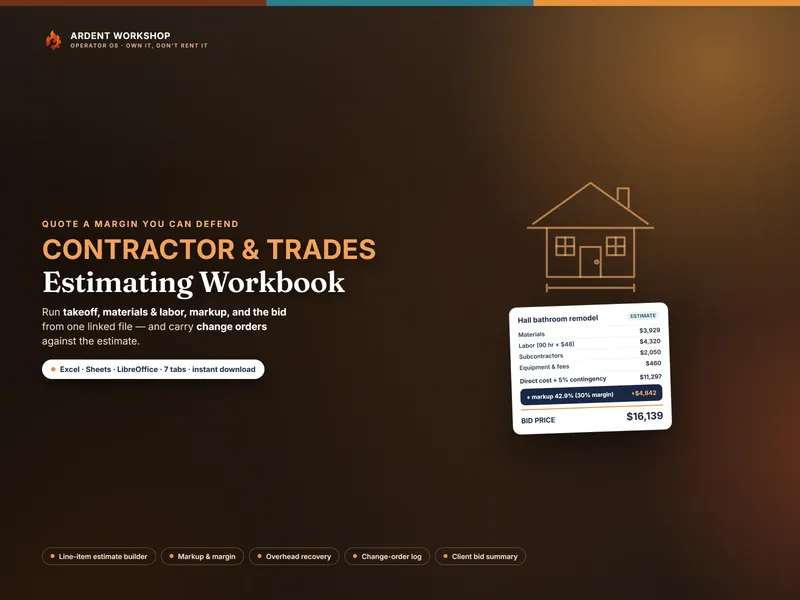
Contractor & Trades Estimating Workbook — Construction Job Costing, Bid Markup & Margin, Overhead & Change Orders (Excel + Google Sheets)
A contractor estimating workbook for Excel & Google Sheets — line-item job costing, bid markup vs margin, overhead, and change orders in one file.
Operator OSView details - $29.95 Spreadsheet
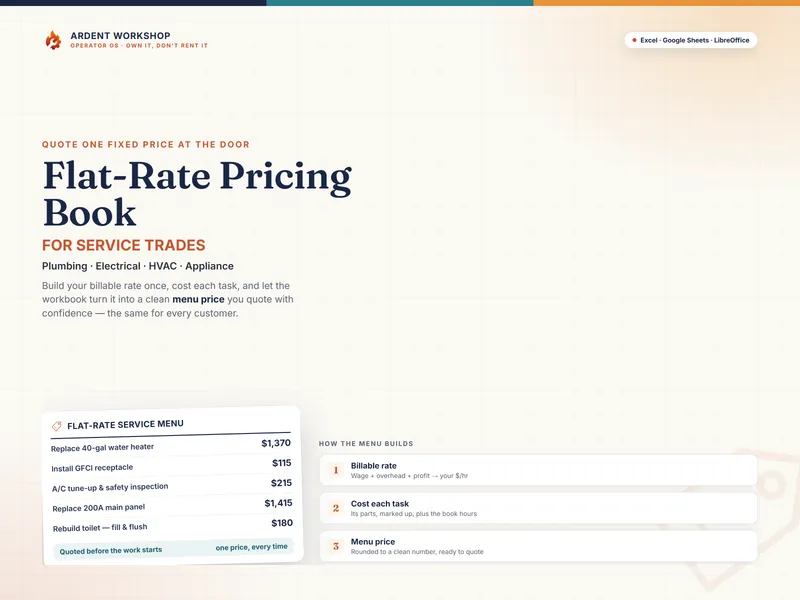
Flat-Rate Pricing Book for Service Trades — Plumbing, Electrical, HVAC & Appliance Price Book, Billable Rate & Markup Calculator (Excel + Google Sheets)
Flat-rate price book for service trades — set your billable rate, cost each task, and build a clean menu for plumbing, electrical, HVAC & appliance work.
Operator OSView details