Legacy book, memory book, life-story book — is there a difference?
In practice the three names describe the same artifact, and families and publishers use them interchangeably. Where a distinction is drawn, it's usually one of emphasis:
- Memory book leans toward the individual recollections — the objects, the rooms, the ordinary days — without needing to cover a whole life.
- Life-story book leans toward the arc: birth to now, in order, with the turning points identified.
- Legacy book leans toward what is being handed on — the lessons, the values, and the things the person wants said to people who will read it after they're gone.
A good one does all three, because they come out of the same conversation. The question "what was your most precious possession as a child?" is a memory question that reliably produces an arc detail and a lesson at the same time.
What a legacy book is not
Three things get confused with it, and the difference matters when you sit down to make one:
- Not genealogy. Genealogical research documents names, dates, and relationships from records — certificates, censuses, registers. A legacy book records what a person remembers, which is frequently imprecise and occasionally wrong. That's not a defect to correct out of the record; it's the record. Note the discrepancy and keep the telling. The two are complementary, and best done separately.
- Not a scrapbook or photo album. An album holds the images. A legacy book holds the answer to who is in this photograph, where was it taken, and what was happening — which is the part that disappears first and the part no album captures.
- Not a memoir. A memoir is written by its subject, shaped and edited, usually for readers outside the family. A legacy book is normally spoken aloud to someone who asked, and its value is in staying unpolished.
Why they're built from questions rather than blank pages
Hand someone a blank book and ask them to write their life story and almost nothing happens — partly because the task has no edges, and partly because a life can look unremarkable from the inside. "Oh, there's nothing to tell" is a common first answer; what it usually means is that the ordinary parts didn't feel worth recording, which is exactly backwards.
A specific question dissolves both problems at once. "Tell me about your life" is answerable by nobody; "walk me through an ordinary day when you were eight years old, from waking up to going to bed" is answerable by anyone, takes ten minutes, and produces exactly the texture that no photograph records — what the house smelled like, who was in it, what was on the table. That's why a legacy book is a question set before it is a book.
How a legacy book actually gets finished
The reason most attempts stall isn't the asking — it's that a whole life has no obvious stopping point, so there's never a session that feels like progress. The fix is to give the project a structure that can be measured:
- Group the questions by era so the life is divided into finishable chunks rather than one infinite subject.
- Work in short sittings. Forty-five minutes to an hour is the honest limit for most people, and eight to twelve questions is a realistic plan for one. You will get through fewer than that, and that's the session going well.
- Track what's captured so you can see which eras are thin. The gaps, not your enthusiasm, decide what to ask next time.
- Mark the questions only this person can answer and clear those first, in every era — so a project that ends early still ends with the right answers in it.
- Record it. The voice is half the keepsake, and a phone voice memo is completely adequate. Get the file off the phone the same week.
- Read it back. The second telling is almost always richer, and they'll correct what you misheard.
A legacy book vs. a memory app
Subscription memory apps do the asking well — a prompt a week, an easy interface, a printed book at the end. What they ask you to accept is that your family's most personal record lives in someone else's account, subject to a renewal and to a company's continued existence. Many services do offer an export; whether it includes the audio, and in what format, is worth checking before you commit. For something explicitly made to outlast the person telling it, that's a real risk to weigh. The alternative is an owned file: the questions and the structure of a good app, in a workbook you keep, print, and copy for every grandchild. See keepsake journal vs memory app for the full comparison.
Where to start a legacy book
Start with three questions, not two hundred. The free Three Stories to Capture First printable gives you the three worth asking before any others, each with the follow-up to ask second and room to write the answer down. When you're ready to do the whole life, the Life-Story & Memory Keepsake Journal is the owned workbook for it: 200 questions across ten eras, a coverage dashboard that names the thinnest decade as your next conversation, and 63 pages of guides on how to ask. There's a full walkthrough in the tutorial on capturing a parent's life story, and the templates for family historians and templates for grandparents hubs collect the rest. This is a keepsake and record-keeping approach — not medical, legal, or mental-health advice, and not genealogical research.
Templates that implement this
Capture a life story before it's lost
3 templates
An owned workbook of 200 interview questions with a dashboard that shows which era of the life is still thin — plus the recipe and estate binders that keep the rest of what a family passes down in one place.
- $19.95 Spreadsheet

Life-Story & Memory Keepsake Journal — 200 Interview Questions for a Parent or Grandparent (Excel + Google Sheets)
200 interview questions for a parent or grandparent, in a workbook that tracks which era of their life is still thin. Excel & Google Sheets.
Life AdminView details - $19.95 Spreadsheet

Family Recipe Heritage Keepsake Binder — Preserve Handed-Down Recipes, Their Origins & "By Feel" Amounts (Excel + Google Sheets)
A family recipe keepsake binder for Excel & Google Sheets — preserve handed-down recipes, their origins, and the "by feel" amounts, in a file you own.
Life AdminView details - $29.95 Spreadsheet
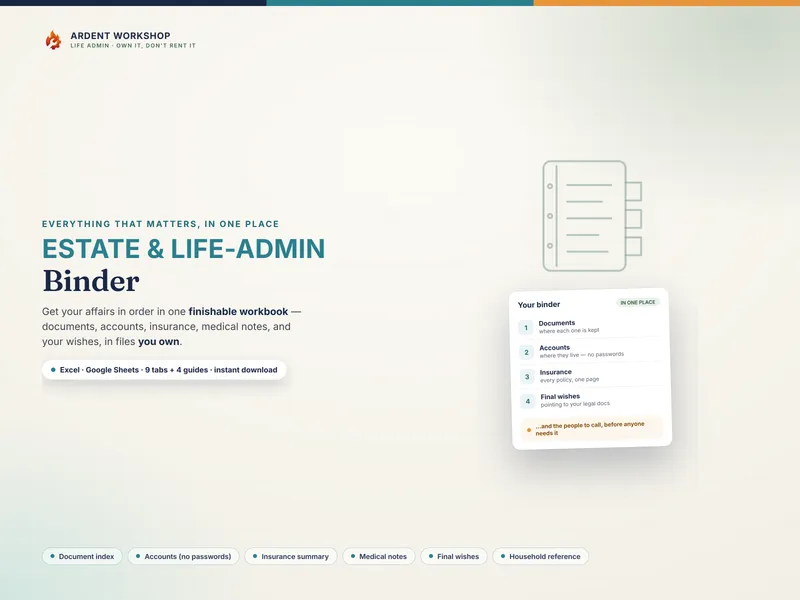
Estate & Life-Admin Binder — Important Documents, Accounts, Insurance & Final Wishes Organizer (Excel + Google Sheets)
An estate & life-admin binder for Excel & Google Sheets — organize important documents, accounts, insurance, and final wishes in one file you own.
Life AdminView details