What goes in a family caregiver agreement
There is no single required form, and what an agreement should say depends on the family and on the state. In practice most cover the same ground:
- Who is party to it — the person receiving care, and the family member providing it. Where the older adult is not signing for themselves, who is signing and under what authority.
- What care is provided — specifically. “Help around the house” is not a description; “transport to medical appointments, weekly grocery shopping, medication reminders twice daily, and overnight stays during recovery periods” is.
- When, and how much — which days, how many hours, and what happens when it runs over.
- What is paid, and how — a rate, a frequency, and the method. Cash with no record is the arrangement that most often causes trouble later.
- Expenses — mileage, groceries bought on the caregiver's own card, supplies. Whether they are reimbursed, and against what.
- When it started — the effective date. Agreements are generally written to cover care going forward rather than to pay retrospectively for care already given, which is one of the specific points to raise with an attorney.
- How it changes or ends — a review date, notice on either side, and what happens if the person's needs change or the caregiver cannot continue.
Why families write a caregiver agreement
Three reasons, in roughly the order families discover them.
- It ends the ambiguity between siblings. Money moving from a parent to one adult child, with nothing written down, is a reliable source of family conflict — often years later, and usually when nobody can remember what was agreed. A dated agreement makes the question answerable in one sentence.
- It recognizes real work as real work. A relative who has cut their hours, or left a job, to provide care is doing something a paid aide would be paid for. Writing it down is how a family stops treating that as a favor that never has to be accounted for.
- How the payments are treated is not obvious. Money paid to a family caregiver can have tax consequences for both sides, and it can matter for public-benefit eligibility if the person receiving care later applies for help paying for long-term care. Which of those apply, and how, depends on your state and on the specifics — which is why an elder-law attorney will normally want the agreement in place before any money changes hands rather than after.
What a family caregiver agreement is not
A family caregiver agreement is not intended to be, and does not by itself grant, any authority to make decisions for someone — that is what a power of attorney or an advance directive is for. It is a work-and-payment agreement, and it is normally written to sit alongside those other documents rather than to replace any of them. What your own documents actually do is a question for an elder-law attorney.
It is also not a substitute for the conversation. An agreement handed to a parent who has not been asked about it reads as a demand, and an agreement written between two siblings without the third reads as a deal done behind their back.
Who to take a caregiver agreement to
An elder-law attorney licensed in the state where the person receiving care lives, and — where money is involved — a tax professional. The agreement itself is short; what is worth paying for is knowing how it will be treated. In the United States, your local Area Agency on Aging can point you to local resources and to caregiver-support programs, and you can find yours through the Eldercare Locator, a free public service of the U.S. Administration for Community Living.
The three conversations that come first
An agreement is a great deal easier to write if three conversations have already gone well:
- Asking a parent about money — not how much they have, but what happens if they cannot get to it for a few weeks, and whether anyone else is already involved.
- Dividing the work with siblings — with the last four weeks written down in hours, which is the only version of that conversation that does not turn into an argument about who remembers what.
- Asking for what you need — hours, money, or a break with dates on it. A caregiver who has never once asked plainly is a caregiver whose family genuinely does not know.
All three have scripts — with the replies you're most likely to get, and the words to say to each — in the Caregiver Conversations Scripts & Letters Swipe Bank. One of the twenty-four is free and ungated if you want to see the shape of them first: the driving conversation.
This page explains a kind of document families use. It is not legal, tax, or financial advice, and nothing here tells you what any agreement means in your state or how any payment will be treated. Have a family caregiver agreement drawn up or reviewed by an elder-law attorney licensed where the person receiving care lives.
Templates that implement this
The conversation comes before the paperwork
3 templates
An agreement is the easy part. The hard part is the conversation with your parent about money, and the one with your siblings about who does what — both of which have to happen first, and both of which have scripts.
- $14.95 Mix
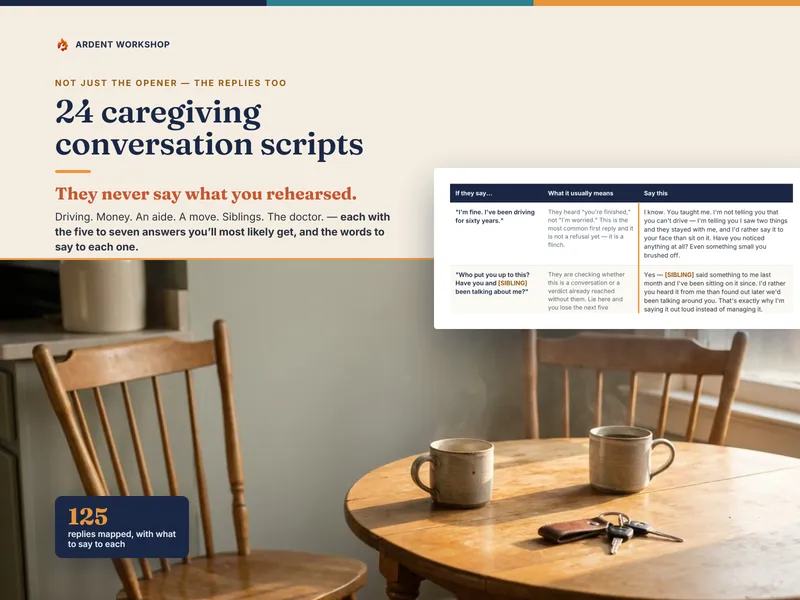
Caregiver Conversations Scripts & Letters Swipe Bank — 24 Scripts for the Hardest Caregiving Talks, Each With the Replies You're Most Likely to Get: Driving, Money, Help at Home, a Move, Siblings
24 caregiving conversation scripts — the opener, the replies you're most likely to get, and what to say to each. Guidance, not medical or legal advice.
Life AdminView details - $24.95 Spreadsheet

Caregiver / Aging-Parent Care Binder — Medications, Refill Alerts, Appointments & an Emergency Handoff Sheet That Writes Itself (Excel + Google Sheets)
Caregiver binder for an aging parent: medications with refill alerts, appointments, care team and documents — plus a self-writing emergency handoff sheet.
Life AdminView details - $24.95 Spreadsheet

Long-Distance Caregiving Coordination Binder — Check-In Log, Who-Does-What Map & a Dashboard That Counts the Days Since Anyone Visited (Excel + Google Sheets)
Coordinate an aging parent's care from another city — a shared check-in log, 15 care areas with owners, and days since anyone visited.
Life AdminView details