What goes in a bill of sale
A bill of sale is short by design. What makes one useful is not length but precision — every line below is there because leaving it out is what causes the argument:
- Both parties, in full. Legal names and addresses for the seller and the buyer, not first names.
- The item, described so it could not be confused with another one. Make, model, color, size, and any serial number. For a vehicle: year, make, model, VIN, plate, and the odometer reading on the day.
- The price, and how it was paid. The amount, the method, the date it cleared, and any deposit paid earlier.
- A transfer-of-ownership line. That ownership passes on payment, that the seller owns the item outright, and that it carries no loan or lien.
- A sold-as-is clause. See below — this is the one people cut.
- Signatures and the date, on two copies, one for each side.
What "sold as-is" actually means
"As-is, where-is" means the buyer takes the item in the condition it is in, having had the chance to inspect it, and the seller makes no promise that it is fit for any particular purpose or that it will keep working. It is the single most load-bearing clause in a private sale — and the one sellers are most tempted to delete, because it reads as unfriendly.
Two things it does not do. It does not cover up a fault you knew about and hid; disclosing known faults in writing is what makes the clause hold up, not what weakens it. And it does not override rights a buyer has that the law says cannot be waived — those vary by state, and an as-is line does not erase them.
Bill of sale vs receipt vs title
These get used interchangeably and are not the same thing. A receipt proves money changed hands. A bill of sale proves a specific item changed hands, on stated terms, and is signed by both parties — it does the receipt's job and more. A title is the state's own ownership document for a titled asset such as a car, trailer, or boat; a bill of sale supports the transfer but does not replace signing the title over.
When your state has its own form
For vehicles, trailers, boats, firearms, and livestock, many states publish a mandatory bill-of-sale form and will not accept a generic one, and several require notarization. A written odometer disclosure is a separate matter: for most vehicle transfers it is a federal requirement rather than a state quirk — the Truth in Mileage Act, implemented at 49 CFR Part 580, which exempts vehicles above a model-year age threshold — so expect to make one whichever form you end up using. Check your DMV (Department of Motor Vehicles) or equivalent before the buyer arrives. For ordinary household goods — furniture, tools, equipment, an instrument — a plain bill of sale is normally all anyone wants.
Before you sign, on a private vehicle sale
Getting to that signature has its own order of operations: confirm the name on the title matches the seller's photo ID before you agree a number, confirm no lien is recorded or get the release in hand, and complete the odometer disclosure described above — the exemptions to it, at 49 CFR 580.17, include vehicles whose gross vehicle weight rating exceeds 16,000 lb and vehicles old enough to have aged out of the disclosure requirement, among others — so read the exemption list and check whether the car in front of you falls under one before you assume either way. The Used-Car Buying Field Kit carries that handover sequence as a card you can hold, alongside the inspection checks that decide whether you sign at all — general buying guidance, not a mechanical inspection, and no substitute for a qualified pre-purchase inspection by a mechanic. Its free Used-Car Inspection Checklist is the walk-around and cold-start pair — no email, no signup.
The step after the signature
For a vehicle, file the release-of-liability or notice-of-transfer with your DMV the same day. Until you do, tickets and tolls can still find you, and a signed bill of sale in a drawer will not stop them. Then file your copy somewhere you could find it in five years — that is the job a household signing log quietly does.
Where to start
A bill of sale is one of the thirteen documents in the Everyday Household Legal & Authorization Template Pack — fillable PDF and editable Word, with the vehicle block, the as-is clause and the guide page that names the mistakes. If you want to try the pack's approach first, the two consent letters are free at Minor-Travel & Caregiver Consent Letters, and the family templates hub has the rest. General templates and guidance — not legal advice.
Templates that implement this
Get a bill of sale you can fill in
3 templates
A fillable bill of sale with the vehicle block, the sold-as-is clause and signature lines already written — one of thirteen household documents in a pack you own.
- $19.95 Mix

Everyday Household Legal & Authorization Template Pack — 13 Fillable Household Documents: Caregiver & Minor-Travel Consent Letters, Bill of Sale, Personal Loan Agreement & Room Rental
The 13 agreements a household needs across a decade — caregiver and travel consent, bill of sale, personal loan, room rental. Fillable PDF + Word.
Life AdminView details - $19.95 Spreadsheet

Vehicle & Auto Records Binder — Car Maintenance Log, Service History & Registration Renewal Tracker (Excel + Google Sheets)
Keep every vehicle's records in one spreadsheet you own — and it works out what's actually due, by date and by mileage, whichever comes first.
Life AdminView details - $24.95 Spreadsheet
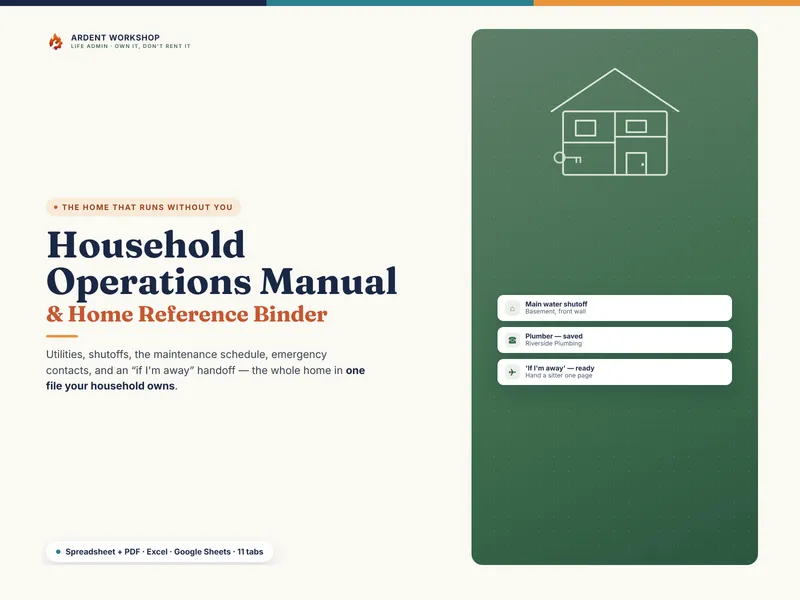
Household Operations Manual & Home Reference Binder — Utilities, Shutoffs, Maintenance, Emergency Contacts & House-Sitter Info (Excel + Google Sheets)
Run your whole home from one file — utilities, shutoffs, the maintenance schedule, emergency contacts, and an 'if I'm away' handoff, all in a file you own.
Life AdminView details