Between appointments, most of what matters about a GLP-1 medication happens at home: which dose went in on which day, how the week felt, whether you ate and drank what you were told to, and whether the next pen will arrive before the last one runs out. Unless you report it, much of that may never reach your chart. A short, consistent record is the difference between answering “how has it been going?” with a shrug and handing your prescriber a page they can read in a minute.
This guide covers what to write down, in the order it tends to matter.
Why keep your own record
A reminder tells you a dose is due. A log you keep yourself can also line up the dose you were on during a given week against how you felt that same week, and give you a page you can print and slide across the desk. It is your file, so it goes wherever you go.
Your medication’s Medication Guide from the U.S. Food and Drug Administration (FDA) and prescribing label list its known side effects and when to call for help. A log does not replace either. It makes your report to your prescriber specific.
Step 1: Write down your schedule exactly as prescribed
Start with the plan, in your care team’s words: the medication, the dose as written on your label, the day it is due, and how many days of slack they said is fine for a late dose. Copy it from the label or your after-visit notes. Do not rely on memory, and do not adjust it yourself; if the plan needs to change, that is a conversation with your prescriber.
Everything else you record is measured against this line. A dose logged a day later than due only means something if the due date is written down.
Step 2: Log each dose with date, site and status
For every dose, record four things:
- Date, and the medication if you take more than one.
- Dose as recorded, copied from the label, not calculated.
- Site, meaning where on the body it went, so you can note any irritation in one spot.
- Status: taken, missed, or held by your care team.
Log the missed and held doses too. A held dose with a note about who said to hold it is exactly the kind of detail that gets lost between visits. If your dose level changes, write the date of the change and what the new label says.
Step 3: Rate side effects daily on a simple scale
Choose a short list of symptoms that matter to you, and rate each one every day on the same scale. This is the heart of a side-effect log. A 0 to 3 scale works well: 0 none, 1 mild, 2 moderate, 3 hard to get through the day, with each number defined once in your own words. The scale matters more than the exact words, because a consistent scale is what lets you total the days into a week and compare one week with the next.
Add a line for anything else that changed that day, such as a new dose level, a missed dose or a day you barely ate. Note it; what it means is a question for your prescriber.
If a symptom worries you, contact your prescriber or pharmacist. Seek urgent care for severe symptoms. A log is for the appointment, not a substitute for a phone call.
Step 4: Note intake against the targets your care team gave you
If your care team gave you daily protein or water targets, write them at the top and record what you actually had each day. If they did not, record the amounts anyway, leave the target blank, and ask at your visit what they would like you to aim for. Please do not borrow a target from a website or a forum. The point of the record is to show your prescriber or dietitian how a normal week actually went against the numbers they chose for you.
Fiber and other items can be logged the same way, with or without a target.
Step 5: Track supply so you reorder in time
Pens and vials run out on a date you can work out in advance. Write down the number of doses on the label, how many pens or vials you have on hand, and any refills remaining. Subtract each logged dose, and what is left tells you the run-out date. Back off from it by however long your pharmacy usually takes, and you have a reorder-by date.
If you take more than one medication, track each one separately. Their run-out dates may not line up.
Step 6: Bring a one-page summary and your questions
Before the appointment, gather the stretch since your last visit onto one page:
- Doses taken, late, early, missed and held.
- Any dose changes and the dates they happened.
- The number of days each symptom was rated 2 or 3, and the week that was hardest.
- Days your intake fell below the targets you were given.
- Your weight change over the period.
- Your supply and run-out dates.
- Two or three questions you want answered.
Print it or share the file. A page like this turns a vague impression into something both of you can point at.
A free GLP-1 log, or the full workbook
You can keep all of this on paper, or in a spreadsheet you build yourself. If you would like a starting point, the free GLP-1 dose and side-effect log is a single-tab log for one medication, with three symptoms and a weekly total, pre-filled with an example so you can see how it works.
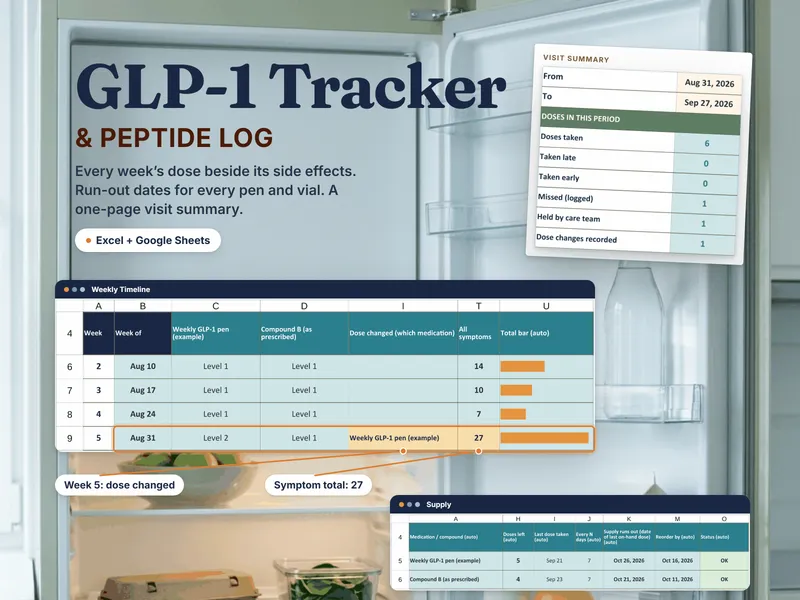
When you want it all connected, the GLP-1 Tracker & Peptide Log is an Excel and Google Sheets workbook with 13 tabs for up to six medications. It:
- Flags each dose on time, late or early against the schedule you typed in.
- Lines up the dose in force each week beside that week’s side-effect totals.
- Works out the date each pen or vial runs out from your label count and logged doses.
- Puts any date range on a one-page Visit Summary.
It is a one-time purchase and the file is yours to keep, with no subscription.
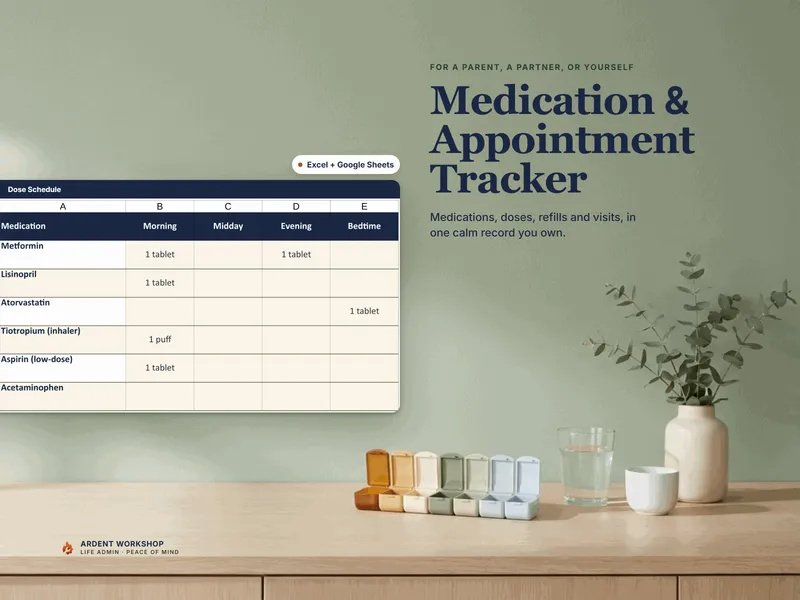
If you take other medications as well, the Medication & Appointment Tracker keeps those visits and refills in one place.
This is a record-organizing method, not medical advice, a diagnosis, or dosing guidance. The workbook stores what you type in and does not recommend doses. Always follow the plan your prescriber gives you.