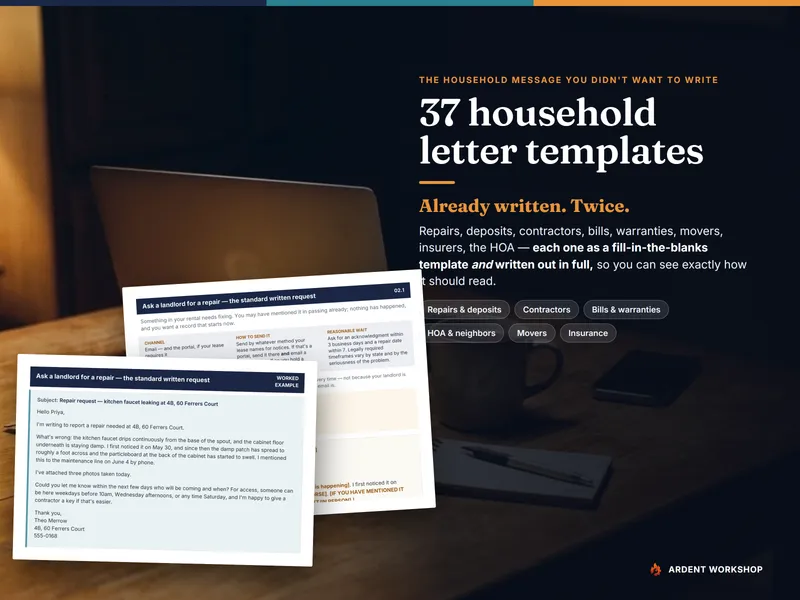
The honest framing is not "save money by not hiring a lawyer." It is that the two are aimed at different questions. A household dispute usually starts as a writing problem — you know what you want, you just cannot face drafting the message — and only some of them become law problems. Using a template on a law problem is a mistake. So is paying an hourly rate to have somebody phrase a request for a quote.
The positioning: a blank reply box, then a swipe bank, then paid help
The usual starting point is a blank reply box: you write three sentences, delete them, and put it off. A swipe bank is the structured middle ground: the message already written, with the facts to gather first and the delivery method that makes it count — a file you own and can edit. Paid help — an attorney, a legal-aid clinic, a tenants' service, a public adjuster — is the heavier option, and the right one the moment the question stops being how to say it and starts being what you are owed.
Swipe templates vs hiring help, side by side
"Hiring help" here means the category as a whole — an attorney, a legal-aid or tenants' service, or an online letter-writing service. They differ sharply from each other, and availability, cost, and scope vary by where you live. Check the specific option you are considering rather than taking a row below as a fact about it.
| Consideration | Swipe templates (owned) | Hiring help (paid per matter) |
|---|---|---|
| What it actually gives you | A well-written ask, plus what to gather first and how to send it | An answer about what the law requires in your situation |
| Cost shape | Paid once, reused for every future dispute | Per matter or per hour; some services are free but means-tested |
| Speed | Minutes — the message already exists | Days to weeks, depending on availability and waiting lists |
| Tells you your rights | No — and a good one says so plainly | Yes; that is the whole point of it |
| Handles the routine ask | Yes — repairs, quotes, billing disputes, warranty claims, deposits | Yes, but at a cost out of proportion to the task |
| Keeps the relationship workable | Usually — a reasonable letter from you is not an escalation | Often escalates, which matters with a landlord, neighbor, or HOA |
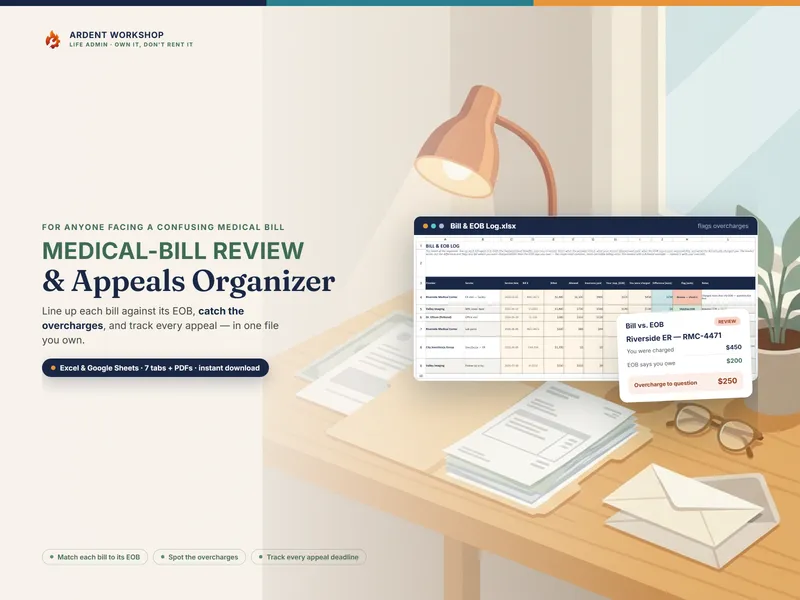
| Builds the record | Yes, if you use it that way — dated, kept, and yours | Only for the matter they were engaged on |
| Still there next year | Yes — files on your own drive | The engagement ends; the advice was for that dispute |
Where hiring help genuinely wins
Anywhere the answer depends on a rule rather than on phrasing. Whether a deduction from your deposit is permitted where you live. How long you have to bring a claim. Whether withholding a payment or refusing access is safe or ruinous. What a notice to vacate actually obliges you to do. What a settlement you are being offered gives up. Those are not writing problems, and a template that pretended to answer them would be doing you harm. Legal-aid clinics and tenants' services exist for exactly this, and many are free — though eligibility rules, scope, and capacity vary a great deal by area, so check what is actually available where you live before you count on it. The Legal Services Corporation's locator will find LSC-funded legal aid near you.
Where the templates win
Everything else — the ordinary run of disputes, the ones that never become law problems. The contractor who has gone quiet mid-job. The bill with a charge nobody can explain. The warranty claim that needs the model, the serial, and the failure date in the first four lines. The deposit statement with "full clean" on it and no invoice behind it. These are ordinary asks, and what makes them work is not legal drafting — it is being specific, dated, sent the right way, and free of the one sentence that sinks a reasonable request ("I shouldn't have to be writing this").
The other thing a template bank does, which paid help mostly does not, is teach you the register. A finished letter — the same message written out in full, with real dates and amounts — shows you how firm is too firm and where a sentence should stop, faster than any amount of instruction does. After a few of those, most of the value has transferred to you.
Using both, in the right order
Write the ask yourself. Nudge, and nudge once more. If it goes further, write the formal complaint with a real deadline and a next step you will actually take. If you reach the point where the deadline has passed and the next step is a court or a regulator — then spend the hour on advice, arriving with a complete dated record and copies of everything you sent. That record is worth more to whoever advises you than a head start on the drafting would have been.
Where to start
Take the repair request and contractor quote-request templates — free, no signup, each shown as a fill-in template and written out in full — and read how to ask a landlord for a repair in writing. If you are already at the end of the line, read what a demand letter is before you send one. If you are renting, templates for renters collects the rest.
This is a comparison of two ways to get a letter written — not legal advice, and not a recommendation for or against engaging anyone. What you are entitled to, and by when, is set by state and sometimes local law and varies sharply.
Frequently asked questions
- Do I need a lawyer to write a letter to my landlord or a contractor?
- This is general information, not legal advice, and it depends on your situation — but for an ordinary repair request, quote request, billing dispute, or warranty claim, usually not. These are routine written requests, and the thing that makes them work is being specific and dated rather than being legally drafted. Where paid help earns its fee is when the answer turns on what the law actually requires: whether a deduction from your deposit is allowed where you live, how long you have to bring a claim, whether withholding a payment is safe, or what to do once a formal process has started. A template can make the ask well; it cannot tell you what your rights are.
- What does hiring somebody to write a letter usually cost?
- It varies enormously by who you ask and where you are, so treat any single figure with suspicion. Broadly: legal-aid clinics and tenants' services are often free but usually have income-eligibility rules and limited capacity; attorneys may charge hourly, a flat fee, or nothing for an initial consultation; and online letter services generally charge per document. The relevant comparison is not template-versus-lawyer on price alone — it is whether your question is a writing problem or a law problem. Paying an hourly rate to have somebody phrase a repair request is expensive; paying it to find out whether you can safely withhold rent is not.
- Will a letter from a lawyer get a better response?
- Sometimes — a letter on a firm's letterhead signals that somebody is prepared to spend money on this, though how much difference it makes varies enormously with who is receiving it. It is also a blunt and expensive instrument, it escalates a relationship you may need to keep working (a landlord, a neighbor, an association), and it does nothing that a clear, dated, specific letter cannot do at the earlier rungs. Plenty of disputes end well without ever getting there. The sequence that works is: a good ask, a short nudge, a formal complaint with a real deadline — and paid help held in reserve for the point where the answer depends on the law.
- Are free letter templates online good enough?
- For the simplest asks, often yes. Three things are worth checking before you rely on one. Check whether it is just the body text, with no guidance on when to send it, which channel makes it count, or how long to wait before a silence is worth writing down. Check whether it is blank, leaving you to guess the register — how firm is too firm, how much detail is enough. And note that they live on web pages rather than in files you hold: a page can change, get gated, or come down, and the version you used last year may not be there next year.
- When should I stop using a template and get advice?
- Three signals. When real money is at stake and you are about to take an irreversible step — withholding a payment, refusing access, signing a settlement. When your housing is at stake, including any notice to vacate or an eviction filing. And when the answer turns on a legal deadline or entitlement you would be guessing at. At those points a template's job is finished: what it should have given you by then is a complete, dated record and a clearly written request, which is the position anybody advising you wants you to arrive in.