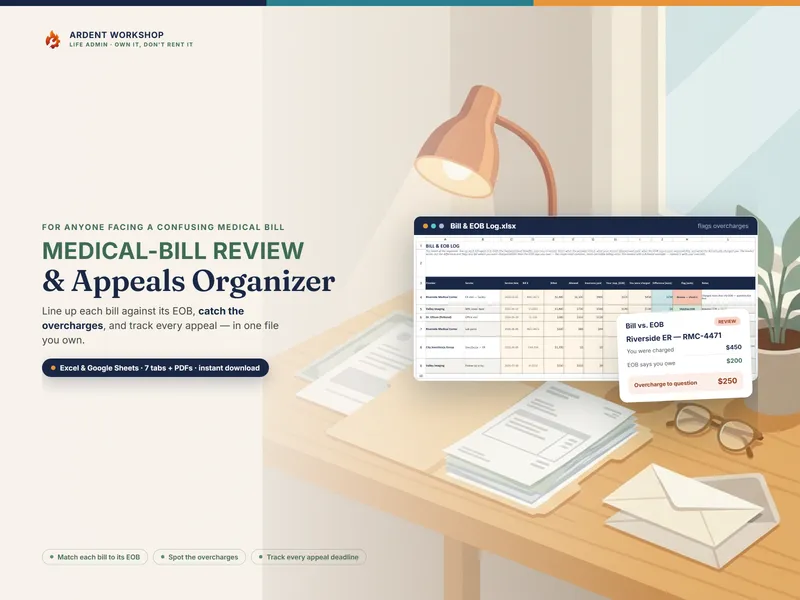
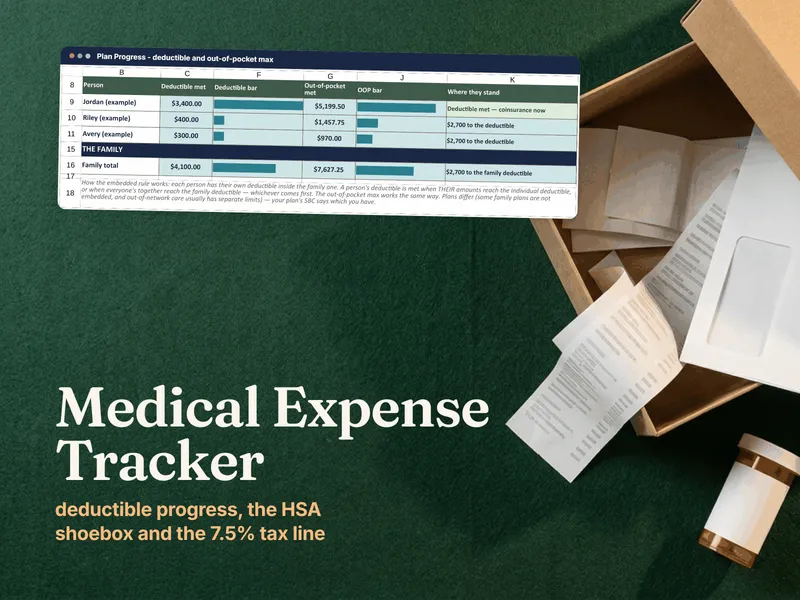
The honest framing is "own it, don't rent it." A billing app can be convenient — importing bills, nudging you at deadlines. But the record at the center of this — your bills, your EOBs, your appeal notes — is some of the most personal data you have, and it's data you'll want years from now. That's something worth owning in a file you control, not leasing on a platform, and not handing your logins to.
The positioning: a shoebox → an owned organizer → a billing app
Most people start with bills scattered — a shoebox, a pile on the counter, a number they hope is right. The two ways to get organized sit at opposite ends. A shoebox is free but nothing lines up, and errors and deadlines slip by unseen. A medical-billing app is the heavier, often-rented option: more automation, but usually on someone else's server and frequently behind a bill. An owned bill-review organizer is the structured middle ground — the same EOB matching and appeal tracking, on a file you keep.
Spreadsheet vs. a medical-billing app, side by side
| Consideration | Bill-review organizer (owned) | Medical-billing app (hosted) |
|---|---|---|
| You own it | Yes — a file on your own drive or Google account | Usually no — access often depends on an account or subscription |
| Cost | One-time purchase, keep forever | Often a recurring fee (some are freemium) |
| If the service ends or you stop paying | You still have the file and your full history | Access can be lost, along with your records |
| Where your medical records live | Your drive or Google account | The company's servers, under their privacy policy |
| Stores your logins / member-ID? | No — built to hold none of that | Often needs account connections and credentials |
| Matches bills to EOBs & flags overcharges | Yes — automatically, per line | Varies by app |
| Tracks denials & appeal deadlines | Yes — with a countdown and a correspondence log | Varies by app |
| Automation / bill import | Manual entry | Often automated — a real convenience |
| Works offline / on paper | Yes — print the logs and checklist | Usually no — needs the app and a connection |
When a medical-billing app makes sense
If your main need is automation — importing bills, reminders through the year — an app's convenience can be worth the subscription. Some people use an app for day-to-day capture and keep an owned organizer as the durable record and the appeal tracker. The two aren't mutually exclusive; just don't let a rented app be the only copy of a medical-billing history you'll want long after the subscription lapses.
When an owned organizer is the better fit
For most people the owned file is the safer foundation. It does the EOB matching and the overcharge flagging, it tracks appeal deadlines, it prints for your records, it stores no credentials, and it can't be taken away by a lapsed payment. Your medical records stay private and permanent because they live where you decide. If you build one thing, build the owned record.
Where to start
Try the free Itemized-Bill Review Checklist to check a bill, then run the whole thing with the Medical-Bill Review & Appeals Organizer — a 7-tab file you own, with a bill-and-EOB log, an appeal tracker, and a dashboard, that works in Excel, Google Sheets, and LibreOffice. This is an organizer — not medical, billing, legal, or insurance advice; it does not determine what you owe or decide an appeal. Not affiliated with or endorsed by any medical-billing app or insurer.
Frequently asked questions
- Is a spreadsheet or a medical-billing app better for reviewing bills?
- They solve the same problem from opposite directions. A medical-billing app is a hosted service — you enter or connect your bills inside someone else's platform, often for a subscription, with your medical and financial records on their servers. A medical-bill spreadsheet is a file you keep: a workbook that lines each bill up against its EOB, flags where you were charged more than you owe, and tracks your appeals, all on your own drive. For records this sensitive and this long-lived, the owned file is the safer foundation. Both can do the math; the difference is who holds the data and whether it's there next year.
- What happens to my bills and appeal history if the app shuts down or I stop paying?
- That's the core risk of renting. A subscription app holds your bill records and appeal history on the company's servers; if it shuts down, changes its terms, raises its price, or you stop paying, your access can go with it. A file you own is an .xlsx or a Google Sheet on your own drive; a lapsed subscription can't lock it, and your history stays intact. Whatever you use, keep your own copy.
- Is my medical and financial data more private in a spreadsheet?
- It can be, because you control it. Your bills, EOBs, and appeal notes are some of the most sensitive records you have. In an app, they sit on a third party's servers under their privacy policy and security. In a workbook you own, you decide where the file lives and who can open it. The Medical-Bill Review & Appeals Organizer is also built to store no logins, passwords, or member-ID numbers — you don't need them to track bills, and they don't belong in a file you might share with a family member or an advocate.
- Can a spreadsheet catch billing errors like an app claims to?
- For the comparison that catches the most, yes. The Medical-Bill Review & Appeals Organizer lines each bill up against its EOB and flags any bill charged more than the EOB's patient responsibility, then tallies the potential overcharge. It also walks you through the ten common errors and tracks appeal deadlines. What no tool — spreadsheet or app — can do is decide whether a charge is truly correct or how an appeal is resolved; those are for the billing office, your insurer, and, if needed, a patient advocate. The tool organizes the facts; the determination isn't its to make.