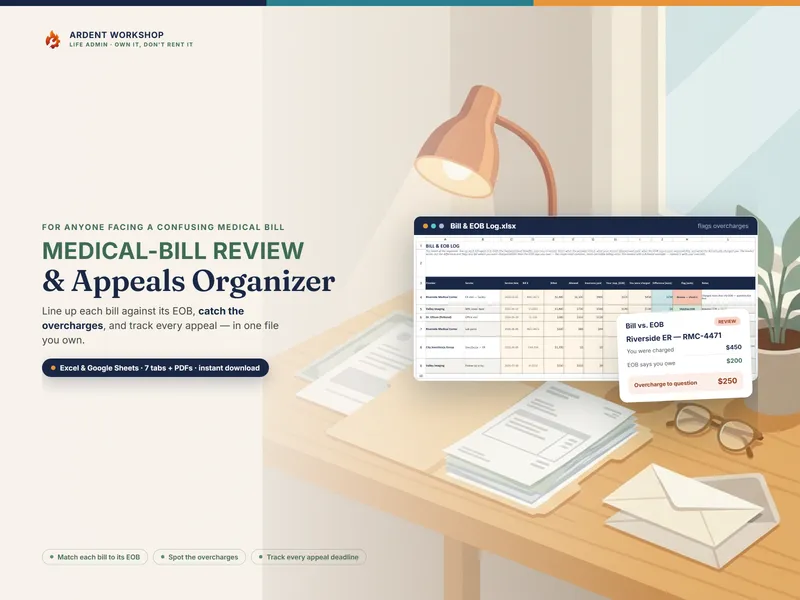
A medical bill is one of the few bills that regularly arrives wrong, and one of the few most people pay without checking. This walkthrough takes a single confusing bill — a fictional ER visit — from the mailbox to a resolved dispute, the same way the Medical-Bill Review & Appeals Organizer walks it through. Nothing here is medical, billing, legal, or insurance advice; it’s the method, so you can see where the money hides.
Step 1 — Don’t pay yet. Wait for the EOB.
The instinct with a bill stamped “amount due” is to pay it. Resist it for a moment. For any care that went through insurance, your insurer sends an EOB — an Explanation of Benefits — for the same services. The EOB is not a bill (most say so at the top); it’s your insurer’s account of the claim: what was charged, what the plan allowed, what it paid, and, crucially, what it says is your responsibility.
That last number is your yardstick. Until you’ve compared the bill to it, you don’t actually know what you owe. What is an EOB? walks through the figures in detail.
Step 2 — Ask for the itemized bill
Most bills you first receive are summaries: “balance due, $450.” A summary hides everything worth checking. Call the billing office and ask for an itemized bill — the line-by-line version with every charge and code. It’s a routine request, and you’re entitled to it. Errors live in the line items, not the total.
Step 3 — Compare the bill to the EOB
Now line them up. For each service, put what the bill charges you next to the EOB’s patient responsibility.
| Service | The bill charges you | EOB says you owe | Flag |
|---|---|---|---|
| ER visit — facility | $450 | $200 | Review — charged $250 over |
| Lab panel | $95 | $16 | Review — charged $79 over |
| Office visit | $30 | $30 | Matches — pay it |
Two of the three charge more than the EOB says you owe — a $329 potential overcharge on one visit. That’s the single most common medical-billing error, and the one this comparison catches every time. In the workbook, you enter both numbers and it flags the mismatch and totals the overcharge for you.
Step 4 — Work the error checklist
A mismatch tells you that something’s off; the itemized bill tells you what. Work down the common errors:
- Duplicate charge — the same service billed twice (that lab panel may also appear on the facility bill).
- Services not received — a test, drug, or day you didn’t get.
- Wrong quantity — more units or minutes than were provided.
- Upcoding — a pricier service billed than the one performed.
- Unbundling — one package split into separately-billed parts.
- Out-of-network surprise — a provider you didn’t choose (anesthesia, radiology) billed out-of-network.
Mark each one found, OK, or to check. Every “found” becomes a specific point for your call or appeal. The free Itemized-Bill Review Checklist is this list, ready to print.
Step 5 — Dispute the overcharge in writing
Call the billing office and raise each issue plainly: “The bill charges $450; my EOB says my responsibility is $200. Can you explain the difference?” Get a name and a reference number on every call. Then follow up in writing — a letter or a portal message creates a record a phone call doesn’t. Keep a copy of everything you send, and set a date to follow up. A dated trail is what keeps a dispute moving when it changes hands.
Step 6 — Appeal a denial before the deadline
If the problem isn’t a billing error but an insurance denial, you have a right to appeal — and a firm deadline, usually measured from the date on the denial letter. The most common way a winnable appeal is lost is a missed date, so file something before the deadline even while you’re still gathering records: a short “I am appealing this denial; supporting records to follow” letter preserves your right. Start with the insurer’s internal appeal; if that fails, ask about an external review, and lean on a patient advocate or your state insurance department if it stalls. What is an insurance appeal? covers the shape of it.
Keep the whole trail in one place
Reviewing one bill is a page of notes; reviewing a year of a family’s bills is a filing system. The Medical-Bill Review & Appeals Organizer is that system — a bill-and-EOB log that flags overcharges, a claims-and-denials tracker with deadline countdowns, and a correspondence log, in one owned file. Start with the free checklist, and see the tools for caregivers hub for more. This is an organizer, not advice — when in doubt, call your insurer, the billing office, or a patient advocate.