This isn't really spreadsheet-versus-software. The two tools do different sizes of job, and a growing operation often ends up with both. The mistake is paying for a per-seat EHS platform to answer the question you actually need first — is everyone trained and current, and can I prove it? — when that's a record you can own outright.
What each one is for
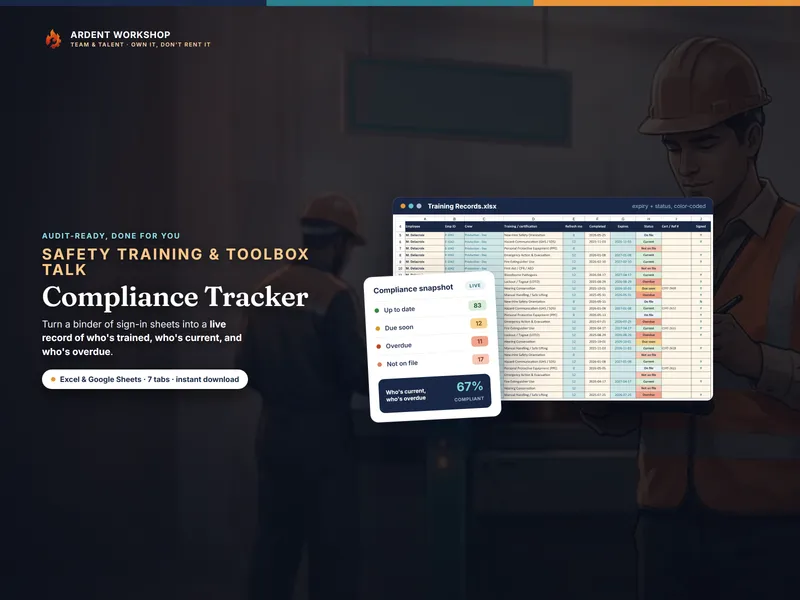
- A safety-training workbook keeps the record. Who's trained on what, when each certification expires, whose refreshers are due, and whether toolbox talks are being held, attended, and signed — rolled up into a compliance picture by crew and employee. It answers "who's current, who's overdue, and can I show it."
- EHS software runs the whole safety program. Course delivery and enrollment, incident and near-miss reporting, inspections and audits, corrective actions, and workflow across sites. It answers "how do we operate and evidence safety at organizational scale."
Tracking training and running a full safety-management system are not the same job — which is why both sit under "safety" and still don't replace each other. A short explainer of the toolbox talk — the smallest unit of safety training the workbook logs — is in the glossary.
When an owned workbook is exactly right
- You need to know who's trained, whose certifications are current, and whose refreshers are due.
- You want to log toolbox talks and prove they happened, with attendance and signed sheets.
- You're a crew, a site, or a small-to-mid business — not an enterprise with a dedicated EHS department.
- You'd rather own the file than rent a per-seat platform to hold a training record.
- You need something audit-ready this week, not a rollout project.
At this stage an owned workbook beats a platform outright for the record question. The free toolbox-talk log is a no-signup taste, and the templates for HR & team leads hub collects the rest.
The signals you also want EHS software
- You deliver real course content at scale. E-learning modules, assessments, and certificates — not just training you record.
- You need automated enrollment and renewal reminders. Assignments and cert renewals chased by the system across many sites.
- You capture incidents, near-misses, and inspections. A safety program is more than training, and you need it all in one system.
- You run audit workflows for a large workforce. Corrective actions, sign-offs, and history at organizational scale.
Even then, the platform runs the program while a simple owned record keeps the training picture you can open and check without logging in — so the workbook keeps earning its place beside it.
Side by side
| What matters | Owned workbook | EHS training software |
|---|---|---|
| Records | Certifications, refresher expiry & toolbox talks | Courses, incidents, inspections & audits |
| Cost | One-time, low — you own the file | Ongoing subscription, often per seat or site |
| Refresher expiry & status | Computed automatically, color-coded | Yes — with automated reminders |
| Toolbox-talk logging | Built in — with attendance & signed-sheet tracking | Sometimes, in a safety-meeting module |
| Course delivery | None — it's a record, not a classroom | Full — modules, quizzes, certificates |
| Incidents & audits | Not its job — it tracks training | Full incident, inspection & audit workflow |
| Data ownership | The file is yours, offline | Hosted in the vendor's platform |
| Best for | Tracking training & proving talks happened | Running a full safety program at scale |
The honest middle ground
A growing operation often ends up with both: a platform for the program it's required to run, and a simple owned record for the training picture the platform buries behind a login. The mistake is the reverse — buying a per-seat EHS suite to answer a training-record question, when an owned workbook does it better and costs once.
Keep your record either way
Whichever stack you run, you still need a fast, defensible way to show who's trained, who's current, and who's overdue. The Safety-Training & Toolbox-Talk Compliance Tracker computes refresher expiry, tracks toolbox-talk cadence, and rolls it all up by crew and employee — one owned file for Excel, Google Sheets, and LibreOffice. Own the record; add an EHS platform only when running a full safety program at scale becomes the job.
This comparison is general information, not safety, legal, or compliance advice. What training and records your workplace must keep are set by the regulations that apply to you — confirm your obligations with your own program, regulator, and insurer.
Frequently asked questions
- Can a spreadsheet replace EHS training software?
- For the part most small and mid-size teams actually act on — knowing who is trained, whose certifications are current, whose refreshers are due, and whether toolbox talks are being held and logged — yes. An owned safety-training workbook computes refresher expiry, flags what's overdue, and rolls it up by crew and employee, with no per-seat fee. What a spreadsheet doesn't do is host e-learning, automate enrollment emails, capture incidents and inspections, or scale workflow across hundreds of sites. If you need to track training and prove talks happened, the workbook is the right first tool; if you're running incidents, audits, and course delivery across a large workforce, that's a platform job.
- Does a spreadsheet make me compliant?
- No tool makes you compliant — a record does, and only if it reflects real, correctly-timed training. A spreadsheet (or an EHS platform) is where you record and present that training; it is not the authority on what your workplace is required to do. What training is mandatory, how often it must be refreshed, and what evidence an inspector accepts are set by the regulations that apply to you. Both the workbook and the software help you keep and show the record; neither replaces confirming your obligations with your own program, regulator, and insurer.
- What does an owned safety-training tracker cost vs EHS software?
- An owned safety-training workbook is a single low one-time cost — you keep the file, edit it offline, and pay nothing monthly. EHS training or safety-management software is typically a recurring per-seat or per-site subscription. The subscription earns its keep when you're delivering course content, capturing incidents, and running audits across a large workforce; paying per seat just to track certifications and log toolbox talks for a crew or a few sites is renting far more platform than the job needs.
- When should I move from a spreadsheet to EHS software?
- When the job outgrows a file. The signals: you're delivering real e-learning at scale, you need automated enrollment and renewal reminders across many sites, compliance hinges on capturing incidents and inspections in one system, or you must run audit workflows for hundreds of workers. Until then, an owned workbook tracks training, refreshers, and toolbox talks perfectly well — and even after you adopt a platform, a simple owned record is a useful backup you fully control.