

Team & Talent 12 min read
How to Hire Seasonal Staff
How to hire seasonal staff before your fall rush: size peak-week headcount, work the hiring ramp backward from opening day, and budget the real cost.
Season-planning tools for pumpkin patches, corn mazes, u-pick fields, farm stands and Christmas tree farms — built for the few short weeks that carry the whole year. Log the weather beside the gate, forecast the next operating day, and count what's still standing in the field, all from one connected file you own.
A pumpkin patch or a tree lot is not year-round retail with a busy season in it — it is a short, weather-exposed run of gate days where one or two people work the gate, the wagon, the maze and the stand at once, alongside a seasonal crew who have never used your tools before. A cash box tells you what came in. It cannot tell you whether Saturday was quiet because the season is soft or because it rained, and by the time you find out, the season is already over. That is a retail business running on a farm's record-keeping habits, and the two need different tools.
Never logged a gate day against the weather? Start free with the Pumpkin Patch Daily Gate Log — no signup — then read what agritourism admission pricing is before you set next season's gate price.
Selling the crop instead of the ticket? Weigh u-pick against wholesale for the acres where either could make sense.
The Pumpkin Patch, Christmas Tree Farm & Agritourism Season Manager is a nine-tab workbook built around a daily gate log with a closed weather band on every row. Because the band is there, the workbook can group your days by weekday and by weather and show what an average day of each kind has actually been worth — then forecast the next operating day from that same grid, with a confidence line that says so when fewer than three matching days exist to back it up.
From there, labor prices itself as a share of that same day's take, with a crew planner that sizes the next shift against what the forecast crowd affords. Each attraction is ranked on contribution margin per visitor, not on the gross it took — concessions can outsell the hayride and still be the weaker line. A crop and inventory countdown runs acres times yield per acre times the share good enough to sell, less what's already gone, down to a projected sell-out date for every grade. And when the gate closes, the next-season plan carries this year's actual daily curve into next year's operating days, staffing and planting quantity.
It is one file for both of the year's selling windows: the pumpkin patch and corn maze in October, then the Christmas tree farm in November and December, with the tree side counted by height band rather than by pumpkin grade and the same gate log, weather grid and crew planner doing the work. It comes as a workbook for Excel and Google Sheets plus five guide PDFs running 66 pages, at $19.95.
Group tours and school bookings run on their own tab alongside the gate log, rather than as a side note scribbled next to a normal day's admissions.
Staffing a season that runs weeks, not months, is its own problem — over-hire and you carry payroll a quiet Tuesday cannot cover; under-hire and a good Saturday turns the parking field into the bottleneck. The Seasonal & Peak-Season Hiring Workbook turns a weekly demand forecast into the exact seasonal heads to hire, works the hiring ramp backward from your opening day, and builds the temp roster with each hire's weeks, hours and fully-loaded cost computed for you.
Selling jam, cider or baked goods off the farm stand. If any of it is made in a home kitchen under your state's cottage food law, the Cottage Food Compliance Pack builds the ingredient statement in weight order, computes the allergen line, carries the published label elements for all 50 states and DC, and traces a batch back to the lots that went into it.
Running hives alongside the patch. Some agritourism operations keep bees for the pollination and sell the honey at the same stand. The Beekeeper's Hive, Harvest & Honey-Lot Logbook logs each hive inspection, turns a harvest into a traceable lot, and prices a jar from what it actually cost to fill.
Recommended tools
4 templates
A connected season workbook for the gate, the weather and the crop, a seasonal-hiring workbook for the short-season crew crunch, and compliance and pricing tools for the honey and home-kitchen goods a lot of these stands sell alongside the season.

Agritourism season workbook for pumpkin patches, corn mazes and Christmas tree farms: log the weather beside each day's gate, forecast the next day, count what is left in the field.
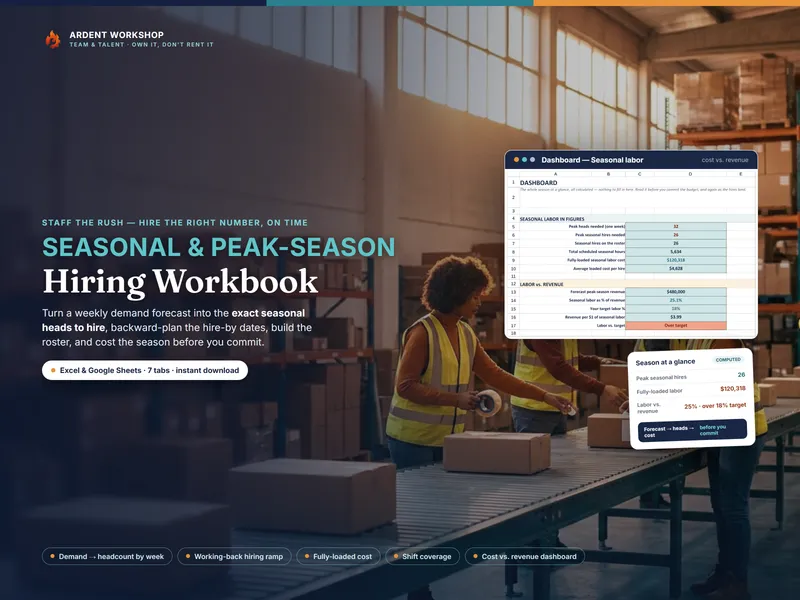
Staff up for a peak without over- or under-hiring: a workbook that sizes seasonal headcount from your forecast, times the hiring ramp, and costs the season.

Cottage food label workbook: ingredient statements ordered by weight, an allergen matrix, label rules for 51 jurisdictions, and two-way batch tracing.

The business side of an apiary for honey sellers — a hive log, a harvest & lot tracker, inventories and a cost-per-jar calculator. Excel + Google Sheets.
Where we fit
Most tools force a choice between a blank spreadsheet you build from scratch and a monthly app that's overkill. Ardent Workshop is the rung in between — structure you own.
Free, but you build and maintain every formula, tab and layout yourself.
Owned, structured, connected workbooks — a one-time price, yours to keep.
Powerful, but overkill, rented and locked-in — built for someone bigger than you.
Running an operation that's genuinely outgrown the file? Ardent Seller isn't the generic SaaS app this ladder warns about — it's maker-first software built by the same workshop: your data stays yours, you can start free or pay as you go with no subscription required, and it's sized for your operation, not someone bigger. The platform to graduate to when a spreadsheet honestly can't keep up.
Reading list
Sizing and timing the seasonal crew before opening day, not after the lot fills the parking field.