Ask five online sellers whether you should list your products on multiple marketplaces or pour everything into one, and you’ll get five different answers — and they’re all partly right. Some swear that spreading across channels saved their business when one platform changed its rules overnight. Others will tell you that chasing every marketplace nearly burned them out before they’d mastered a single one.
Here’s the honest answer up front: whether you should sell on multiple marketplaces depends less on the marketplaces and more on whether your systems, time, and margins can absorb the added complexity. Expanding to a second or third channel multiplies your reach — but it also multiplies your listings, your inventory math, your customer messages, and your chances of overselling. Get the systems right first, and more channels become a growth engine. Add channels before you’re ready, and you’ve built a bigger, leakier bucket.
Let’s make the real case for each side, then draw the line where it actually belongs.
The Real Question Isn’t “More or Fewer” — It’s “Can You Run More?”
Most “should I go multichannel?” debates get framed as a reach problem: more marketplaces, more eyeballs, more sales. That’s true, but it’s the easy half. The hard half is operational. Every channel you add comes with its own listing format, its own fee structure, its own buyer expectations, and its own inventory count that has to stay in sync with all the others.
So the useful question isn’t “would another marketplace get me more customers?” — the answer to that is almost always yes. The useful question is: “Can I run another storefront without dropping the quality of the ones I already have?” That reframing is what separates sellers who scale across channels from sellers who quietly collapse under them.
The Case for Selling on Multiple Marketplaces
The strongest argument for going wide is simple: that’s where the buyers already are. Online marketplaces are not a niche — the top 100 marketplaces worldwide were on track to move roughly $3.8 trillion in merchandise in 2024 (opens in new tab), and shoppers spread their attention across several of them. A buyer who would never find you on one platform is browsing a different one entirely.
There’s also a behavioral case. A widely cited Harvard Business Review study of 46,000 shoppers (opens in new tab) found that most shoppers used multiple channels on their way to a purchase, and the more channels they touched, the more they tended to spend. People don’t shop in one place anymore — meeting them in more than one is meeting demand that already exists.
Beyond reach, three real advantages stand out:
- Risk diversification. If a single marketplace suspends your shop, changes its algorithm, hikes fees, or buries your category, a multichannel seller bends instead of breaks. Sellers who depend on one platform are one policy email away from a crisis.
- Audience differences. Buyers on a handmade-focused marketplace behave differently from buyers on a big general marketplace or your own website. Different price sensitivity, different expectations, different best-selling products. Multiple channels let you match the right product to the right crowd.
- Compounding discovery. Each channel has its own search engine and its own browsing audience. Listing in more places creates more entry points back to your brand — including your own site, where your margins are highest.
Side A in one line: demand is fragmented across platforms, so a presence on several captures sales a single shop never could — and protects you when any one platform turns hostile.
The Case for Mastering One Marketplace
Now the other side — and it’s stronger than the “more is better” crowd admits.
Every marketplace rewards focus. Platform search algorithms tend to favor sellers with steady sales velocity, fast response times, strong reviews, and complete, optimized listings. Those signals are easier to build when your attention isn’t split four ways. A seller who fully masters one channel — nailing the listings, the photography, the keywords, the customer service — often out-earns a seller who is mediocre across three.
The operational costs of going wide are real, and they hit small sellers hardest:
- Inventory synchronization. This is the silent killer. Sell the last unit of something on one channel, forget to decrement it on the others, and you’ve oversold — leading to cancellations, refunds, and the kind of reviews that tank a new shop. The more channels, the more often this happens.
- Listing maintenance multiplies. A price change, a photo update, a seasonal tweak, a discontinued item — every edit now has to happen in several places, in several formats. What was a five-minute task becomes a half-hour chore.
- Fragmented attention and burnout. Customer messages, fee reconciliation, and policy compliance all multiply per channel. For a solo maker, spreading thin across platforms often means doing everything at 70% instead of one thing at 100%.
- Brand dilution. Building a recognizable shop — consistent voice, photography, and customer experience — is hard enough in one place. Spread too early and you never develop the depth that turns one-time buyers into repeat customers.
Side B in one line: mastery beats presence — one fully optimized, well-run channel usually outperforms a scattered presence across several, and it does so with far less operational drag.
Where the Real Dividing Line Is
Both sides are right; they’re just describing sellers at different stages with different setups. The honest dividing line comes down to a handful of factors. Here’s how the same decision changes depending on your situation:
| Factor | Favors one channel | Favors multiple channels |
|---|---|---|
| Stage | New shop still finding product-market fit | Established shop with proven sellers |
| Time available | Side hustle, limited hours | More hours, or help/automation in place |
| Inventory tracking | Counts live in your head or scattered notes | One central, reliable source of truth |
| Product range | Many one-of-a-kind or low-stock items | Repeatable products with steady stock |
| Margins | Thin — extra fees would erase profit | Healthy enough to absorb new platform fees |
| Systems | Manual everything | SKUs, templates, and tracking already set up |
The pattern is clear: single-channel focus is the right call until your systems and proven demand can support more. Multiple channels reward sellers who’ve already built the operational backbone — not sellers hoping more storefronts will rescue weak sales.
One especially important row is product range. If you sell one-of-a-kind pieces or tiny batches, multichannel listing is genuinely dangerous — the same unique item listed in two places is an overselling incident waiting to happen. Sellers of repeatable, restockable products have a much easier path to going wide.
So, Should You Sell on Multiple Marketplaces? The Verdict
For most small sellers, the answer is: start with one, master it, then expand deliberately — not reactively.
That means resisting the urge to open a second shop because sales feel slow. Slow sales on your first channel rarely get fixed by adding a second; you just spread the same problem across more storefronts. Master the fundamentals in one place first — listings that convert, photography that earns the click, keywords that get you found, service that earns five-star reviews. Those skills transfer to every channel you add later.
But the verdict flips for established sellers. If you’ve got proven products, reliable stock, and your operations are humming, staying on a single platform is leaving money — and resilience — on the table. At that point the diversification argument wins: you’re one policy change away from a bad quarter, and expanding protects you while it grows you.
The dividing line, again, is readiness — not ambition.
How to Expand Without the Chaos
When you’re ready to add a channel, the difference between smooth growth and overselling chaos is whether you’ve built the backbone first. Use this as a go/no-go checklist before you open a second storefront:
- You have one central inventory count that every channel pulls from — not separate counts per platform living in your head.
- Every product has a consistent SKU so the same item is unmistakably the same item across every channel.
- You know your true margin per channel after that channel’s specific fees — and it’s still profitable.
- Your best-sellers are restockable, not one-of-a-kind pieces that can’t safely live in two places.
- You have listing templates ready so launching on a new channel is copy-and-adapt, not start-from-scratch.
- You have the weekly hours (or automation) to maintain another storefront without neglecting the first.
If you can’t check most of those boxes, the highest-return move isn’t another channel — it’s building the systems that make the next channel safe.
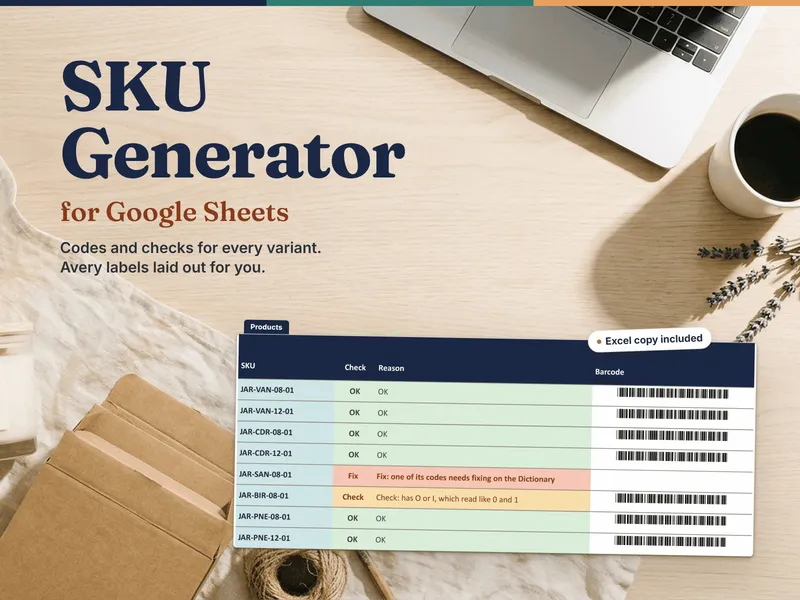
A consistent SKU system is the foundation of all of this. The same product needs the same identifier everywhere, or your inventory will drift the moment you go multichannel. A tool like the SKU Generator (also in a Google Sheets version) gives you a clean, scalable naming convention before the chaos starts — not after.
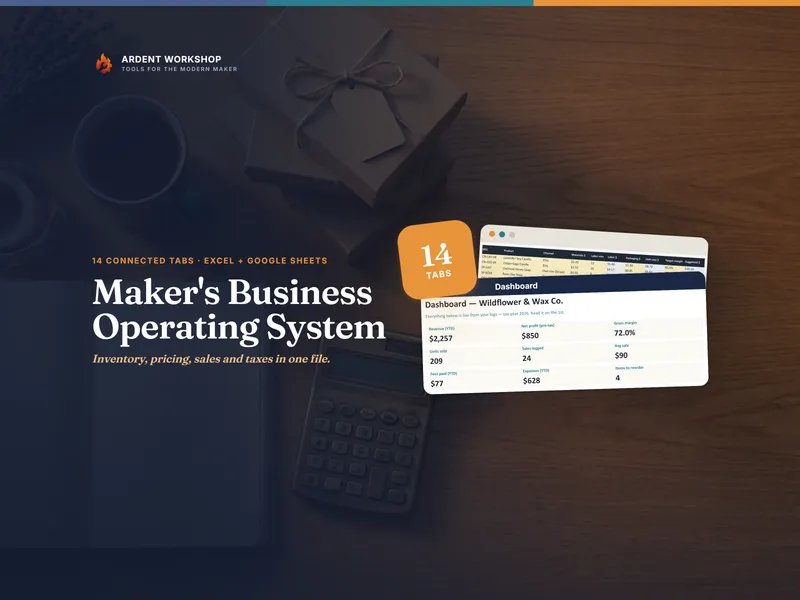
For tracking sales and stock across channels in one place, the Craft Business Manager acts as your single source of truth, so a sale on any platform reflects in one master count instead of three disconnected ones. If you’d rather have inventory, pricing, sales, and wholesale all connected in a single file, the Maker’s Business Operating System does the same job across your entire operation. And because every marketplace skims a different cut, knowing your real per-channel margin matters — the Etsy Seller Toolkit helps you see what’s actually left after fees so you don’t expand onto a channel that quietly erases your profit.
The other thing that turns launching a new channel into a copy-and-adapt job instead of a from-scratch slog is having your listing copy ready. A Product Description Copy Bank gives you fill-in-the-blank descriptions in a consistent brand voice, so the same product reads like you on every storefront — not three different shops that happen to sell the same thing.
The Bottom Line
Selling on multiple marketplaces isn’t inherently smart or risky — it’s a multiplier. It multiplies whatever you already have. Strong systems and proven products? More channels multiply your growth and your resilience. Shaky inventory and thin margins? More channels multiply your mistakes.
So don’t ask “one or many?” as if it’s a personality type. Ask “am I ready to run another storefront at full quality?” Master one channel, build the systems that make the next one safe, then expand on purpose. Done in that order, going wide is one of the best growth moves a seller can make. Done in reverse, it’s one of the fastest ways to burn out.
And when your business outgrows a stack of spreadsheets juggling several channels at once, Ardent Seller (opens in new tab) is the next step — built to keep inventory, orders, and sales in sync across everywhere you sell.