The formula
Utilization rate is a division, and the whole art is in defining the two numbers honestly:
- Booked (or billable) hours — the hours a person spends on client-facing, chargeable work in a period.
- Available hours — the hours that person could realistically work in the same period, after you subtract time off, holidays, and any standing internal commitments.
Utilization rate = booked hours ÷ available hours. If a designer has 160 available hours in a month and 120 land on client projects, they're running at 75% utilization. The other 40 hours went to the things every service business still has to do — internal meetings, admin, business development, learning — that don't appear on an invoice.
Billable vs. booked — a small but important distinction
Two closely related versions of the number travel under the same name:
- Billable utilization counts only hours a client actually pays for. It's the revenue-facing view — how much of your capacity turns into billings.
- Booked (or scheduled) utilization counts every hour assigned to project work, billable or not. It's the planning view — how full people's calendars are before the month even starts.
A capacity planner works on the booked view: it asks whether the commitments you've already made fit inside the hours you actually have, ahead of time, so you can act before the crunch instead of explaining it afterward.
What a healthy target looks like
There's no single correct number, and any figure quoted as a universal law should be treated with suspicion — it depends on the role, the business model, and how much non-billable work a job legitimately carries. As a rough sense of direction, many client-services teams aim for something in the region of three-quarters to four-fifths of available hours on billable work for hands-on delivery roles, and deliberately lower for people who also sell, manage, or lead. Treat any target as a conversation starter, not a verdict:
- Senior and leadership roles run lower on purpose. A principal who bills at 40% may be spending the rest winning the work that keeps everyone else busy — that's the job, not a problem.
- Junior delivery roles usually run higher, because more of their week is hands-on project work.
- The right target is one you set, in the open. A shared number people understand beats a benchmark copied from someone else's business.
Over-utilization and under-utilization
Utilization is a two-sided risk, and both sides cost money in different ways:
- Under-utilization is idle capacity — people you're paying for whose hours aren't turning into billings. A little slack is healthy and necessary; a lot, sustained, is either a sales problem or a sign you're over-staffed for the work in hand.
- Over-utilization is the quieter danger. A person booked past 100% for weeks has no room for a sick day, a slipped deadline, or the next opportunity — and the overflow usually gets paid for in overtime, rushed quality, or burnout and turnover. A number pinned at the ceiling isn't a badge of efficiency; it's a warning light.
The useful read is per person, per period. A team that averages a comfortable rate can still hide one person drowning and another with an empty calendar — the fix is to move work between them, which you can only do if you can see it.
Why teams that sell time track it
For an agency, studio, or consultancy, people are both the product and the largest cost. Utilization is the bridge between the two: it tells you whether the capacity on the payroll is being converted into client work, or leaking away as idle time and overload. Tracked over time it answers the questions the business actually turns on — can we take on this next project, or are we already full? Do we need to hire, or just rebalance? Which month does the team first run tight? Without the number, those are gut calls; with it, they're decisions you can defend.
Common mistakes
- Chasing 100%. A team with zero slack can't absorb a surprise or pursue anything new. Full is not the goal; sustainable is.
- Confusing utilization with profitability. A person can be fully utilized on work that's priced too low. High utilization on unprofitable projects just loses money faster.
- Reading the average, not the people. The team number hides the individual who's overloaded and the one who's idle — and it's the individuals you actually manage.
- Measuring against the wrong denominator. If "available hours" ignores PTO and holidays, every rate is quietly wrong. Net the time off out first.
Utilization is one half of capacity planning
Utilization rate looks backward and sideways — how full are people right now? Capacity planning looks forward: given the work we've committed to, do the hours add up, and where will we run short? They use the same raw material — available hours netted against booked work — which is why one tool can carry both.
Own the number, don't rent it
You don't need a per-seat resource-management platform to know your utilization. Between a blank spreadsheet you'd have to wire up yourself and a monthly SaaS app sized for someone bigger sits an owned workbook. The free Team Capacity Starter is an ungated taste — book a few people and watch the flags light up. The full Team Capacity & Utilization Planner nets every assignment against available hours and shows per-person-per-month utilization with Over / Low / OK flags, team utilization versus target, spare capacity, and the first month the team runs tight — for Excel and Google Sheets, yours to keep. Weigh it against a subscription tool in capacity-planning spreadsheet vs. resource-management software, or browse the templates for agencies & studios hub.
Templates that implement this
Track utilization without a per-seat app
2 templates
Book people onto projects, net every assignment against their available hours, and read per-person utilization with Over / Low / OK flags — one owned workbook, not a monthly subscription.
- $24.95 Spreadsheet

Team Capacity & Utilization Planner — Resource Planning for Excel & Google Sheets
A team capacity and utilization planner for Excel & Google Sheets: book people onto projects and see who's over-allocated and who has room, by month.
Team & TalentView details - $19.95 Spreadsheet
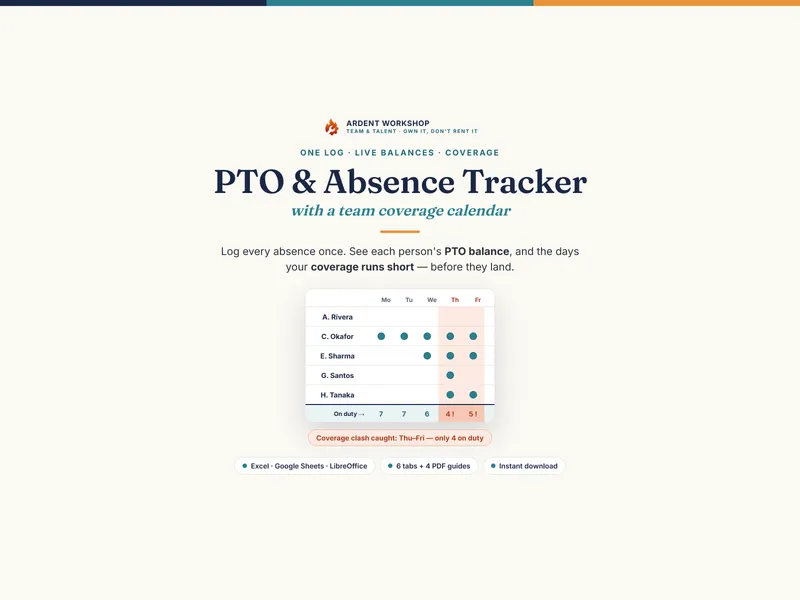
PTO / Absence & Coverage Tracker — Employee Leave & Vacation Tracker with a Team Coverage Calendar (Excel + Google Sheets)
A PTO and absence tracker for Excel & Google Sheets — log leave once, see each person's balance, and a team calendar that flags coverage clashes.
Team & TalentView details