Flat-rate pricing vs. hourly: what changes
Quoting by the hour ties your price to a meter the customer can't see the end of, and it punishes your best technician — the one who does the job in two hours instead of four earns you less for being good. Flat-rate pricing fixes both: each task carries one price, set in advance, the same for every customer.
- One price, quoted up front. The customer approves a known number before the work starts — fewer surprises, fewer disputes, more closed jobs.
- Efficiency pays you. You price the task, not the clock, so a faster tech earns more per hour for the shop, not less.
- Consistency. Every customer gets the same price for the same task, and any tech can quote it from the book.
How a flat-rate price is built
Every flat-rate price is the sum of two parts: the parts the task needs, marked up, plus the labor it takes, priced at your billable rate.
- Parts, marked up. What the parts cost you, plus a markup that covers ordering, stocking, and the warranty. Small parts usually carry a higher markup than large ones, because a $12 part costs about as much to order and stock as a $500 one.
- Labor at your billable rate. The book hours the task takes multiplied by your billable rate — not your technician's wage. The billable rate is the wage loaded with its burden, the unbillable hours, your overhead, and a profit. (See markup vs. margin for the math that turns a target margin into the markup you charge.)
- Rounded to a clean number. The total is rounded up to a tidy menu price — a $1,368.72 result becomes a $1,370 quote.
You can price a single task without doing the arithmetic by hand with the free flat-rate task calculator — enter your billable rate, the parts and markup, and the book hours, and it returns the menu price.
The billable rate is the number to get right
A technician's wage is not what an hour of your business costs. By the time you add the labor burden (payroll taxes, workers' comp, benefits), divide by the hours your techs are actually billable, and add the overhead every billable hour has to carry, the real cost of a billable hour is much higher than the wage — and that's before any profit. Build the billable rate once, and every task in the book is priced on solid ground; guess it low, and every task underpays.
How to build a flat-rate price book
- Start with the rate. Work out your billable rate from wages, burden, billable hours, overhead, and the profit you want to keep.
- Cost each task once. List the parts a task needs and the hours a competent tech takes, then price it. Do it carefully one time and the task is priced for years.
- Build the book a few tasks at a time. Start with the work you do most. A book of two dozen common tasks often covers most of what walks through the door.
- Add a diagnostic or service-call fee. Rolling the truck and finding the problem is real work; charge for it, and credit it toward the repair if the customer says yes.
- Recompute the rate every year. As wages and insurance climb, last year's rate quietly slides toward break-even.
Common flat-rate pricing mistakes
- Pricing labor at the wage, not the billable rate. The wage doesn't carry the truck, the insurance, or the unbillable hours — the rate does.
- Confusing markup with margin. A 50% markup is only a 33% margin; charge a markup as if it were a margin and you underprice every part. (See profit margin.)
- Never updating the book. Parts prices move and wages rise; a menu built two years ago is quietly underpricing today.
- No diagnostic fee. Free diagnostics turn every tire-kicker into an unpaid truck roll.
Related templates and concepts
Flat-rate pricing builds on bid markup and the profit margin it produces. To weigh a workbook against the subscription apps, read spreadsheet vs flat-rate pricing app, or browse every tool on the templates for service trades hub.
Templates that implement this
Tools for pricing and bidding service-trade work
3 templates
A connected workbook that turns your billable rate, parts, and book hours into a clean flat-rate menu — plus an estimating workbook for the custom-bid jobs alongside it.
- $29.95 Spreadsheet
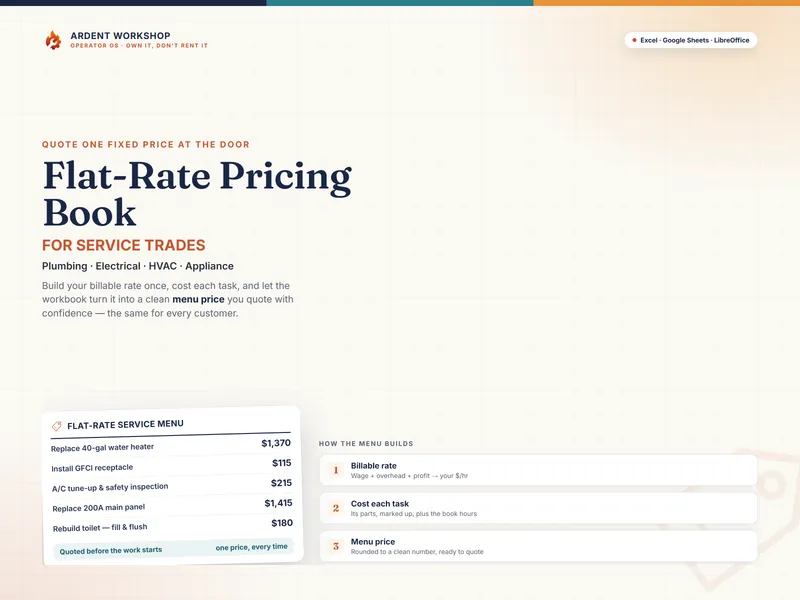
Flat-Rate Pricing Book for Service Trades — Plumbing, Electrical, HVAC & Appliance Price Book, Billable Rate & Markup Calculator (Excel + Google Sheets)
Flat-rate price book for service trades — set your billable rate, cost each task, and build a clean menu for plumbing, electrical, HVAC & appliance work.
Operator OSView details - $14.95 Spreadsheet
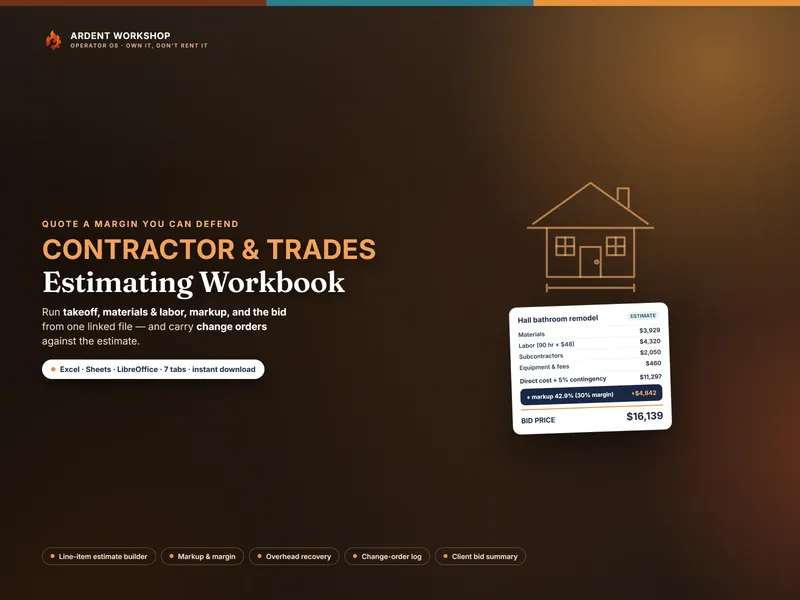
Contractor & Trades Estimating Workbook — Construction Job Costing, Bid Markup & Margin, Overhead & Change Orders (Excel + Google Sheets)
A contractor estimating workbook for Excel & Google Sheets — line-item job costing, bid markup vs margin, overhead, and change orders in one file.
Operator OSView details - $69.00 Bundle

Trades & Service-Business Bundle — 7-Product Contractor Toolkit: Estimating, Flat-Rate Pricing, Crew Scheduling, Safety and Apprentice Records, Client Paperwork (Excel + Google Sheets)
Seven trades and contractor products in one bundle, plus a Control Panel for Excel or Google Sheets that works out what a billable crew hour costs.
Operator OSView details