Etsy SEO decides whether a buyer ever sees your listing. The marketplace serves tens of millions of active buyers and millions of active sellers (Etsy Q4 2025 investor results (opens in new tab)); without keyword-optimized titles, all 13 tag slots used, and a healthy listing quality score, your products get buried. The five-step playbook below — keyword research, title and tag optimization, description rewrites, photo quality, and shop activity — is what separates listings on page one from listings nobody sees.
Why SEO Matters on Etsy
SEO on Etsy determines where your product appears in search results when a potential customer enters a query. If your listing is well-optimized, it’s more likely to appear at the top of search results - and more visibility means more clicks, favorites, and ultimately, more sales.
Etsy’s search algorithm considers several factors:
- Keywords in your titles, tags, and descriptions
- Listing quality score based on engagement (clicks, favorites, purchases)
- Relevance of your listing to the buyer’s search query
- Shop performance (shipping times, customer reviews, etc.)
Neglecting SEO means you’re leaving your shop’s success up to chance. But with a focused SEO strategy, you can actively drive traffic to your store.
Etsy Search Works in Two Stages — and That Changes Everything
Here’s the mental model that makes the rest of this post make sense, and most sellers never get told it.
Etsy search runs in two distinct stages:
- Query matching — Etsy assembles the set of listings that could answer the search. If your keywords don’t match the buyer’s phrase, you’re not in this set. You’re not ranked low. You’re not in the room.
- Ranking — Etsy orders that set using signals like listing quality score, recency, shipping price, and the shopper’s own habits.
These two stages fail differently, and the fix is different for each. A listing that never appears has a keyword problem — no amount of better photos will save it. A listing that appears but gets scrolled past has a ranking and conversion problem — no amount of keyword stuffing will save it.
Diagnose which one you have before you fix anything. Etsy Shop Stats tells you: near-zero impressions means stage one. Plenty of impressions with few clicks means stage two. Those are the only two diseases, and sellers waste months treating the wrong one.
Tips to Improve Your Etsy SEO
Here are some actionable steps to start optimizing your Etsy listings:
1. Do Keyword Research
Find out what your customers are searching for. Use tools like Etsy’s search bar (auto-suggested terms), Google Trends, or third-party platforms like EverBee (opens in new tab) to discover high-volume, relevant keywords.
The core discipline is simple: describe your product the way a stranger would search for it, not the way you’d name it.
You called it a “Whispering Willow Pendant.” Nobody searches that. They search “dainty gold leaf necklace.” Your creative name is worth exactly zero impressions, because it exists only in your head.
Free research you can do in ten minutes:
- Type your product into Etsy’s search bar and read the autocomplete. Those are real searches real people make.
- Scroll to the bottom of the results for related searches — more real queries.
- Read your competitors’ tags on listings that are clearly selling (visible on the listing page, lower down).
- Check your own Shop Stats under “Search terms.” These are queries that already found you — the highest-signal data available, and it’s free.
- Cross-check seasonality in Google Trends so you’re not optimizing for “Christmas ornament” in April.
2. Optimize Titles and Tags
Include your most important keywords at the beginning of your title. Use all 13 tag slots, making sure to include long-tail keywords (e.g., “personalized gold name necklace” instead of just “necklace”).
Titles. Etsy allows up to 140 characters. Front-load the phrase a buyer would actually type, then add qualifiers. Compare:
| Title | |
|---|---|
| ❌ Weak | Necklace - Handmade Jewelry - Gift for Her - Cute - Custom - Trendy - Boho - Unique Gift - Sale |
| ✅ Strong | Personalized Gold Name Necklace, Custom Dainty Nameplate Pendant, Bridesmaid Gift, Gift for Mom |
The weak one is a pile of single words separated by dashes. It matches nothing specific, because nobody searches “unique.” The strong one contains complete phrases people type: personalized gold name necklace, dainty nameplate pendant, bridesmaid gift.
Tags. You get 13 tags at up to 20 characters each. Do that arithmetic: 13 × 20 = 260 characters of keyword real estate, and most sellers use maybe 80 of it on single words.
Rules that matter:
- Use multi-word phrases, not single words. “Necklace” is one tag competing against everything. “Gold name necklace” is one tag competing for a search that exists.
- Use all 13. Every time. An empty tag slot is a search you cannot appear in. It’s the cheapest miss in the entire marketplace.
- Don’t repeat the same phrase across multiple tags in different orders — Etsy handles word order and plurals reasonably well. You’re wasting slots that could hold new phrases.
- Fill in your attributes. Color, material, occasion, and recipient act as searchable data too, and they’re free.
- Match tags to title phrases. Reinforcing the same phrase across title and tags is stronger than scattering thirteen unrelated ideas.
Here’s the shift in one line: instead of 13 tags each fighting for the biggest search in your category, aim for 13 tags each winning a smaller one.
| Approach | Example tags | Result |
|---|---|---|
| ❌ Broad single words | necklace, gold, gift, jewelry, cute | Buried under millions |
| ✅ Long-tail phrases | gold name necklace, dainty name pendant, bridesmaid necklace, custom name jewelry | Fewer searches, far better odds |
3. Write a Strong Description
Your description doesn’t directly impact Etsy SEO, but it helps with Google search and also encourages buyers to make a purchase. Use natural language that includes your keywords where appropriate.
The description has two jobs, and they’re both about conversion, not Etsy ranking:
- The first two lines matter most — they’re what shows before “read more,” and they’re often what Google displays. Lead with what the item is and who it’s for, not “Welcome to my shop!”
- Answer the questions that stop a purchase: exact dimensions, materials, processing time, personalization options, care, and return policy. Every unanswered question is a buyer who leaves to think about it.
And here’s the indirect SEO link: a description that converts produces sales, sales feed your listing quality score, and listing quality score is a ranking factor. The description doesn’t rank you directly — it ranks you by making the signal that ranks you.
4. Use High-Quality Photos
While not directly tied to SEO, great photos increase your click-through and conversion rates, which in turn improves your listing’s ranking in search.
This is the same feedback loop, one step earlier. Your thumbnail is doing all the work in the search grid — it’s competing against roughly 60 other thumbnails on the same screen, and it’s the only thing that earns the click.
- Shoot the first photo for a thumbnail, not a gallery. Fill the frame; a beautifully composed shot with the product small in the middle disappears at grid size.
- Use all available slots. Scale reference (in a hand, on a body, in a room) is the single most-requested and least-provided photo.
- Show it in use, not just on white. Buyers are imagining owning it.
Photos don’t rank you. Photos earn the click that earns the sale that ranks you.
5. Keep Your Shop Active
Etsy rewards consistent activity. Regularly updating your listings or adding new items can help keep your shop higher in search rankings.
A note on renewing listings, because it’s widely misunderstood: new and recently-renewed listings get a small, temporary recency boost while Etsy gathers data on how shoppers respond. It’s a short window, not a lever. Serially renewing a listing that isn’t converting just pays listing fees to re-run an experiment you already failed.
Adding genuinely new listings is the version of this that works — each one is a new set of keywords you can be found for.
Etsy publishes how its search works in the Etsy Seller Handbook (opens in new tab), which is worth reading directly rather than through the game of telephone that is Etsy SEO advice.
How Long Does Etsy SEO Take to Work?
Longer than you want, and this is where most sellers sabotage themselves.
When you change a listing’s keywords, you’ve entered a different set of searches. Etsy then needs enough impressions to learn how shoppers respond to your listing in that new context. That takes time and traffic, not hours.
The failure mode is predictable: a seller rewrites tags, sees nothing in four days, rewrites them again, sees nothing, rewrites again. Each rewrite resets the experiment. They’re not doing SEO — they’re preventing it, over and over.
Instead:
- Change one listing’s title and tags deliberately.
- Write down what you changed and the date. Memory is not a record.
- Leave it alone for several weeks.
- Compare impressions and clicks to the same window before the change.
- Keep what worked, and apply that pattern to the next listing.
That’s a slow loop. It’s also the only one that produces knowledge instead of activity.
Introducing the Ardent Workshop Etsy SEO Tool
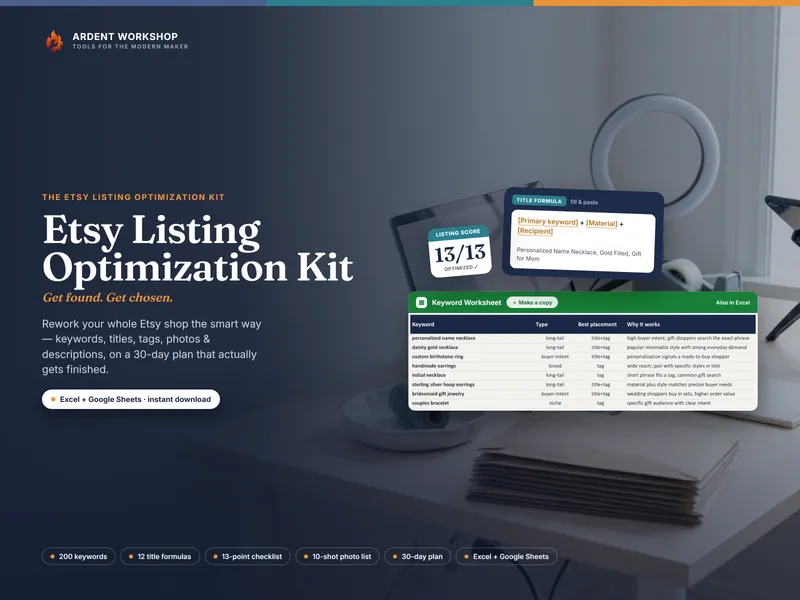
Optimizing multiple listings manually can be overwhelming. That’s where the Etsy SEO Tool from Ardent Workshop comes in - a powerful Excel-based template designed to simplify your SEO workflow.
Here’s what makes it a game-changer:
- Centralized Keyword Tracker: Easily track keywords across all your listings in one place.
- SEO Scores: Using a custom algorithm, the tool provides both tag-specific SEO scores and a consolidated SEO score for your products and shop, so you can make informed decisions that set you apart from competitors.
- Validation: This tool helps you validate your listing titles, descriptions, and tags in full compliance with Etsy’s current rules.
- Competitor Analysis Tools: See how your listings stack up against similar products in your niche.
- User-Friendly Interface: No tech skills required - just plug in your data and start optimizing.
This tool is perfect for sellers who want a structured, repeatable SEO process without subscribing to expensive monthly services.
It also solves the record-keeping problem from the section above. The reason most sellers can’t tell whether their SEO works isn’t that the data is hidden — it’s that they never wrote down what they changed or when. A tracker turns a year of guessing into a year of evidence.
Final Thoughts
SEO is not a one-time task - it’s an ongoing process that can dramatically improve your visibility and sales on Etsy. By investing time into keyword research, listing optimization, and performance tracking, you’ll set your shop up for long-term success.
If you take one thing from this post, take the two-stage model. Ask whether your problem is that buyers never see your listing, or that they see it and scroll past. Keywords fix the first. Photos, price, reviews, and description fix the second. Almost every wasted hour in Etsy SEO comes from applying one to the other.
And with tools like the Ardent Workshop Etsy SEO Tool, Etsy SEO doesn’t have to be complicated. With everything organized in a single, intuitive Excel file, you can work smarter—not harder—on making your listings stand out.
Ready to take your Etsy shop to the next level? Check out the Ardent Workshop Etsy SEO Tool and start optimizing with confidence.