You are forty episodes into a C-drama and you have no honest idea how many are left.
The C-Drama & Donghua Tracker is a seven-tab Excel and Google Sheets workbook that computes the hours left in every Chinese drama and donghua (Chinese animation) you are watching, ranks them into an Up Next queue closest-to-done first, and ships a built-in wuxia, xianxia and xuanhuan genre guide with a 14-term glossary. It is an episode tracker that answers the question a plain watchlist cannot: how much is actually still ahead of you.
Because that is the question these series raise. Not what you have watched — how much is left, and whether you can finish it before the next thing starts. A C-drama is not an eight-episode season. It is forty, fifty, sixty episodes at three quarters of an hour each, which is a real fraction of a year. Donghua runs shorter per episode and drips out a couple a week for months, so it sits open on your list far longer.
This workbook does the arithmetic you have never once sat down and done. Want to try it first? The free C-Drama / Donghua watchlist starter is a single tab that computes the hours left — a real taste of the engine, no signup.
How many hours are left in what you’re watching?
Tell it three things about a series — how many episodes it has, how many you have watched, and how long an episode runs — and it computes your progress and, more usefully, the hours left to finish it.
Then it does the thing a list cannot. The Up Next tab takes what you are actively watching and ranks it by how few hours remain, so the row at the top is the one you could finish soonest — it shows your nearest twelve, and the total underneath counts them all. There is nothing to type on that tab; it reads straight from your catalog and reorders itself the moment you update an episode count. That total is either motivating or sobering, depending on the week.
That total is the number this workbook exists to produce, and it is the answer to “can I start something new?”
Wuxia, xianxia, xuanhuan — settled
The labels on Chinese drama and donghua are genuinely confusing, and almost nobody stops to explain them. Wuxia and xianxia are not the same thing. Xuanhuan is neither. Guzhuang tells you about the costumes and nothing about the plot — and a streaming platform will happily file all four under “fantasy” and leave you to work it out.
So there is a genre guide built into the workbook, and a printable copy in the download. Ten genres — wuxia, xianxia, xuanhuan, historical/guzhuang, palace and court intrigue, republican era, danmei-adapted, transmigration, cultivation and mythology — each with its Chinese name, what marks it out, where it is set, and the tell: the single question that decides which one you are actually watching. Here are four of the ten, as they appear in the file:
| Genre | Chinese | Where it’s set | The tell |
|---|---|---|---|
| Wuxia | 武侠 | A quasi-historical jianghu — inns, bamboo forests, the outlaw world of martial artists | The hero’s power came from a decade in a training hall, not from heaven |
| Xianxia | 仙侠 | Mortal, demon and heavenly realms — often all three | Someone flies unaided, ascends, or survives divine lightning |
| Xuanhuan | 玄幻 | An invented world, not a mythic version of China | It feels like xianxia, but the cosmology is homemade rather than inherited |
| Historical / Guzhuang | 古装 | A named dynasty, or a deliberately unnamed “ancient” one | If someone calls a show guzhuang, they’ve told you the wardrobe, not the plot |
Underneath the guide, a fourteen-term glossary of the vocabulary the subtitles never define — jianghu, shizun, qi, tribulation, ascension, rebirth, CP.
These are conventions, not rules. A series can sit in two at once, and the marketing will call a xianxia a wuxia if it thinks that sells better. The guide gives you the tells so you can trust what you are watching over what the banner says.
Your taste, counted
Rate what you finish across five lanes — Story, Cast, Visuals, Music and Pacing — and the workbook averages them into your own score. A single star rating flattens a fifty-episode drama; five smaller questions are easier to answer and tell you more later. Pacing is usually where the honest score drops.
Log what the critics said on the Critic Ratings tab — a score from Douban, MyDramaList, IMDb, Bilibili or anywhere else, with the scale it used — and the workbook turns each into a percent and shows the average next to yours on your catalog. The gap between those two columns is the most useful thing you will learn about your own taste: the series you loved that nobody rated, and the acclaimed one that left you cold.
The Dashboard reads all of it back to you — series tracked, completed, watching now, episodes and hours watched, the hours left in what you’re watching, your top genres ranked by what you actually watched rather than what you would claim, and your top five beside the critics’. Every number calculates itself.
What you get
A seven-tab workbook that opens in Excel, Google Sheets and LibreOffice Calc — and if Sheets is your home, a one-click “Make a copy” link, already set up and tested, with no import to do. Alongside it: a Start Here guide that teaches the method in about five minutes, the printable genre guide, and a print-and-fill watchlist for the days you would rather hold a pen.
It opens on a worked example so you can see it working, and you clear that out when you are ready for your own. Cells you type into are light-orange and cells that calculate are pale-teal — and every tab also names its calculated columns in writing, so the distinction never depends on seeing the colors.
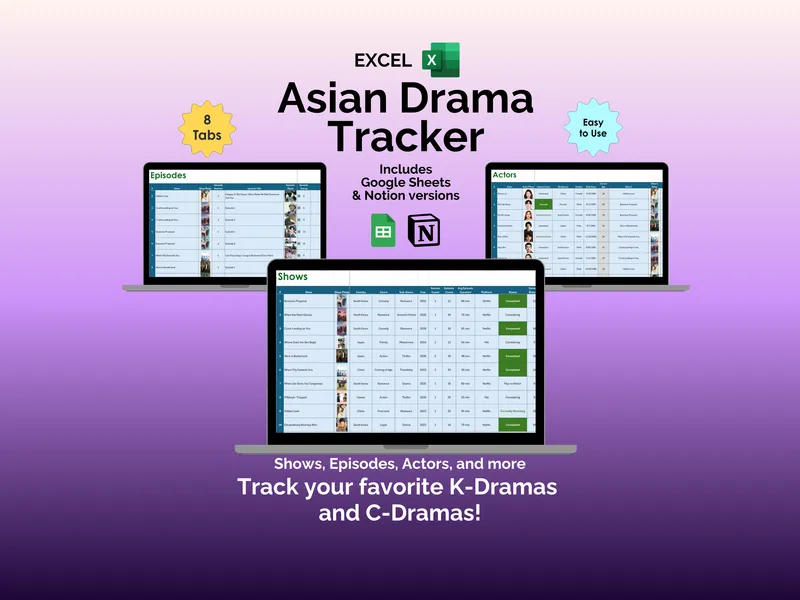
Already have the Asian Drama Tracker? That one spans K-drama and C-drama as a straightforward watchlist with actors and a journal. This one goes deeper on Chinese series specifically: it is the one with the hours-left engine, the self-ranking Up Next queue, and the wuxia/xianxia genre guide. If you watch across both countries, they sit happily side by side.
Own it, don’t rent it
No account. No subscription. No app deciding what to show you, and no list trapped inside someone else’s walls. It is a file you keep — on your own computer or in your own Drive — that will still open in ten years, long after a platform has quietly dropped the series you were halfway through.
A note on what this is: a personal watch log, not professional or purchasing advice. The example catalog is fictional and illustrative — every series title, rating and critic score in it was invented to show the workbook in use, and is not a real production, a real review, or a real person’s opinion. Series titles, studio names, streaming-platform names, and review-site names belong to their owners; this product is not affiliated with or endorsed by any studio, platform, or review site.