Normal wear and tear vs. damage: the two questions that separate them
In practice the argument reduces to two questions, and it is worth holding them apart because they need different answers.
- Would this have happened anyway, to a careful tenant, over this length of time? This is about the nature of the item. Carpet, paint, caulk, grout, blinds, cabinet hinges, and flooring all deteriorate with use no matter who lives there. A countertop, a window, a door, and an appliance drawer do not wear out from being looked at — when those are broken, something happened.
- Can either of us show what it looked like before? This is about the record, and it decides who carries the argument. An item that declined and was never photographed on day one is not really a dispute about wear at all; it is a dispute about who caused it.
How long you lived there changes what counts as normal wear and tear
Wear is a function of use and of duration, which is why the same observation means different things after different tenancies. One step of decline in a carpet after six months invites a question. The same decline after three years mostly does not. A useful working rule when you are filling in your own record: ask whether the length of your tenancy makes the change unsurprising — and note that many jurisdictions apply a published useful-life schedule to the item rather than a rule of thumb.
A related idea appears in many jurisdictions under the name depreciation or useful life: even where a deduction is legitimate, a landlord may not be entitled to charge the full price of a brand-new item to replace one that was already part-worn. Whether and how that applies is jurisdiction-specific and worth looking up before you accept a replacement-cost charge.
Normal wear and tear vs. damage, item by item
The table below is not a statement of law and it is not advice — it is a map of how these items are commonly argued about, so you know which side of the line a given row of your own record is likely to sit on.
| The item | Usually argued as ordinary wear | Usually argued as damage |
|---|---|---|
| Carpet | Matting in traffic paths; general dulling; light soiling after a long tenancy | Burns, pet stains soaked through to the pad, tears, bleach marks |
| Wall paint | Fading; light scuffing; small nail holes where the lease allows them | Crayon and marker; large gouges; unapproved colors; holes left by anchors and mounts |
| Hard flooring | A dulled finish; light scratching in walkways | Deep gouges; water damage and cupping; pet scratching at doors |
| Bathroom caulk and grout | Discoloration, shrinking, and mildew over time | Caulk removed and not replaced; tiles loose because grout was scrubbed out |
| Countertops | Very light surface scratching on a laminate top | Burns, chips, deep knife scoring, delamination at the sink |
| Blinds | Yellowing and slight warping from sun and time | Snapped slats; a broken mechanism; a set removed and not returned |
| Doors and hardware | Finish wear near handles; hinges loosening | Holes; a door off its hinges; a lock changed without permission |
| Keys, fobs, and remotes | Nothing — these do not wear | Any that are not returned |
| Cleanliness | Ordinary living dust between cleans | A unit handed back dirty; food or trash left behind |
The same thing settles every row on that table
In every row above, the thing that resolves the argument is the same: a dated photograph of that item taken on the day the tenancy started, and a matching one taken at handover. Same room, same angle, same distance. Matching pairs are what persuade — a careful move-in set paired with four hurried snaps taken while a van is double-parked outside is not a comparison, it is two unrelated collections.
Two habits matter most for this table specifically. Photograph the caulk and grout along their whole length, because those are the rows that decline quietly. And photograph the items that are already worn on day one, because pre-existing and documented is the strongest position there is. The rest of the method — the day-one walk, what to write beside each item, the move-out comparison, and answering a deduction statement — is set out in how to document a rental to protect your deposit.
Whatever you write it in, keep the record to conditions, dates, and photo references — no account numbers, no policy numbers, no logins, no door or alarm codes — since it is a file you may end up handing to a landlord, a mediator, or a small-claims clerk. Keep it somewhere you will still have it after the tenancy ends, too: that is the argument for a file you own rather than a rental-management app you are given an account on.
Where the wear-and-tear rule actually comes from
Which deductions are permitted, how wear and tear is defined in your jurisdiction, whether depreciation applies, and what a landlord must itemize are set by state law — sometimes city ordinance — and by your lease. They differ enormously and they change. Your state or city housing agency, your state attorney general's consumer division, and local tenants' rights organizations publish the applicable rules, usually for free, and are the right place to check before you accept or dispute a charge — USAGov's tenant-rights and landlord-complaint page (opens in new tab) is a reasonable place to find the agency that covers your state. See also what a security deposit is.
Make the record while it is still free to make
The free Move-In Condition Checklist covers 28 checks, room by room, with a box for the condition and a box for whether you photographed it, and a worked example so you can see what a useful entry looks like. No email, no signup. The Renter's Home Records & Deposit-Protection Binder carries all 70 checks and scores them again on the way out, so each row gets a verdict rather than a note. More records and letters for tenants are on the templates for renters page.
This page is general information about how the wear-and-tear distinction is commonly understood. It is not legal advice and does not state the rule in any particular jurisdiction.
Templates that implement this
Tools that make the distinction provable
2 templates
Knowing the distinction does not help unless you can show which side a given item was on when you arrived. A binder that scores the unit at both ends and compares them.
- $21.95 Spreadsheet
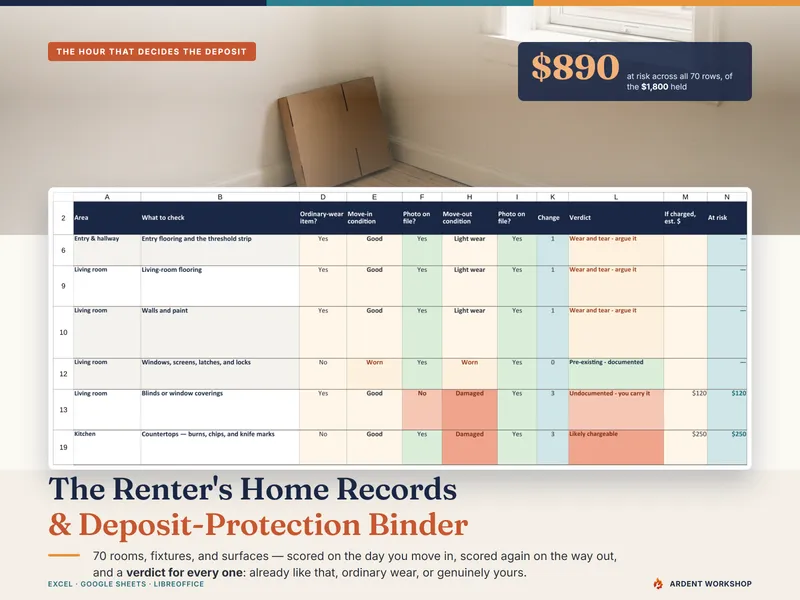
Renter's Home Records & Deposit-Protection Binder — a 70-Row Move-In / Move-Out Condition Log That Scores Both Ends, a Notice-to-Vacate Countdown, and a Deposit Worksheet (Excel + Google Sheets)
Score 70 things on move-in day and again on the way out. The binder compares them and shows what your own record has as pre-existing, wear, or at risk.
Life AdminView details - $19.95 Spreadsheet

Home Maintenance & Warranty Log — Appliance Warranty Tracker, Repair Log & Seasonal Home Maintenance Checklist (Excel + Google Sheets)
Track every appliance warranty, repair, and seasonal task in one spreadsheet you own — type a purchase date and it flags what's still under warranty.
Life AdminView details