The short version: eight steps
- Read three numbers out of your lease — the deposit, your notice period, and (from your state) the return deadline.
- Photograph the unit before a single box comes in. Video first, then wide, then close. Floors low, from two corners, in daylight.
- Score every item, including the ones that are fine — and record whether a dated photograph exists for each.
- Send the record to the landlord and keep proof that you sent it.
- Keep the tenancy in writing as it happens — repairs, payments, notices.
- Walk the unit again two weeks before you leave, same rows, same angles.
- Close out the handover on paper — clean photos, key count, meters, forwarding address.
- Answer any deduction statement line by line, conceding what you owe and disputing the rest with dated evidence.
Why day one decides it
A security deposit is your money, held by the landlord against a narrow set of claims — and at the end of a tenancy those claims are settled by evidence rather than by recollection. The window for a useful photo set is short and it does not come back. Once your things are in, the floor is half covered, the baseboards are behind furniture, the walls are behind shelves, and the one photograph you will wish you had — the wide, boring, empty shot of a room with nothing in it — is no longer available at any price.
That is the practical reason the order matters. It is also why the habit that feels most excessive at the time turns out to be the important one: photographing the rows where the answer is good. Nobody argues about those on day one. They argue about them fourteen months later, when a wall that was fine has a scuff on it and there is no record of what it looked like before.
What “documented” actually means
There is a difference between recording a condition and being able to prove one, and it is worth being precise about it because it is where most deposits leak.
- Recorded means you wrote “light wear” beside an item. Useful for your own memory. Almost worthless in a dispute.
- Documented means there is a dated photograph of that specific item, in its room, taken before you occupied the place, and you still have the original file.
The difference shows up at move-out as two very different sentences. “The bathroom caulk was already discolored when I moved in” is a claim. “The bathroom caulk was already discolored when I moved in, here is the photograph, taken on the fourteenth” is a fact. The first invites a negotiation; the second is much harder to argue with.
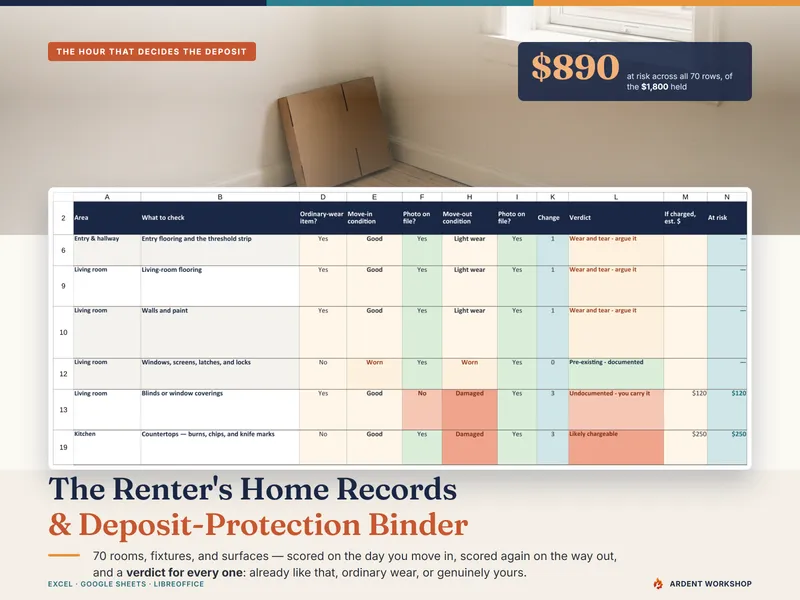
This is also why the photo column deserves its own place in whatever you use to record all this. A row that declined and was never photographed is not really a dispute about wear at all — it is a dispute about who caused it, and without a picture you are the one carrying it. The free Move-In Condition Checklist is that column on paper, if you want somewhere to start before you read the rest.
Photographs that are actually worth something
Seven habits separate a set that settles an argument from one that does not, and none of them takes extra time.
- One continuous walkthrough video first. Ten to fifteen minutes, narrating what you see, opening every door, running every faucet, testing every lock and every fan. A still photograph cannot show that a window latch did not catch on day one; eleven seconds of video can.
- Wide first, then close. One frame that establishes the whole room, then the detail. A close-up of a scratch with no context does not prove which room it was in — and which room it was in is exactly what gets argued about.
- Floors low, from two opposite corners, in daylight. Raking light along a surface shows scratches, matting, and traffic paths a flat photograph will not.
- Keep the original files. Do not screenshot, crop-and-resave, or send through anything that strips metadata. The date is most of the value. Those originals also carry location and device details alongside the date — no matter to the landlord, who knows the address, but keep the originals to yourself rather than posting them publicly.
- Photograph the keys — the count, not the cuts. Lay every key, fob, remote, and mailbox key out and photograph them with the count visible, blade-down or overlapping. Unreturned keys are a common deduction and a hard one to argue, because the count is nobody’s memory; a key’s cuts, though, can be copied from a clear photograph, and this is a picture you may end up sending to someone.
- Photograph the meters. Every utility dial, on the day you take possession. It settles the first bill argument in about ten seconds.
- Back it up the same week. One copy is not a copy. A phone is a single point of failure holding the only proof of what an apartment looked like before you lived in it.
One standing rule keeps the whole record safe to hand over: keep it to conditions, dates, and photo references, and write no account numbers, no policy numbers, no logins, and no door or alarm codes into it. This is a file you may end up emailing to a landlord, a mediator, or a small-claims clerk, and it should be safe to send as it stands. The same applies to the mid-tenancy photographs, which — unlike the day-one and move-out sets — are taken in an occupied home: frame the fault, not the room, and keep mail, screens, documents, and people out of shot.
Ordinary wear, damage, and the line between them
Most of what gets argued about at move-out is one question in different clothes: would this have happened anyway? Normal wear and tear is the shorthand for “yes, to any careful tenant, over this length of time,” and it is generally the landlord’s cost rather than yours. Damage is the shorthand for “no, something happened here.”
Two things decide which side a given item falls on.
The nature of the item
Carpet, paint, caulk, grout, blinds, cabinet hinges, and flooring deteriorate with use no matter who lives there. A countertop, a window, a door, and an appliance drawer do not wear out from being looked at. The item-by-item table — carpet, paint, hard flooring, caulk, countertops, blinds, doors, keys, cleanliness — is on normal wear and tear.
How long you lived there
Wear is a function of time as well as use. One step of decline in a carpet after six months invites a question; the same decline after three years mostly does not. When you are judging your own record, ask whether the length of your tenancy makes the change unsurprising.
Where exactly the line falls is set by your state, sometimes your city, and your lease — this guide cannot tell you, and any page that states a rule as universal is wrong for most of its readers. What it can tell you is which rows to photograph hardest: the ones where the answer will turn on what the item looked like before.
The move-out walk, done early
The comparison only works if the two halves are comparable. A careful move-in set paired with four hurried snaps taken while a van is double-parked outside is not a comparison; it is two unrelated collections. Same rows, same order, same angles.
Do it about two weeks out rather than on the day. The rows it flags as probably-yours are, at that point, still things you can do something about — and replacing a cracked slat, refitting a screen, patching two anchor holes, and having the carpet cleaned are things you can fix yourself at your own price, rather than at whatever a contractor bills the landlord — which is what turns up on the statement. This is the highest-return half hour in the second half of a tenancy.
Answering a deduction statement
If a statement arrives and you disagree with it, the shape of a good reply is the same every time.
Open with the facts: the address, the tenancy dates, the deposit amount, the date you handed over keys, and the forwarding address you gave. Then concede what you concede — go through their statement line by line and accept the charges your own record says are genuinely yours. This is not weakness. A letter that concedes four honest lines is far harder to dismiss than one that concedes none, and it makes the lines you do dispute read as considered rather than reflexive.
Dispute the rest with evidence rather than adjectives. For each line, name the photograph, the date it was taken, and what it shows. State the figure you believe is owed, give a reasonable date to respond by, and say plainly what you will do next. Naming small-claims court as a next step is ordinary and expected, and those courts are generally designed to be used without a lawyer. A written demand that names dates and photographs gives a landlord a reason to answer before it gets that far. Send it in a way that produces proof of delivery, and keep a copy.
Before you send anything, look up your own state’s return deadline, whether an itemized statement is required, and what the penalty is when a landlord misses it. Several states provide real consequences, and knowing whether yours is one of them changes the letter.
Two things worth doing on your very next lease
If you are reading this in the middle of a tenancy rather than at the start of one, the most useful thing you can take away is a number: how many items would be at risk purely because nobody photographed them. Every one of those was an hour of work at the beginning that nobody had time for, and the only place it can be changed is at the start.
The second is to keep the record somewhere you will still have it. The landlord’s portal holds the landlord’s version of your tenancy, and access to it commonly ends the day the tenancy does — usually just before you would like to look something up. Keep your own copy of the photographs, the sent repair requests, the payment confirmations, and the condition record, in a file you control. That trade-off is the whole of a renter’s binder vs. a rental-management app.
The free Move-In Condition Checklist is a printable place to start — 28 checks, room by room, with a worked example. No email, no signup. More records and letters for tenants are on the templates for renters page.