
Loop scheduling, defined
Loop scheduling is a rotation. Rather than assigning each subject to a weekday, you put the subjects in a list and decide how many of them fit in a school day. Each day the child does the next ones in line, and when the list ends it starts over. The Homeschool Year Planner calls that number Loop subjects per day, and it is set per child.
Fixed days vs loop
In the planner, every course has a Schedule of either Fixed days or Loop. Neither is better. They suit different kinds of subjects, and you can mix both: you are not choosing a style for the whole family, just a schedule for each course.
- Fixed days — the course meets on specific weekdays: math every school day, or science on Tuesday and Thursday. Lessons run one after another on those days. If a Tuesday falls in a break, that meeting is skipped and the sequence moves on to the next Thursday.
- Loop — the course sits in a rotation with other loop courses. It has no weekday. Its turn comes when the rotation reaches it.
Breaks, holidays and no-school days are skipped by both kinds.
Loop subjects per day
The one setting that shapes a loop is how many loop subjects the child does each school day. With 2 loop subjects per day, the child does the next two in the rotation, then the next two the following day. With L loop slots per day and K loop courses, each course gets about L ÷ K turns per school day while all K are in the rotation. That is how you tell whether a loop is too thin or too crowded: add courses and each one comes up less often; add slots and each comes up more.
A worked rotation
Say a child has Art, Music, Poetry, Geography and Nature Study on loop, at 2 loop subjects per day. The rotation runs like this:
- School day 1: Art, Music
- School day 2: Poetry, Geography
- School day 3: Nature Study, Art
- School day 4: Music, Poetry
- School day 5: Geography, Nature Study
- School day 6: Art, Music, and the loop starts over
The math: 2 slots a day ÷ 5 courses = 0.4 turns per course per school day, so each course comes up every 2.5 school days, which is 2 turns each over a five-day week (10 slots across 5 courses). Nobody had to decide that Poetry belongs on Thursday.
What happens on a sick day
A sick day does not mean Poetry was missed. If the child is sick the day after school day 1, the rotation simply waits: Poetry and Geography are still the next two in line, so they are what the child does when school resumes. The subject just comes around again, which is why loops are forgiving. A fixed-days course is tied to its weekdays instead: once the day is marked No school, its next lesson moves to the course's next meeting. If the sick day was a Tuesday, in a Tuesday-and-Thursday science course the Tuesday lesson lands on Thursday.
When a loop course finishes
When a loop course reaches its last lesson, it leaves the rotation. The others come around sooner. In the example above, if Art finishes, four courses share 2 slots a day, so each comes up about every 2 school days (2 ÷ 4 = 0.5 turns per course per day), roughly two and a half times in a five-day week instead of two.
Which subjects suit which
- Math, phonics, a language (sequential skill building) — Fixed days, because each lesson depends on the last.
- A weekly lab, class or co-op — Fixed days, because it meets on set days.
- Read-alouds and literature — Loop, because the order is flexible.
- Art, music, crafts, picture study — Loop: regular exposure, not a weekday.
- Nature study, geography, poetry — Loop: short and repeatable.
- A short unit with a hard end date — Fixed days, with a start date (the planner's "Begins on" field).
How the planner does it
In the Homeschool Year Planner, you pick Fixed days or Loop on each course row, set Loop subjects per day for each child, and the schedule is laid out against your real calendar with breaks, holidays and no-school days skipped. It covers up to 5 children and 40 courses, in Excel and Google Sheets, with printable weekly pages. It is a file your family keeps, not a subscription planner you rent month to month.
Pacing a fixed-days course first
If you only need to know whether one course on fixed school days will finish in time, the free Homeschool Curriculum Pacing Calculator takes a lesson count, start lesson, school-days-per-week pattern, start date and breaks, then shows the school days available, lessons per week needed and planned finish date, and whether that fits before a last day. It handles one child and one course on fixed days; it does not do loops. For the arithmetic by hand, with a worked example, see how many lessons a week you need to finish a curriculum.
Where to go next
Loop scheduling plans the year ahead. A record of what actually happened is a different job: see what a homeschool portfolio review is, and the Homeschool Portfolio, Attendance & Transcript Records Binder, which proves the year after the fact while the planner plans it ahead. Or browse every template for homeschool families.
Templates that implement this
Schedule loops and fixed days in one file
2 templates
A workbook that gives every course a Fixed days or Loop schedule, skips breaks and no-school days for both, and shows the planned finish date for up to 5 children and 40 courses. Excel and Google Sheets, plus printable weekly pages, and a file your family keeps.
- $12.95 Spreadsheet
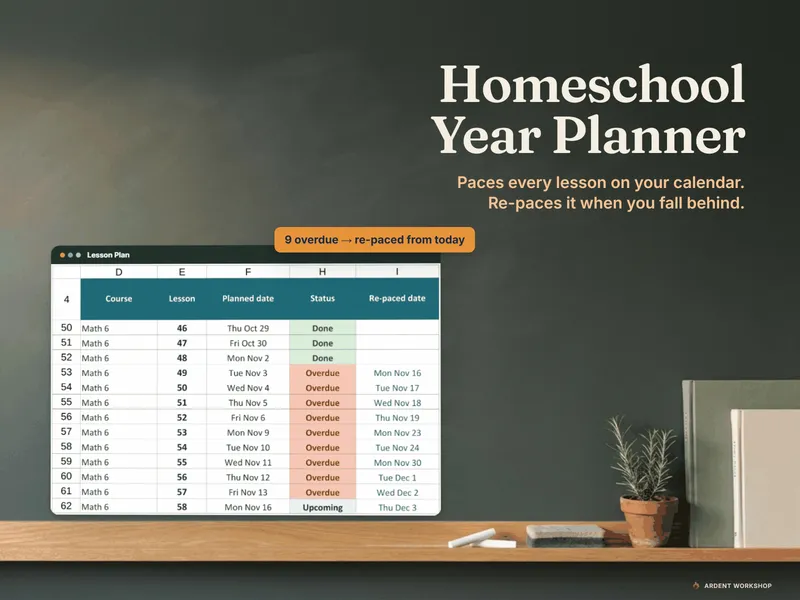
Homeschool Year Planner — Pace Every Lesson on Your School Calendar, Re-Pace When You Fall Behind (Excel + Google Sheets)
A homeschool planner for Excel & Google Sheets that paces every lesson across your real school calendar and re-paces what's left when you fall behind.
Life AdminView details - $19.95 Spreadsheet
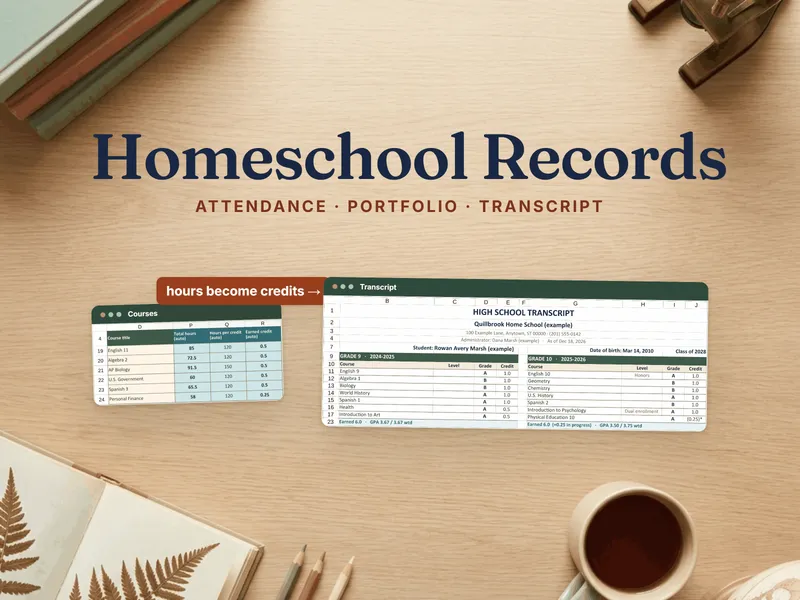
Homeschool Portfolio, Attendance & Transcript Records Binder — Hours to Credits, GPA, Transcript & Portfolio for Every Child (Excel + Google Sheets)
A homeschool records workbook for Excel & Google Sheets — attendance, hours, portfolio and a one-page transcript, with logged hours turned into credits.
Life AdminView details
Frequently asked questions
- What is the difference between loop scheduling and fixed days?
- A fixed-days course meets on specific weekdays, such as math every school day or science on Tuesday and Thursday, and its lessons run one after another on those days. A loop course has no weekday: it sits in a rotation, and each school day the child does the next few subjects in line, then the rotation keeps going.
- What happens to a loop when someone is sick?
- Nothing is missed. Because no subject is tied to a weekday, a sick day does not mean Poetry was skipped; it simply comes around again in the rotation. Breaks, holidays and no-school days are skipped by both loop and fixed-days courses.
- Which subjects suit a loop?
- Subjects you want to touch regularly without a fixed order: read-alouds and literature, art, music, crafts, picture study, nature study, geography and poetry. Sequential skill building such as math, phonics or a language is better on fixed days, because each lesson depends on the last.
- How often does each subject come up in a loop?
- With L loop slots per school day and K courses in the rotation, each course gets about L divided by K turns per school day. Two slots a day across four loop courses is about one turn every two school days, or roughly two and a half times in a five-day week.
- Can I use loops for some subjects and fixed days for others?
- Yes. You are not choosing a style for the whole family, just a schedule for each course. Math can run on fixed days while art, music and poetry share a loop.