
The definition and the formula
Billable utilization is the share of paid hours that are also billable hours:
- Billable utilization = billable hours ÷ paid hours. A crew paid for 240 hours in a week that bills 168.5 of them is running at 168.5 ÷ 240 = 70.2%.
"Paid" is every hour that shows up on payroll — regular time, and any non-billable time you still pay for. "Billable" is only the hours that land on a customer's invoice. Every hour that's paid but not billable pulls the percentage down, and it's a bigger category than most pricing spreadsheets assume.
What actually eats the hours
None of this is waste, exactly — it's the paid time that never touches an invoice, and for a trades or service crew it's specific and recurring:
- Toolbox talks and safety meetings. Required, and paid, and never billed to the customer whose job wasn't being worked on during them.
- Apprentice classroom and related-instruction time. A registered apprentice's class day is a legal requirement of the program, not a scheduling choice — and it's paid, unbillable time.
- Drive time between jobs and to the supply house. The truck doesn't bill by the mile, but the driver is on the clock.
- Shop and yard time — loading, staging, equipment maintenance, the hour spent finding the right fitting.
- Rework. Fixing a callback or a mistake is paid labor that (if you're pricing honestly) doesn't get billed twice.
- Waiting on a supplier, an inspector, or another trade to clear the space before yours can start.
Why it multiplies through every price
Utilization doesn't just shave a little off the crew's output — it's a divisor sitting underneath the rate you charge for every hour of labor on every job:
- Burdened cost per billable hour = wage × (1 + payroll burden) ÷ utilization. The wage and burden set what an hour costs you; utilization decides how many billable hours are left to spread that cost across.
Work it through: a $28/hr wage with a 25% payroll burden (taxes, workers' comp, benefits) costs $28 × 1.25 = $35.00 per paid hour. At a genuine 70% utilization, that's $35.00 ÷ 0.70 = $50.00 per billable hour before overhead or profit are even added. Price the same crew as if it ran 80% instead — a ten-point error that's easy to type into a field without checking — and the rate comes out $35.00 ÷ 0.80 = $43.75. That's $6.25 less on every billable hour, or 12.5% under-recovered on every invoice, forever, until someone re-measures the number.
Run your own crew's numbers with the free Billable-Hour Check — it takes one real week of paid and billable hours and returns the percentage, so you're not typing in a guess.
Utilization is not productivity, and low isn't lazy
It's tempting to read a low number as a crew that isn't working hard enough. That's usually the wrong read. A toolbox talk is a safety control, not slack. An apprentice's class day is required by the program they're enrolled in, not a choice either of you made this week. A technician driving between three service calls is doing exactly what the schedule asked.
Utilization measures how paid time gets allocated, not how hard anyone worked while they had a wrench in hand — that's a separate question, closer to productivity or efficiency. The lever that actually moves utilization is usually routing and scheduling — tighter job clustering, fewer supply-house trips, better sequencing with other trades — not asking people to work faster.
How to measure it instead of estimating it
The fastest way to this number is also the least reliable: guess, or reuse a figure someone quoted you once. Measuring it takes one real week:
- Pick one real week, not a typical one. A representative week beats an idealized one — include the drive time, the toolbox talk, the supplier wait that actually happened.
- Take paid hours from payroll or the schedule. That's the denominator — every hour anyone was paid for, billable or not.
- Subtract the non-billable hours you already log somewhere. Safety-meeting sign-in sheets, the apprentice program's hour log, route or timesheet notes on drive time and shop time — most crews are already recording these pieces separately without ever subtracting them from paid hours to get a rate.
What's left, divided by paid hours, is a measured utilization rate for that week — not a guess borrowed from somewhere else.
What counts as "good" depends on the trade
There isn't one right number. A service-call electrician running short hops between calls, a remodeling crew parked on one job site all week, and a shop carrying a first-year apprentice will land in different places, and reasonably so. Treat any band you see quoted for this metric — including anywhere else on this site — as a rule of thumb to sanity-check your own measured number against, not a published benchmark to price against directly. The number that should set your rate is the one you measured from your own week.
Related templates and concepts
Billable utilization feeds directly into flat-rate pricing, where it's one of the inputs to the billable rate every menu task is priced from, and it sits alongside bid markup as one of the numbers a defensible price depends on. Browse every tool built for the trades on the templates for contractors and templates for service trades hubs.
Templates that implement this
Tools that price labor from hours already logged
3 templates
The Trades & Service Business Bundle derives billable utilization from hours you're already logging across four separate files — timesheets, the schedule, safety records, apprentice hours — instead of asking you to guess it. The pricing book and estimating workbook then take the resulting rate and turn it into flat-rate tasks and defensible bids.
- $69.00 Bundle

Trades & Service-Business Bundle — 7-Product Contractor Toolkit: Estimating, Flat-Rate Pricing, Crew Scheduling, Safety and Apprentice Records, Client Paperwork (Excel + Google Sheets)
Seven trades and contractor products in one bundle, plus a Control Panel for Excel or Google Sheets that works out what a billable crew hour costs.
Operator OSView details - $29.95 Spreadsheet
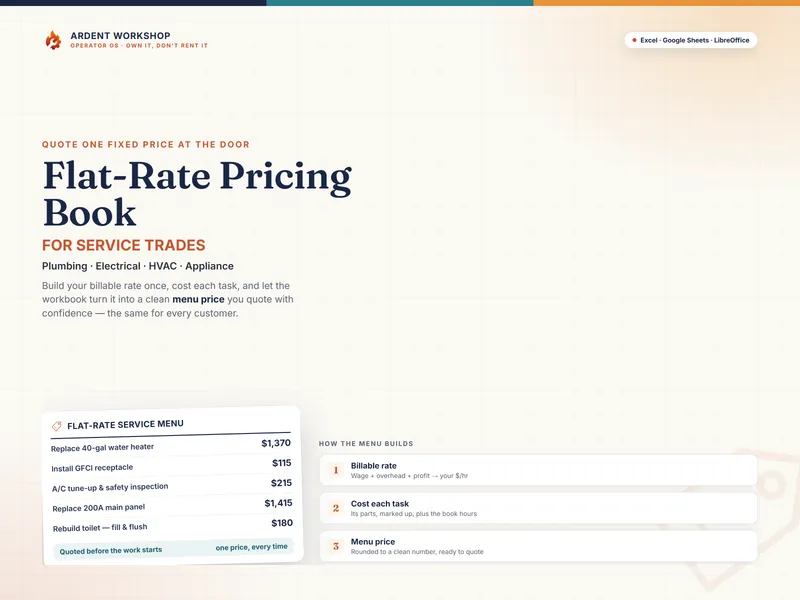
Flat-Rate Pricing Book for Service Trades — Plumbing, Electrical, HVAC & Appliance Price Book, Billable Rate & Markup Calculator (Excel + Google Sheets)
Flat-rate price book for service trades — set your billable rate, cost each task, and build a clean menu for plumbing, electrical, HVAC & appliance work.
Operator OSView details - $14.95 Spreadsheet
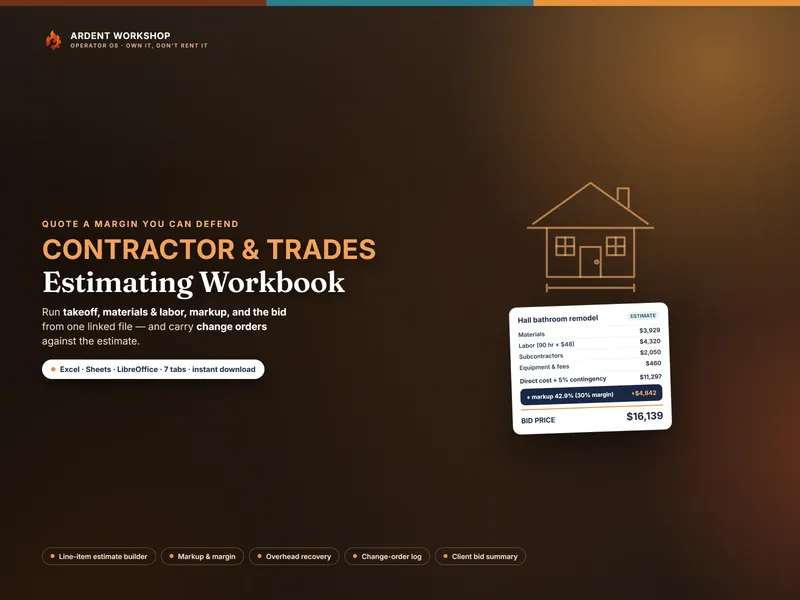
Contractor & Trades Estimating Workbook — Construction Job Costing, Bid Markup & Margin, Overhead & Change Orders (Excel + Google Sheets)
A contractor estimating workbook for Excel & Google Sheets — line-item job costing, bid markup vs margin, overhead, and change orders in one file.
Operator OSView details