The phases depend on the clinical question
MedlinePlus describes elimination and reintroduction as possible parts of food-allergy assessment. Suspected foods are removed, then added back individually when the clinician considers it appropriate. The foods, duration and setting depend on the person and condition; this page does not prescribe a schedule.
Reintroduction is not always a home experiment
Improvement during elimination does not prove a food allergy. The NIAID-sponsored guideline, section 4.2.2.8 explains the need for clinical interpretation and, in some cases, further testing. An oral food challenge requires trained healthcare staff and a facility equipped to treat severe reactions. Do not deliberately retry a suspected allergen at home to fill in a journal.
MedlinePlus's safety guidance warns that elimination testing may be unsafe after a serious food reaction. Breathing difficulty, throat swelling or fainting can signal anaphylaxis: call 911 in the U.S. rather than waiting to log the event.
What a diary can show
Record meal ingredients, amounts if known, times, symptoms and uneventful meals. Keep observations separate from interpretations. “Pain started at 2pm” records an event; “wheat caused it” makes a claim the diary alone cannot establish. A count of symptoms after a food is a descriptive calculation, not the probability that you are allergic to it.
Foods eaten together cannot be separated by counting alone. A clinician can decide what further assessment is useful; avoid turning an adjustable reaction window into a diagnostic threshold.
Check the plan before restricting foods
The NIAID-sponsored guideline, section 4.2.2.7 notes nutritional risks from prolonged elimination of multiple foods. Ask a clinician or dietitian how nutritional needs will be met.
For suspected celiac disease, NIDDK advises against starting a gluten-free diet before diagnostic testing, because it can affect results. Ask about testing before changing gluten intake.
How to keep the records
The free Food & Symptom Log starter is a one-page printable for pairing what you ate with how you felt — a good first step, already filled in with a worked example. The full Food & Symptom / Elimination-Diet Journal adds the counting: you set a reaction window in hours, and it checks every meal against every symptom, ranks your watched foods by how often a symptom followed one, and runs the phases with computed dates and a reintroduction log that checks for the reaction itself. For the practical side, see how to keep a food and symptom diary, or weigh a spreadsheet against a food-diary app. General information for organizing your own records — not medical or dietary advice.
Templates that implement this
Run the phases and keep the records
3 templates
A journal that checks every meal against your symptom log inside a reaction window you set, ranks your watched foods by how often a symptom followed, and runs the elimination phases and reintroductions with real dates — a record you own.
- $13.95 Spreadsheet

Food & Symptom Journal — Elimination-Diet Tracker That Ranks Your Trigger Suspects & Makes a Doctor-Ready Summary (Excel + Google Sheets)
A food and symptom journal that ranks your watched foods by how often a symptom followed a meal containing them. Excel & Google Sheets.
Life AdminView details - $18.95 Spreadsheet
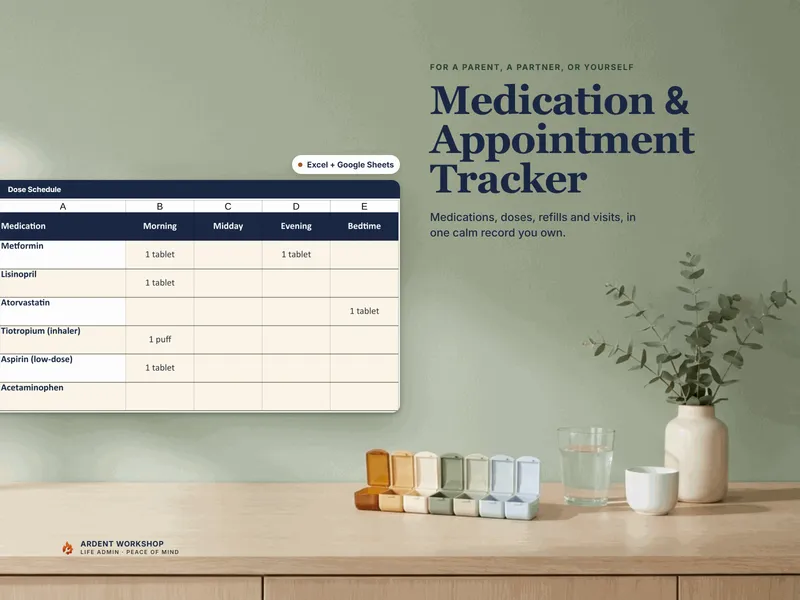
Medication & Appointment Tracker — Medication List, Dose Schedule, Refill & Appointment Organizer (Excel + Google Sheets)
A medication and appointment tracker to organize medications, doses, refills, and upcoming appointments in one file you own (Excel + Google Sheets).
Life AdminView details - $12.95 Spreadsheet

Blood-Sugar / Diabetes Log — Glucose Tracker with Auto In-Range Flags, A1C Trend & Doctor Summary (Excel + Google Sheets)
A downloadable Excel and Google Sheets recordkeeping template for logging glucose readings, tracking A1C records and preparing a summary for appointments. This is a digital spreadsheet, not medication or a medical device. Targets are entered by the user with their care team.
Life AdminView details