
A training package is prepaid sessions with an end date
Personal trainers, strength coaches, Pilates and yoga instructors and online fitness coaches often sell the same thing: a training package. It has three parts:
- A block of sessions — a fixed number, such as ten or twenty, that the client uses up one at a time.
- A validity window — the number of days the package is good for, after which it is used up, expired or renewed.
- A per-session value — the price divided by the number of sessions. It is the figure that matters when a session is delivered, deducted, refunded or left unused.
Packages also carry a delivery type (in-person, online, small group or a hybrid), minutes per session, and the rules for late cancels and no-shows. But the three parts above are what make something a package and not a one-off booking.
How is a package different from a monthly membership?
A membership sells access, or a recurring allotment of sessions, for each billing period, and it renews on its own. A package sells a fixed number of sessions that are used up. That one difference changes your bookkeeping. A package always has an end, and it ends one of two ways: the client trains steadily and runs out of sessions before the date (a renewal conversation), or the client slows down and the date arrives with sessions unused (a lapse). A package also leaves a balance behind at every moment, namely the sessions you have been paid for and have not delivered yet. A membership does not leave that balance in the same way, so it needs less tracking, but it also gives the client less of a reason to commit to a schedule.
Why a package is money you still owe
When a client pays $650 for ten sessions, you hold $650 of cash and $650 of promises. Accountants call that a liability, and it is a useful way to think even if you never see the word in your bank app. The idea behind it is revenue recognition: revenue is earned when a session is delivered, or deducted under your late-cancel or no-show policy, not when the package is paid for.
The part you still owe is the unearned amount: sessions left times the per-session value, counting only cash you actually received. A balance the client has not paid yet is left out, because money you never received is not money you hold. In a month when many clients renew, cash runs well ahead of what you have earned, and that is exactly when the bank balance feels most spendable.
What happens when a package ends: the expiry policy
Every package that is not fully used ends in one of three ways, depending on the expiry policy in your terms. Choose one, put it in writing before the first session, and apply it to everybody:
| Expiry policy | What happens to unused sessions | Effect on your books |
|---|---|---|
| Forfeit | They expire, and are not refunded, credited or carried into a new package. | Their value is breakage: revenue you recognize in the month the package expires. |
| Extend once | The package gets a set number of extra days one time. Whatever is still unused after that expires. | Breakage is recorded only after the extension ends. |
| Refund unused | The unused sessions are paid back at the per-session value. | A real debt until you settle it, and the most cash out of the three. |
Breakage is the value of the sessions left when a package expires under a forfeit policy, and it is the reason forfeit is tempting. It is also the policy to think about hardest. Some states and countries limit how prepaid services can expire or be forfeited, so check the consumer rules where you work before you rely on it. This is general business guidance, not legal advice, and a local professional should review any terms you use as a contract.
How to price a training package
A package price is the per-session price times the sessions, often with a discount for committing to the block. The price on your rate card is not the rate you earn, though. A session is more than its hour: there is the drive to an in-home client, the admin of booking, billing and writing the next program, mileage, and the card processor's cut. Before you set or discount a package, work out the effective hourly rate: earned revenue plus late fees, less platform and processor fees, floor fees and travel cost, divided by session, travel and admin hours.
If the effective rate falls under your target, the fixes are to raise the price at renewal, restructure the package (shorter sessions, or a longer window with fewer sessions), move the client online or into a group, or cut the travel.
How to renew a package before it lapses
Renewal depends on pace: the sessions per week a client actually trains. Use the last six weeks of sessions where there is recent history, the planned pace for a client with none, and zero for a client who has stopped. Pace times the days left, divided by seven, is the number of sessions the client will likely use before the package expires. The rest are at-risk sessions.
That tells you which conversation to have. A client who will run out before the date is a renewal: mention the next package at a regular session and send the payment link the same day. A client who will not use what is left is a lapse risk: book the remaining sessions now, or decide whether an extension is fair before the date passes. Either way, the time to ask is before the last session, not after it.
Late cancels and no-shows inside a package
A package also needs a rule for sessions a client does not attend. The common design is a notice window in hours: a cancellation with enough notice is free, and a late cancel or no-show is handled by your policy, in one of three ways. You deduct the session from the package, charge a fee and keep the session in the package, or waive it. Waiving should be a choice you make for one session, so the policy still holds for everybody else. A policy that applies itself from the hours of notice beats one you have to remember to enforce, and for the similar rule in lesson studios, see what a makeup-lesson policy is.
Track packages with a workbook you own
You can start free with the Trainer Package Balance Tracker, a one-tab package tracker that works out each client's sessions left, expiry date and a Low, Expired or OK flag from the sessions used you type in. It opens pre-filled with a worked example, so you can see it working before you enter your own. When you want the whole picture, the Personal Trainer Practice Workbook is the full workbook, in Excel and Google Sheets. It shows how much of the money you have taken is still owed back as undelivered sessions, which packages will run out or lapse at each client's real pace, and what each client really earns per hour once travel, admin, fees and late cancels are counted. It also applies your cancellation policy from the hours of notice and suggests a tax set-aside from each month's net. It comes with an 18-page guide, a 10-page Package Policies & Renewals Playbook and six client scripts, and you keep it with no monthly fee and no per-client charge.
Related terms and guides
A training package is one piece of running a coaching practice like a business. To weigh a workbook you own against a monthly app, read spreadsheet vs personal training software. Or browse every tool built for independent trainers on the templates for personal trainers hub.
Templates that implement this
Tools that keep your package balances for you
3 templates
A connected workbook that shows how much of the money you have taken is still owed back as undelivered sessions, which packages will run out or lapse at each client's real pace, and what each client really earns per hour, plus the wider operator tools behind a solo service business.
- $24.95 Spreadsheet
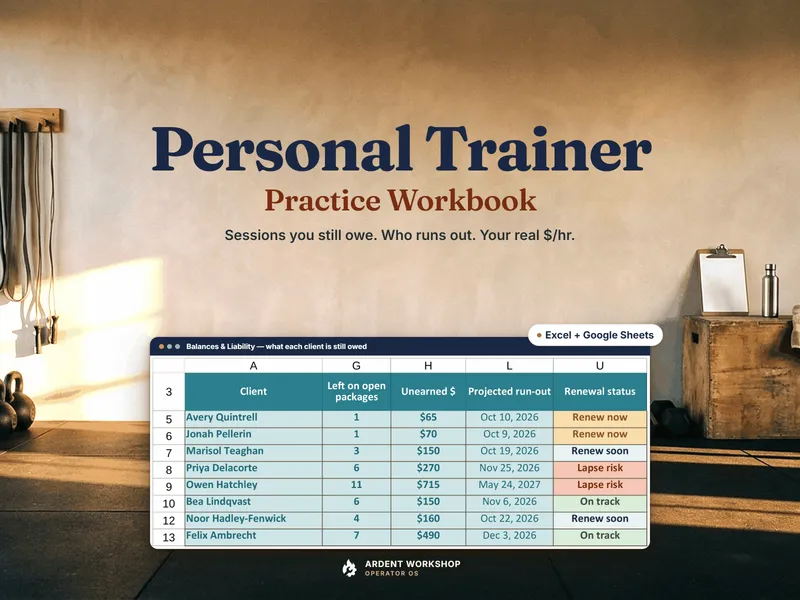
Personal Trainer & Fitness-Coach Practice Workbook — Package Liability, Run-Out Forecast & Real Hourly Rate (Excel + Google Sheets)
A personal trainer template for Excel and Google Sheets showing sessions owed in dollars, who runs out or lapses next, and each client's real hourly rate.
Operator OSView details - $29.95 Spreadsheet
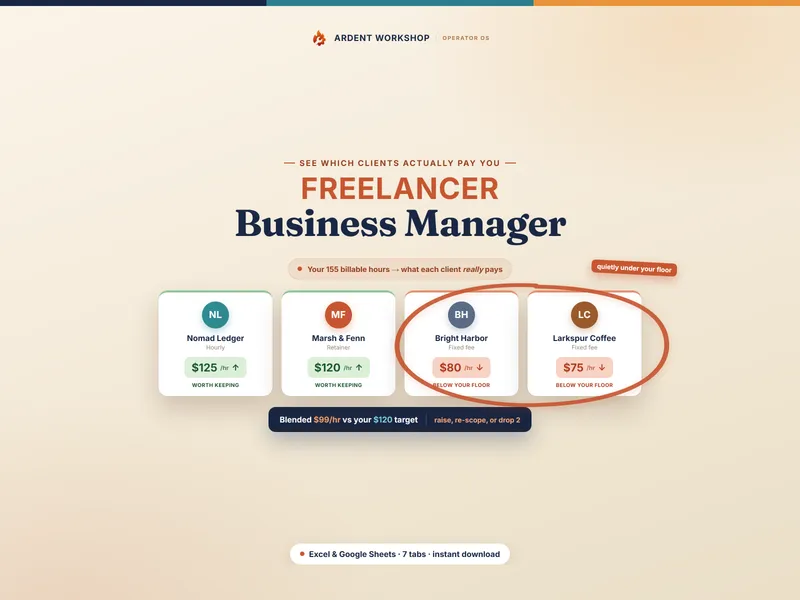
Freelancer Business Manager — Per-Client Profit, Effective Rate Calculator, Pipeline & Retainer Tracker (Excel + Google Sheets)
A workbook for freelancers & consultants — track per-client profit, effective hourly rate, pipeline, retainers, and invoices in Excel or Sheets.
Operator OSView details - $24.95 Spreadsheet
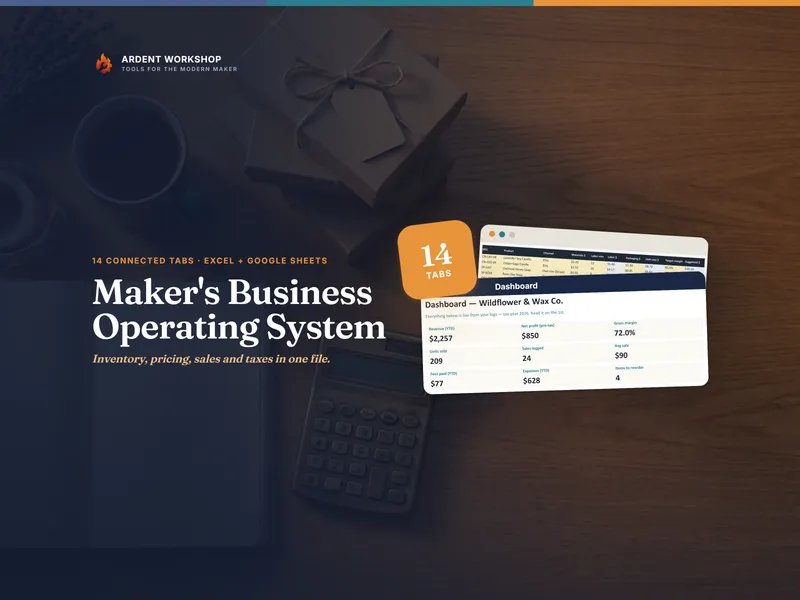
Maker's Business Operating System (Excel + Google Sheets)
One connected spreadsheet — Excel plus a ready-made Google Sheets copy — running your handmade business inventory, pricing, sales, wholesale and taxes.
Operator OSView details
Frequently asked questions
- What is a training package?
- A training package is a prepaid block of sessions that a client buys up front, with a validity window and a per-session value. For example, ten sessions valid for a set number of days. The client commits and you are paid in advance, but the cash is a promise to deliver sessions, not yet earned revenue.
- How is a training package different from a monthly membership?
- A package sells a fixed number of sessions that are used up, so every package has an end: it runs out or it expires. A membership sells access or a recurring allotment for each billing period and renews automatically. The package leaves you with sessions still owed at any moment, which is why it needs a balance to track.
- Is the money from a training package revenue when I get paid?
- Not under revenue recognition, the accounting idea the Personal Trainer Practice Workbook follows. Revenue is earned when a session is delivered, or deducted under your late-cancel or no-show policy, not when the package is paid for. Until then, the cash you hold for undelivered sessions is unearned: a liability you still owe the client in sessions. This is a business reference, not accounting or tax advice.
- What happens to unused sessions when a package expires?
- That depends on the expiry policy in your terms. Under forfeit, the leftover sessions expire and their value becomes breakage, revenue you keep. Under extend once, the package gets a set number of extra days first. Under refund, the unused sessions are returned at the per-session value. Some states and countries limit how prepaid services can expire or be forfeited, so check the consumer rules where you work before you rely on forfeiture.
- How do I price a training package?
- Start from the per-session value, which is the package price divided by the number of sessions, and then count what a session really costs you: travel, admin time, card or platform fees and late cancels. A package that looks fine on the rate card can earn far less per hour once those are counted, so check the effective hourly rate against your target before you set or discount a price.
- When should a client renew a package?
- Raise renewal before the last session, based on the client's real pace rather than the plan they started with. A client who trains steadily will run out before the package expires, which is a renewal conversation. One who slows down risks lapsing with sessions unused, which calls for booking those sessions or deciding whether an extension is fair.