
A makeup-lesson policy is a rule you set before you need it
Every private teacher — piano, guitar, voice, math, test prep, a swim coach — runs into the same moment: a student cancels the Tuesday lesson. Do they get it back? For free? This week or whenever? A makeup-lesson policy answers all of that in advance, so you're not negotiating it parent by parent, week by week. It's a short set of rules, ideally written into your studio agreement, that covers four things:
- The notice window — how far ahead a student must cancel to earn a makeup credit instead of forfeiting the lesson. A full day's notice is a common rule of thumb, though many studios set 48 hours or a same-week deadline; the point is that you pick it and say it out loud.
- What a late cancel or no-show does — a cancellation inside the window, or simply not showing, is typically charged in full and earns no credit. Your time was reserved; it can't be resold on short notice.
- How many makeups, and when they expire — an open-ended promise of unlimited makeups is a promise to work extra hours forever. Most policies cap credits and expire them (say, by the end of the term) so they don't pile up.
- How a makeup is rescheduled — from your open slots, on your terms, rather than a standing obligation to bend your calendar to theirs.
Why the policy matters: makeup credits leak money quietly
A makeup credit is a promise to teach a lesson you've already been paid for — or worse, one you were never paid for. One or two are nothing. But across a full roster, over a term, unwritten makeups compound into a stack of owed lessons you can't quite remember agreeing to. That's the quiet leak: not a dramatic loss, just a steady one, because the memory that tracks favors always forgives the student and never the teacher.
A clear policy fixes both halves of the problem. It caps what you owe (the notice window and expirations keep credits from accumulating), and it makes each credit visible — a number you and the family both agree on, instead of a fuzzy sense of "I think I owe you one." The goal isn't to be strict for its own sake; it's to offer makeups on terms you chose, and can afford, rather than terms that erode by default.
An illustrative example
Illustrative only — pick your own window and terms. Say your policy reads: "Cancel by 6 p.m. the day before and you'll receive one makeup credit, redeemable within the current term from my available slots. Cancel later than that, or miss the lesson without notice, and the lesson is charged in full. Credits don't roll over between terms."
A student cancels Monday's lesson on Sunday afternoon — inside the window, so they earn +1 makeup credit. Two weeks later they text an hour before the lesson: that's a late cancel, charged in full, no credit. In week six they use their standing credit for a Saturday makeup slot, and the balance returns to zero. At term's end, any unused credit expires. Nobody argues, because the rule was set before any of it happened.
The four attendance outcomes, and what each one does
A workable policy really comes down to four outcomes for any scheduled lesson. This is the table the Private-Lesson & Tutor Studio Manager automates — mark the outcome and it adjusts the credit and the charge for you:
| Attendance outcome | Makeup credit | Charged? |
|---|---|---|
| Attended | No change | Yes — normal lesson |
| Canceled with notice (in your window) | +1 credit owed | Not for this lesson — redeemed later as a makeup |
| Late cancel (inside the window) | No credit | Yes — charged in full |
| No-show | No credit | Yes — charged in full |
In the workbook, the Lesson Log dropdown uses the exact labels Cancelled (notice) and Cancelled (late) so each row is unambiguous — one earns the credit, the other charges the lesson. The Student Roster then shows, per student, the makeup credits you currently owe, right next to their unpaid balance. The credits you'd otherwise lose track of become a column you can read at a glance.
Turn your policy into something you can actually track
Writing the policy is step one; the harder part is honoring it without keeping a ledger in your head. You can start free with the Lesson & Payment Log — a single-tab log of each lesson, who attended, and whether it's paid, with no signup. When you want the credit math to run itself — crediting a makeup on a notice cancel, spending it when you deliver one, and surfacing what you owe per student — the Private-Lesson & Tutor Studio Manager is the full, owned workbook built around exactly this policy.
Related terms and guides
A makeup-lesson policy is one piece of running a lesson studio like a business. To weigh a workbook you own against a monthly app, read spreadsheet vs music-lesson software. Or browse every tool built for private teachers on the templates for music teachers and templates for tutors hubs.
Templates that implement this
Tools that track your makeup credits for you
3 templates
A connected workbook that credits a makeup when a student cancels in time and spends it when you deliver one — so your policy lives in a number, not your memory — plus the wider operator tools behind a solo service business.
- $24.95 Spreadsheet

Private-Lesson & Tutor Studio Manager — Student Roster, Attendance, Makeup Credits & Income (Excel + Google Sheets)
A workbook for music teachers, tutors & coaches — track students, attendance, makeup credits, packages, and income in Excel or Google Sheets.
Operator OSView details - $24.95 Spreadsheet

Maker's Business Operating System (Excel + Google Sheets)
One connected spreadsheet — Excel plus a ready-made Google Sheets copy — running your handmade business inventory, pricing, sales, wholesale and taxes.
Operator OSView details - $29.95 Spreadsheet
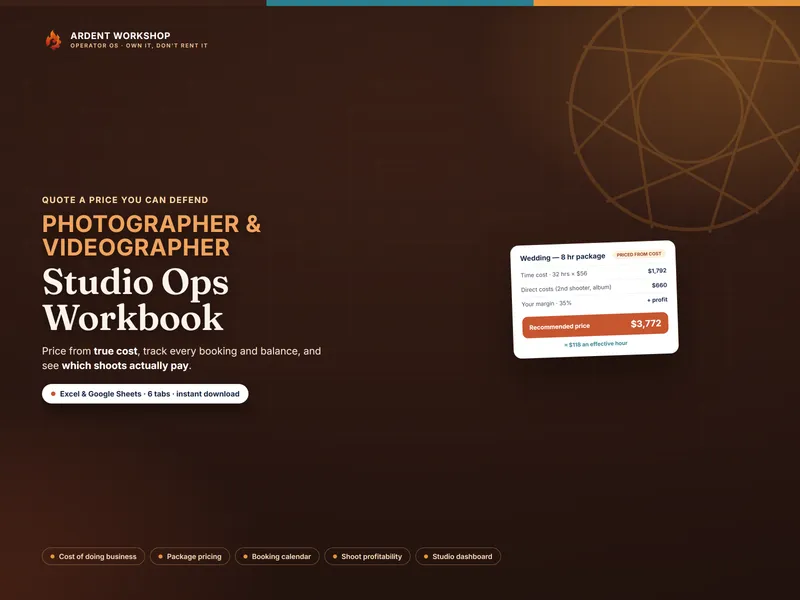
Photographer / Videographer Studio Ops Workbook — Package Pricing, Booking & Profit Calculator (Excel + Google Sheets)
Photography business workbook for Excel & Google Sheets — price packages from true cost, track bookings and balances, and see which shoots actually pay.
Operator OSView details