The three jars
- Spend — money the child can use now, on whatever they choose. Letting them make their own small spending decisions, including the occasional regretted one, is much of the lesson.
- Save — money that stays put and builds toward something specific: a toy, a bike, a trip. This is the jar that teaches waiting.
- Give — money set aside for other people: a donation, a gift, a cause the child cares about.
How families pick the percentages
There is no standard split, and nobody can tell you the right one. Families choose percentages that reflect their values and their child's age. As illustrations only: a family with a young child might keep most of the money in spend so it feels real and immediate, while a family with an older child saving for something big might weight the save jar more heavily. Some families set the give jar at a round number the child can easily understand. Each child can have their own split, and you can change it as they grow. The one hard rule is that the three percentages total 100%. Nora's 50/40/10 split in the next section is one illustration, not a recommendation.
How the split is calculated each payday
The arithmetic is simple, which is exactly why it is easy to get lazy about. Take the week's payout and multiply it by each percentage. Here is a worked example for a fictional child, Nora, whose week came to a $9.50 payout, split 50% spend, 40% save and 10% give:
- Spend: $9.50 × 50% = $4.75
- Save: $9.50 × 40% = $3.80
- Give: $9.50 × 10% = $0.95
The three amounts add back up to $9.50. If your family adds a parent match on the save portion, it is calculated on the $3.80 and added to that jar, so it does not change what goes to spend or give. In the Kids Chore Chart & Allowance System, every Ledger row makes this split for you.
Running balances are the hard part
The split itself is a one-minute job. What gets complicated is the memory: what is in each jar right now, which weeks were paid, and whether you owe anything. With paper jars you are trusting the coins and your memory. A simple ledger fixes that, with one row per payday, the three amounts, a "paid?" tick, and running totals for each jar. The American Academy of Pediatrics' HealthyChildren.org article “Kids & Money: Help Your Child Learn Good Financial Habits” encourages tracking a child's savings in a notebook or spreadsheet, and the same habit extends naturally to all three jars.
The giving jar
Giving is an easy jar to skip, but it does not have to be a charity. It can be a birthday present for a friend, a donation to a shelter the child picks, or help for a neighbor. What matters is that a share leaves the child's hands for someone else, and that the child chooses where it goes.
A savings goal and weeks-to-goal
Saving works better with a target. Name the goal and its price, then work out how long it will take at the child's recent saving rate: the amount still needed, divided by what the save jar has been growing each week, gives an estimated number of weeks, rounded up.
For illustration, in the workbook's fictional sample Nora is saving for an $85 concert ticket and has $48.12 in her save jar, leaving $36.88 to go. Over her last four weeks, her save jar grew by about $3.93 a week on average. That rate covers several paydays, so it differs from the single $3.80 save share in the payday example. $36.88 divided by $3.93 is 9.4 weeks, which rounds up to 10.
"Ten weeks to go" is a concrete target where "keep saving" is not, and it is an estimate you can recompute as the rate changes. A parent match shortens the wait, which is a vivid way to show that saving is rewarded.
Paper jars, a spreadsheet, or an app
All three work, and the right one depends on how many children you have and how much bookkeeping you want to do.
- Paper jars — free, tactile, and great for a young child with one or two coins a week. There is no math to automate and no running balance beyond what you can see in the jar.
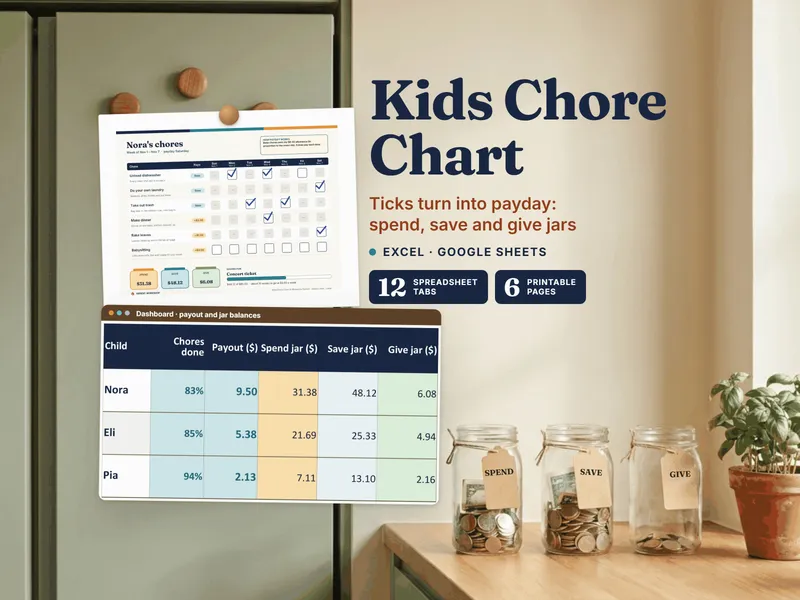
- A spreadsheet you own — handles several children, different percentages, carried balances, and goals. The Kids Chore Chart & Allowance System is built for this: it works out each payday, splits it into the three jars, flags any payday you still owe, and prints each child's own fridge chart from the same data. No app or subscription.
- A subscription allowance app — handy if you want a card or bank link for the child, but typically a recurring fee. Check each provider's current pricing, which changes.
Starting from scratch? The free chore chart and allowance starter covers one child's week: a short chore list, the Sunday-to-Saturday tick grid, and that week's payout split into spend, save, and give.
Next: how the allowance is earned
A spend-save-give split sits on top of an allowance rule, so the next decision is how the money is earned. See chore-based vs flat allowance for the trade-offs, including Kiplinger's “Don't Tie Allowance to Chores” viewpoint. This is a family money-habit approach, not financial advice.
Templates that implement this
Run the three jars from one workbook
1 template
Tick the chores and the workbook works out each child's payday, splits it into spend, save, and give, and keeps the balances going week to week.
Frequently asked questions
- What percentages should I use for spend, save, and give?
- There is no standard. Families pick splits that fit their values and their child's age: some lean heavily toward spending for a young child who needs to feel the money is theirs, others shift toward saving as a child gets a goal worth waiting for. Whatever you choose, the three percentages should total 100%, and you can change them as your child grows.
- Does the giving jar have to go to charity?
- No. Giving is whatever your family decides it means: a donation, a gift for a friend, a contribution to a cause the child picks. The point of the jar is that a share of every payday is set aside for other people before the child decides what to do with the rest.
- Can I add a parent match to the savings jar?
- Some families do. A parent match tops up the save portion by a percentage you choose, which makes waiting for a goal visibly pay off. It is optional, and the workbook calculates it for you if you turn it on.
- How do I keep track of three jars for more than one child?
- Paper jars work for one child and a small amount of cash. Once there are several children, different percentages, and balances that carry from week to week, a spreadsheet does the arithmetic and keeps each child's running totals in one place, so you are not reconstructing who has what from memory.
- Should allowance be tied to chores?
- Families disagree, and it is a trade-off rather than a settled question. Kiplinger, for one, argues against paying for basic chores and suggests paying for extra jobs instead. Others prefer a base allowance for expected chores. See our comparison of chore-based and flat allowances for the trade-offs, then choose the rule that fits your family.