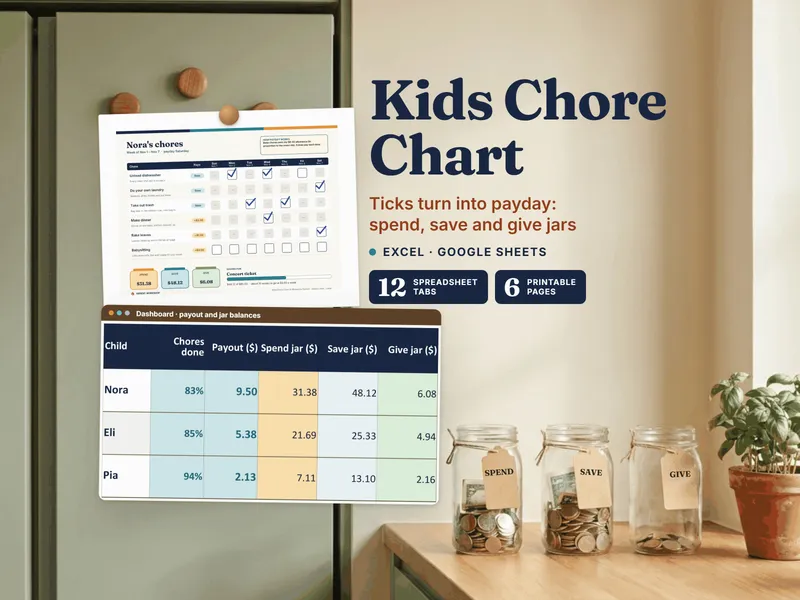
The short answer: there is no single right rule, only trade-offs. A flat allowance is simple and predictable; a chore-based one links effort to money; a hybrid pairs a base with paid extras. Whichever you pick, the Kids Chore Chart & Allowance System tracks it, and the free chore chart and allowance starter lets you try one child's week first. This is a family choice, not financial advice.
What is a flat allowance?
A flat allowance is a fixed amount paid on a fixed day, regardless of what the child did that week. Chores are separate: they are part of being in the household, and the allowance is a tool for learning to handle money. It is the easiest to run, because there is nothing to count.
What is a chore-based allowance?
A chore-based allowance ties the money to the work. Each chore is assigned, the child ticks it off, and the payout depends on what got done. It can be fully performance-based, or it can pay only for some jobs. It takes more bookkeeping, since someone has to tally the week and work out what is owed.
What does each one teach?
- Flat: budgeting with a predictable income, saving up across weeks, and that helping at home is a family duty rather than a job.
- Chore-based: that effort and reliability affect what you earn, and that skipped work has a visible cost.
- Hybrid: both. Expected chores build routine, and optional extras show that more work can earn more.
Advice differs. Kiplinger's “Don't Tie Allowance to Chores” argues against paying for basic chores and suggests paying for extra jobs instead. That is one viewpoint, not a verdict; plenty of families weigh the same trade-offs and choose differently.
Chore-based vs flat allowance, side by side
| What matters | Flat allowance | Chore-based allowance | Hybrid (base plus paid extras) |
|---|---|---|---|
| How it is paid | Same amount every payday | Varies with chores completed | A base for expected chores, plus a set amount per extra job |
| Main lesson | Managing a steady income | Effort and reliability affect earnings | Routine is expected; more work can earn more |
| Pros | Simple and predictable, with no tally to dispute | A clear link between work and money | Keeps a steady base while rewarding extra effort |
| Cons | No built-in link to chores, so they need their own system | Can turn tasks into a negotiation; a child may skip chores and forgo the money | Two kinds of chore and a base rule to explain and track |
| Tracking effort | Almost none | A weekly tally and a payout calculation | A weekly tally, the base rule and the extras |
| Works well when | You want money lessons kept separate from household duties | You want chores and pay to be visibly connected | You want both a routine and a way to earn more |
How does a hybrid allowance work?
Some families split the difference. Each assigned chore is either Base, an expected chore that counts toward a weekly base allowance, or Paid extra, an optional job that earns a set amount each time it is done. Everyday chores are expected; going beyond them pays.
The base then needs a rule. Two common ones:
- Proportional: the base times the share of base chores done. Do four of five and you earn four fifths. It is forgiving, and a missed chore costs a little rather than everything.
- All-or-nothing: the full base is paid once a threshold percentage of base chores is met, and nothing otherwise. It sets a clear standard but can feel harsh after one bad week.
Neither is correct. Pick the one that matches how your family wants to handle a missed chore, and tell the kids before the week starts.
How do you track either one?
- List the chores for each child. Mark each as Base or Paid extra, with a pay amount for extras.
- Tick the week. A Sunday-to-Saturday grid is enough, on paper or on screen.
- Work out the payout. Apply your rule to the base, then add the extras.
- Split it, if you teach jars. Divide the payout into spend, save and give at each child's own percentages. The spend-save-give allowance explainer covers how.
- Record what you paid. Otherwise it is easy to forget what you still owe.
That arithmetic is the part that wears families out on paper. The HealthyChildren.org article from the American Academy of Pediatrics, “Kids & Money: Help Your Child Learn Good Financial Habits,” encourages tracking a child's savings in a notebook or spreadsheet. The workbook does exactly that: it keeps each jar's running balance from week to week, flags any payday you still owe, and counts down the weeks to each child's savings goal.
Paper, workbook or allowance app: which fits?
- Paper chart. Free, and good for ticking chores. There is no math and no running balances, so you tally and remember the rest yourself.
- An owned workbook. The Kids Chore Chart & Allowance System works in Excel and Google Sheets, with no app or subscription, and the file is yours. It pays a base plus paid extras, and you choose whether the base is paid in proportion to chores done or all-or-nothing. It also prints each child's own fridge chart from the same data. Want a flat allowance? Don't set any of a child's chores to Base in the Pays as column on the Assignments tab. With nothing to measure, the workbook pays that child's full base every week.
- A subscription allowance app. Rented, not owned. Apps such as Greenlight and BusyKid give the child a card linked to real money, which a workbook does not do. Check their sites for current pricing.
If you hand out the money yourself, the middle rung is usually the right size. Own it, don't rent it.
Which should you choose?
Start with what you want the money to teach.
- Money skills kept apart from household duties: go flat.
- Effort and reward connected: go chore-based.
- Both: use the hybrid.
Whichever you pick, try it for a few weeks with the free starter sheet, which is pre-filled with an example child so you can see the payout and the three jars before you set up your own. When you have more than one child, or want running balances and fridge charts, the Kids Chore Chart & Allowance System carries all of it.
Working out the jars first? Read what a spend-save-give allowance is. Setting up the chores themselves? See how to build a chore system that actually sticks.
Frequently asked questions
- What is the difference between a chore-based and a flat allowance?
- A flat allowance is the same amount on the same day no matter what got done; chores are handled separately as part of living in the house. A chore-based allowance ties some or all of the money to chores completed. Some families land in between: a base allowance for expected chores, plus paid extras for bigger jobs.
- Should kids be paid for basic chores?
- Families disagree, and it is a values choice rather than a settled answer. Kiplinger's "Don't Tie Allowance to Chores" argues against paying for everyday chores and suggests paying for extra jobs instead. Other families like the direct link between effort and money. This page lays out the trade-offs so you can decide.
- What is a hybrid allowance?
- A hybrid pays a weekly base allowance for the chores everyone is expected to do, and a set amount each time a child does an optional extra job, such as washing the car. The base teaches routine; the extras teach that more work can earn more.
- What is the difference between proportional and all-or-nothing?
- Both are ways to pay the base. Proportional pays the base times the share of base chores done, so 4 of 5 chores earns four fifths. All-or-nothing pays the full base once a threshold percentage of chores is met, and nothing if the child falls short. Proportional is gentler; all-or-nothing is clearer about the standard.
- How do I track a chore-based allowance without an app?
- A paper chart works for ticking chores. The hard part is the math afterward: working out the payout, splitting it into spend, save and give, and remembering what you still owe. A spreadsheet can do that for you. The free starter sheet shows one child's week, and the paid workbook handles every child, running jar balances and printable fridge charts.
- Can I switch from flat to chore-based later?
- Yes. Tell your kids the new rule before it starts, and begin at the start of a week so there is a clean cutoff. With a tracker that supports both, you change the rule once and the payouts follow it.