What a pre-purchase inspection actually is
A pre-purchase inspection is narrow and specific: one mechanic, one car, one visit, paid for by the buyer. It is not the walk-around you do yourself in the driveway or the parking lot — that is useful, but you are not a mechanic, and you do not have a lift. It is also not a vehicle history report, which tells you what a database says happened to the car, not what condition it is in today. A PPI is the mechanical check: the frame, the fluids, the brakes, the suspension, and a scan for stored codes, done by someone with no stake in whether the sale closes.
What it costs, and who pays
A mobile pre-purchase inspection — a mechanic who travels to the car rather than the other way around — typically runs roughly $180–$220. That is the buyer's cost, and it is separate from a vehicle history report: as of September 2026 Carfax runs $44.99 for a single report and AutoCheck $24.99–$29.99. The buyer pays for the PPI because that is what makes the finding worth trusting — a mechanic you hired, who has never spoken to the seller, has nothing to gain by softening what they find.
What the mechanic should check
A proper PPI goes places a buyer's own checklist cannot reach without a lift and a scanner: the frame and undercarriage, the engine and transmission for leaks and wear, the brakes and suspension components, the fluids, and a scan for trouble codes stored in the car's computer even when no warning light is currently lit. Ask what the shop's standard inspection covers before you book it — coverage varies — and ask for a written, itemized report rather than a verbal thumbs-up.
What a PPI can tell you — and what it can't
It can tell you the mechanical and electrical condition of that specific car, on that day, including faults a visual walk-around has no way to catch: a leak starting behind a panel, wear building inside a transmission, a code the computer has already logged. What it can't do is stand in for the other two pieces of the picture. It is not a full service or accident history — that is what a history report and the seller's own records are for. It is not a guarantee of how the car holds up a year from now — it is a snapshot, not a warranty. And it is not a title, lien, or paperwork check, and it says nothing about whether the asking price is fair.
Dealer sale vs. private sale
At a dealer, confirm before you agree to anything that an independent mechanic — including a mobile inspector who comes to the lot — is allowed to put the specific car you're looking at through a PPI. A dealer's own service department checking their own inventory is not independent, no matter what they call the service. A dealer selling more than five used vehicles in a twelve-month period is also required, under the FTC's Used Car Rule, to post the Buyers Guide window form on each used car it offers — everywhere except Maine and Wisconsin, which run their own equivalent state rules. A private seller has no such obligation. In a private sale, you arrange the logistics directly with the seller — driving the car to your mechanic, or having a mobile inspector meet you at the seller's location — and you get the seller's agreement before any money changes hands.
What to do with the findings
A PPI report is only useful once it turns into numbers. Get a repair quote for each item the mechanic flagged — the inspecting shop or your own mechanic can usually price the part and labor — and use that priced list to negotiate the asking price down, ask the seller to fix the items before closing, or walk away if the total changes the math on the deal. Decide the number above which you walk before the report comes back, not after; it is far easier to hold a ceiling you set in advance than one you're inventing while standing next to a car you already like.
Where the kit fits — and where it stops
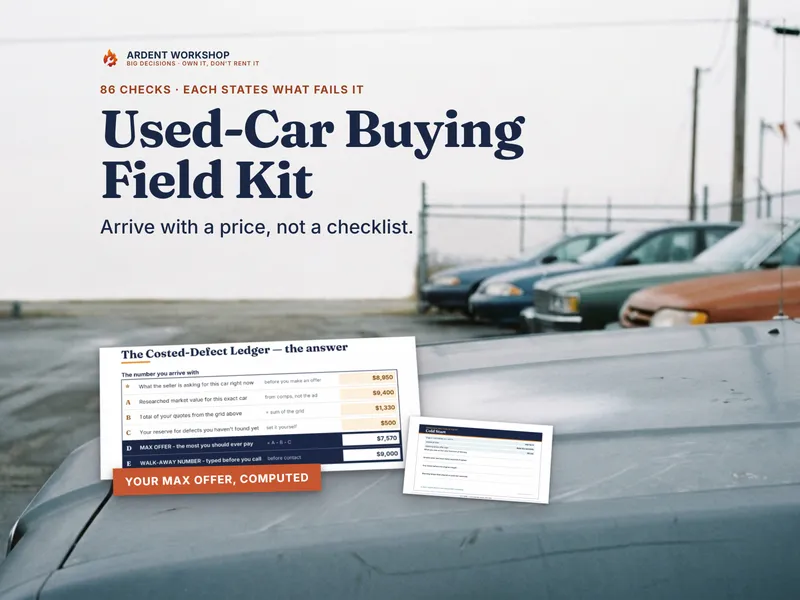
A PPI on every car you look at adds up fast, and the cars that turn out to be worth one are only ever a subset of the cars you go and see. The Used-Car Buying Field Kit is what you use before you spend the $180–$220: 86 checks that each state what counts as a fail, so a car with a cracked frame rail or a transmission that shudders on the test drive gets ruled out on your own time, for free, before you book anyone. When a car clears your own checks and is genuinely a contender, the kit hands you a PPI request sheet — a page you give your mechanic naming what to check and what to report back — so the $180–$220 you do spend gets a focused answer instead of a generic once-over. Findings the mechanic prices then go into the kit's Costed-Defect Ledger the same way your own findings do, computed against your researched market value and your reserve to produce a max offer.
None of that replaces the inspection itself. The kit is explicit about this: it is general buying guidance, not a mechanical inspection, and no substitute for a qualified pre-purchase inspection by a mechanic. If you want to try the kit's approach before buying it, the free Used-Car Inspection Checklist — the walk-around and cold-start cards — carries 20 of its checks. No email, no signup.
Two neighboring pages go deeper on the halves this one only touches. Field kit vs. a vehicle history report covers the paperwork half a PPI does not look at — title brands, liens and reported accidents — and where each of the three tools stops. What to check when buying a used car is the step-by-step version of the walk-around, cold start and test drive you do yourself before you book anyone.
Own it, don't rent it
The usual path is a free checklist you printed off the internet, a $180–$220 mobile inspection you either book on every car or skip entirely because you can't tell which ones deserve it, and a history report bought out of habit — Carfax listed a single report at $44.99 as of September 2026. The kit sits between the free checklist and the paid inspection at $12.95, once: one download, printed for this car and every car after it, that tells you which ones are worth the mechanic's time and what to hand them when you get there. The inspection and the report are priced per car; the kit is not.
Templates that implement this
Decide which cars are worth a pre-purchase inspection
1 template
86 checks that state what counts as a fail, so you spend a PPI on cars that clear your own inspection first — plus a PPI request sheet that tells your mechanic exactly what to check and what to report back.
Frequently asked questions
- What is a pre-purchase inspection?
- A pre-purchase inspection (PPI) is an independent mechanic's inspection of a specific used car, done before you buy it, that you — the buyer — pay for. A qualified mechanic who has no stake in the sale puts the car on a lift, checks the mechanical and electrical systems, and gives you a written report of what they found. It is separate from the visual checks a buyer does on their own, and separate from a vehicle history report, which reads a database rather than the car in front of you.
- How much does a pre-purchase inspection cost?
- A mobile pre-purchase inspection — a mechanic who comes to the car rather than the other way around — typically runs roughly $180–$220. That is separate from a vehicle history report: as of September 2026 Carfax runs $44.99 for a single report and AutoCheck runs $24.99–$29.99. Prices vary by shop, region, and how far a mobile mechanic has to travel, so confirm the number before you book.
- Who pays for the pre-purchase inspection — buyer or seller?
- The buyer. It is your money paying for your own mechanic's opinion, which is exactly why the finding is trustworthy — a mechanic you hired and who has never met the seller has no reason to go easy on the car. If a seller offers to pay for the inspection or insists on choosing the shop, that is a reason to be more careful, not less.
- What should a mechanic check during a pre-purchase inspection?
- The things a buyer cannot check without a lift and a diagnostic scanner: the frame and undercarriage for damage or rust, the engine and transmission for leaks and wear, the brakes and suspension components, the fluids, and a scan for stored trouble codes even if no warning light is currently on. A good shop gives you a written, itemized report — not a verbal "it's fine" — with what they found and, ideally, what it would take to fix it. Ask what the inspection covers before you book, since shops vary in how thorough their standard PPI is.
- What can a pre-purchase inspection tell you — and what can't it?
- It tells you the mechanical and electrical condition of that specific car on the day it was inspected, including problems a visual walk-around cannot find: a leak starting behind a panel, wear inside a transmission, a code stored in the computer. It cannot tell you the car's full history — that is what a vehicle history report and the seller's own service records are for — and it cannot guarantee how the car will hold up next year; it is a snapshot, not a warranty. It also is not a title or lien check, and it will not tell you whether the asking price is fair — that is a separate piece of research.
- Do you need a different approach for a dealer versus a private sale?
- Mostly logistics. At a dealer, confirm up front that they will allow an independent mechanic — including a mobile one who comes to the lot — to inspect the specific car before you commit; a dealer's own service department doing the inspection is not independent, whatever they call it. A dealer selling more than five used vehicles in a twelve-month period must also display the FTC's Buyers Guide window form on each used car it offers — everywhere except Maine and Wisconsin, which run their own equivalent state rules — while a private seller has no such obligation. In a private sale, you will usually need to arrange a time and place with the seller directly — either driving the car to your mechanic's shop or having a mobile inspector meet you at the car — and get the seller's agreement before you pay anyone or hand over a deposit.
- What do you do with the pre-purchase inspection findings?
- Get the findings in writing, and get a repair quote for each item that failed — the same shop that inspected the car, or your own mechanic, can usually quote the part and labor. With a priced list in hand you have three moves: negotiate the price down by the cost of what needs fixing, ask the seller to fix it before closing, or walk if the total changes the deal. Decide your walk-away ceiling before you get the report back, not after — a number is much easier to hold to when you set it before you are standing next to the car you already want.