It's tempting to treat these as competitors — as if buying one makes the other unnecessary. They aren't competing for the same job. A history report reads a database about the VIN. A field kit reads the car parked in front of you. One can see a car's paper past and cannot see its condition today; the other can see its condition today and cannot see its paper past. A careful buyer doesn't pick a side — they use whichever one covers the gap the other leaves.
The positioning: a free checklist → a field kit → a report or a PPI
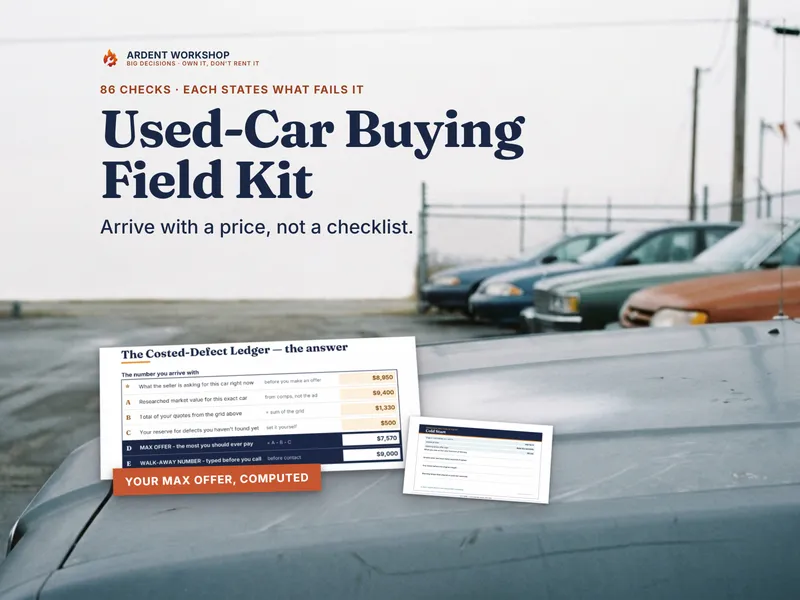
The usual starting point is a free checklist printed off the internet — a box that says "check the tires" without saying what a failing tire looks like or what four new ones cost. It's free, and it is also why it is easy to stand at a car nodding along, then negotiate on a number you never actually worked out. A used-car buying field kit sits above that: every check states what counts as a fail, every defect carries the exact line to get quoted, and a fillable page turns the quotes you collect into a number to open at. Above the kit sit the two paid, per-car services that see what a printed checklist never can — a vehicle history report (as of September 2026, Carfax runs $44.99 for a single report and AutoCheck $24.99–$29.99) that reads the car's paper past, and a mobile pre-purchase inspection (roughly $180–$220 as of September 2026) that puts a mechanic's lift, scan tool, and trained eyes on the one car you're closest to buying. None of the four replaces another — they sit at different points on the same ladder, and the kit's own paperwork checks tell you to use the two above it.
What a history report can see that the kit cannot
A vehicle history report is the only one of the two that can see a car's paper record. Run against the VIN, it can surface:
- Title brands — salvage, junk, flood, or rebuilt titles recorded against the VIN in any state.
- Reported accidents — collisions that were reported to an insurer or a state agency, where the report's data source recorded one.
- Odometer readings on file — a history of recorded mileage that can catch a reading that's gone backward or that jumps implausibly between two records.
- Liens and open loans — whether a lender still has a claim against the title, which is your problem the moment you take ownership if it isn't cleared first.
None of that is visible from the driver's seat or from underneath the car, no matter how carefully you look. That's exactly why the field kit's own checklist has a step that tells you to pull one — it isn't trying to replace this half of the job.
What the field kit can see that a report cannot
A report is built from what was reported. It has no way to see the car that's actually sitting in the lot in front of you today, and a great deal about a used car never gets reported to anyone:
- Current condition, panel by panel. Whether the tires, brakes, glass, lights, and body panels pass or fail right now — the field kit's 86 checks each state what counts as a fail, a measured value where one exists and a plain condition where no number is meaningful, rather than leaving "check the tires" for you to guess at.
- What a defect will actually cost you. The kit never prints a made-up repair-cost figure — it ships 22 pricing bases, the exact part-and-labor line to get quoted for each kind of defect, and leaves the number itself to a quote you get for the actual car. Priced by you, computed by the kit.
- A cold start and a test drive. A rough idle that fades as the engine warms, a pull under braking, smoke that doesn't clear — none of it exists in any database, because none of it was ever reported to anyone. It only shows up if someone starts the engine cold and drives the car.
- A number to open at. The kit's fillable working set computes a max offer from a researched market value, the defects you actually had quoted, and a reserve you set — plus a walk-away number you type in before you ever call, so the negotiating room between the two is decided before you're standing in front of the seller.
Unreported damage that was repaired for cash, a private seller who never filed an insurance claim, or wear that simply hasn't been recorded anywhere — a report shows nothing for any of it. That gap is exactly what the field kit is built to cover.
Field kit vs. vehicle history report, side by side
| Consideration | Field kit (owned) | History report (paid, per VIN) |
|---|---|---|
| What it looks at | The car in front of you, today | What's been reported about that VIN, in the past |
| Can see current condition | Yes — 86 checks, each stating what counts as a fail | No — condition today is invisible to a records lookup |
| Can see title brands, liens, salvage records | No — it points you to run a report and check the title | Yes, where a record exists on file for that VIN |
| Prices what a defect will cost you | Yes — 22 pricing bases; you get the quote, the kit does the arithmetic | No — not what it's for |
| Cost | $12.95, one time | $44.99 (Carfax) or $24.99–$29.99 (AutoCheck), per report, as of September 2026 |
| Reusable on the next car you look at | Yes — print it again, no per-car cost | No — a new VIN needs a new report |
| Produces a number to open at | Yes — a computed max offer and a walk-away ceiling you set | No |
| Requires the seller to share the VIN first | No | Yes |
| Substitutes for a mechanic's inspection | No | No |
The third option: a mobile pre-purchase inspection
A mobile pre-purchase inspection, typically run by an independent mechanic who comes to the car for roughly $180–$220 as of September 2026, sees more than either the kit or a history report — a lift, a scan tool, and a trained set of hands checking things neither a buyer with a checklist nor a records database ever will. It's also the most expensive of the three, and it only covers one car, so on a shortlist of several it is the step to spend once rather than every time. The kit ships its own PPI request sheet to hand your own mechanic, precisely so this step, when you do use it, tells the mechanic exactly what you've already found and what's left for them to check.
Use more than one
A workable order, for a car you're seriously considering: run a history report (or at minimum a title check) once the seller shares the VIN, before you spend an afternoon driving out to look at a car with a branded title. Walk the car with the field kit's checks in hand, price whatever you find, and let it compute a max offer against the walk-away number you set for yourself before you call. If the car clears both of those and you're close to an offer, that's the point at which a mobile PPI earns its cost — on the one car left, not on every car you looked at along the way.
A dealer selling more than five used vehicles in a twelve-month period is also required, under the FTC's Used Car Rule, to post a Buyers Guide window form on each used car it offers — everywhere except Maine and Wisconsin, which run their own equivalent state rules. It costs you nothing: a separate, free disclosure that neither the kit nor a history report replaces, and one a private seller has no obligation to provide.
What neither can do
Neither one makes the purchase for you, and neither one guarantees a result. A history report only knows what was reported — cash repairs, unreported wear, and issues nobody ever filed a claim for don't appear on it. A field kit only knows what a check by an informed, careful buyer can actually find — it's general buying guidance, not a mechanical inspection, and it's no substitute for a qualified pre-purchase inspection by a mechanic. Registration, titling, and safety-inspection rules are set by your state, not by either tool — check your own state's DMV before you assume anything about what a title or a lien means for you.
Try it before you buy either
The free Used-Car Inspection Checklist — the walk-around and cold-start cards — carries two cut-out cards drawn from the field kit's own pages: 20 checks across the ten-minute walk-around and the cold start, each stating what counts as a fail, shown filled in with a worked example. No email, no signup. What they can't do is price anything you find, rank one car against another, or produce a number to open at — that's what the full Used-Car Buying Field Kit is for: 86 checks, 22 pricing bases, and a fillable working set that turns what you find into a max offer.
Where to go next
Templates for car buyers collects the rest of the sequence — shortlisting, inspecting, costing and record-keeping. For the inspection itself, what to check when buying a used car walks the whole review in order, step by step.
Frequently asked questions
- If I buy the field kit, do I still need a Carfax or AutoCheck report?
- Yes. The field kit's own paperwork page tells you to run one — it cannot substitute for it. A history report reads a database of what has been reported against a VIN: title brands, reported accidents, odometer readings, lien and salvage records. No amount of walking around a car, opening its hood, or driving it around the block puts that paper trail in front of you. The two tools are answering different questions, and the paperwork question is one only a report — or a title search at your state DMV — can answer.
- What's the actual difference between a used-car field kit and a vehicle history report?
- A history report looks backward at the VIN: what's on file. A field kit looks at the car in front of you, right now: 86 checks that each state what counts as a fail — a measured value where one exists, a plain condition where no number is meaningful — plus the exact part-and-labor line to get quoted for anything that does fail, and a fillable page that turns those quotes into a max offer. A report can't hear a cold start, see a weeping gasket, or feel a pull under braking. A kit can't see whether the odometer was rolled back three owners ago or whether the title carries a salvage brand. Neither one is a smaller version of the other — they're looking at different halves of the same car.
- Should I run the history report before I go look at the car, or after?
- Before, if the seller will give you the VIN over the phone — it's one of the questions worth asking on a pre-contact phone screen, before you spend an afternoon driving out to look at a car with a branded title. If a seller won't share the VIN before a visit, that's worth noting on its own. Either way, run the report before you hand over money, not after: a title brand or a flood record found after the sale is a much harder problem than one found before it.
- Is a mobile pre-purchase inspection better than a field kit or a history report?
- A mobile pre-purchase inspection (PPI), typically run by an independent mechanic for roughly $180–$220 as of September 2026, sees more than either one — a lift, a scan tool, and a trained set of hands and eyes on the specific car. But it only covers one car, and it costs more than the field kit and either report combined, so booking one on every car you go and look at gets expensive fast. A workable order: use the field kit and a history report to narrow the field, and reserve the PPI for the car you're actually about to make an offer on.
- Can the field kit tell me if a car was in an accident?
- It can tell you what a collision usually leaves behind for you to find yourself — panel gaps that don't line up, mismatched paint, overspray, a trunk floor or door jamb that doesn't match the rest of the car — because several of its 86 checks are built around exactly that. What it cannot do is tell you whether an accident was ever reported to an insurer, a state title agency, or NMVTIS. That's what a history report is for, and it's also why a careful buyer doesn't skip either one: a car can pass a visual check and still carry a reported accident, and a report can show nothing on file for a car that was repaired for cash and never reported.