The listing photos look good, the price is fair for the mileage, and the seller says it “runs great.” None of that is the review. The review is what the car does cold, what its panels and paperwork say about where it has been, and whether the documents in your hand actually agree with each other and with the car in front of you.
Here is that review, in the order worth doing it.
Before you go
Ask the seller not to start the car before you arrive, and try to see it in daylight. A cold engine tells you things a warm one hides, so a car that has already been warmed up — whatever the reason — cannot be judged on its cold start that day. Put a hand on the hood before you do anything else: if it is warm on a car you were told has been sitting, the cold-start section below is off the table for this visit, and it is worth arranging a second one. Bring a flashlight, a tire tread depth gauge (or a quarter), and every document the seller has for the car — title, registration, and any service history.
The ten-minute walk-around
Work around the car once, slowly, before you drive it.
Panels and paint. Sight down each side of the car in good light. Uneven gaps between the hood, fenders and doors, or a color or texture that doesn’t quite match between two adjacent panels, both point to prior collision repair. What counts as a fail: a visible gap or color mismatch between adjacent panels — not a specific measurement, a condition.
Tires — tread. Check the tread depth in the middle of the tire and at the shoulders with a gauge, or use the quarter test: insert a quarter into the tread groove with Washington’s head down. If you can see the top of his head, the tread is worn to roughly 4/32 inch or less and it’s time to start budgeting a replacement soon. What counts as a fail: tread at or below 2/32 inch — a replacement threshold NHTSA (opens in new tab) sets itself, not a manufacturers’ recommendation it reports, and not a legal minimum.
Tires — age. Find the four-digit code at the end of the “DOT” stamp on the sidewall: the first two digits are the week the tire was made and the last two are the year, so a code reading “2318” means the 23rd week of 2018. What counts as a fail: there isn’t a hard number here. NHTSA’s tire safety page (opens in new tab) notes that some vehicle and tire manufacturers recommend replacing tires at six to ten years old regardless of remaining tread — that is a manufacturers’ recommendation NHTSA reports, not a threshold NHTSA itself sets, and not a legal minimum. A tire well inside its tread limit but eight years old is a condition worth pricing, not a pass.
Glass and lights. Check the windshield for chips or cracks in the driver’s sightline and confirm every exterior light works, including turn signals and brake lights with a second person watching. What counts as a fail: a crack or chip directly in front of the driver, or any light that does not come on.
Underneath, with the flashlight. Look for fresh fluid drips on the ground where the car has been parked, and for rust or damage on the exhaust and the frame rails you can see without a lift. What counts as a fail: any fresh (wet, not dried) fluid on the ground, or visible rust perforating a structural rail rather than surface rust on a bracket.
The cold start — and what to listen for
This only works once, on a genuinely cold engine — which is why arriving before the seller starts it matters more than almost anything else on this list.
| What you’re checking | What counts as a fail |
|---|---|
| Sound in the first 30 seconds | Knocking, rattling, or a belt squeal — a condition, not a measured value |
| Exhaust color | Blue or blue-white smoke (burning oil) or thick black smoke (fuel mixture) that doesn’t clear within a few seconds of idle |
| Warning lights | Any light that stays on after the initial bulb check, or one that flashes and clears before you can read it |
| Idle behavior | An idle that surges, stalls, or won’t settle within a minute of starting |
Pop the hood while it’s still cold. Pull the oil dipstick and check the color and texture — black and gritty rather than amber and translucent is a fail. Open the coolant reservoir cap only once the engine is fully cold, and check the fluid is the color the manufacturer specifies rather than rusty or oil-streaked. Check the battery terminals for white or greenish corrosion, which is a fail on its own even if the car starts fine.
The test drive
Idling in the driveway won’t surface most of what’s wrong with a used car. Plan a route with:
- A stretch above 45 mph — a pull to one side, a vibration through the wheel, or a wind noise from a door seal each fail here.
- A hard stop from that speed, on an empty street, both hands on the wheel — pulling to one side under braking, a grinding or metal-on-metal sound, or a pedal that sinks toward the floor are each a fail.
- Full-lock turns in both directions, slowly, listening for a clicking or popping sound — a fail, and a classic symptom of a worn CV joint.
- A pothole or rough patch — a knock, clunk or bottoming-out sound from the suspension is a fail.
- Every electrical accessory — air conditioning (does it get cold within a couple of minutes), heat, all four windows, and the infotainment screen. Anything that doesn’t work is a fail; whether it’s worth negotiating depends on the part-and-labor cost you get quoted for it, not a guess.
The paperwork that has to agree with itself
A car can pass every mechanical check and still be the wrong car, if the paperwork doesn’t hold together.
| Document says | Compare against | What counts as a fail |
|---|---|---|
| VIN on the dash plate | VIN on the driver’s door jamb sticker | Any character mismatch — stop, do not proceed |
| VIN on the title | VIN on the car (dash and door jamb) | Any mismatch |
| Title’s brand field | What the seller told you about the car’s history | A brand — salvage, rebuilt, flood, lemon-law buyback — that wasn’t disclosed up front |
| Odometer on the title/disclosure | Odometer in the car right now | A reading lower on the paperwork than what’s showing in the car |
| Registered owner’s name | Seller’s ID | A name that doesn’t match, with no explanation (estate sale, dealer consignment, etc.) |
Worked example: one viewing, end to end
On an invented listing — a 2019 sedan, 61,000 miles on the odometer, seller asking $14,500:
| Check | Found | Result |
|---|---|---|
| VIN, dash vs. door jamb vs. title | All three read the same 17 characters | Pass |
| Title brand | Clean, no brand | Pass |
| Lien check (state DMV) | No lien on file | Pass |
| Tire tread, all four | Front-left (FL) 5/32, front-right (FR) 5/32, rear-right (RR) 4/32, rear-left (RL) 3/32 | Pass — none are at the 2/32 line, though the RR and RL are closest to it |
| Tire date code, all four | 1st week of 2019 — seven years old at the time of this viewing | Price the set of four — inside the six-to-ten-year band some manufacturers flag, whatever the tread reads |
| Cold start | Clean idle, no smoke, no lights | Pass |
| Test drive — highway pull | Slight pull to the left under braking | Fail — flagged for the PPI |
That single fail doesn’t kill the deal by itself — it becomes a line item for the mechanic doing the pre-purchase inspection, and a specific question for the seller: has this car had any brake or alignment work, and when. The tire-age row is the other kind of finding: not a fail, but a set of four tires worth getting quoted now rather than discovering next winter, and subtracted from what you offer. That is one line item, not two: the two rear tires closest to the tread limit are part of that same set of four, so pricing the set already covers them.
Check the recall history and get a paid inspection
Run the VIN through the free lookup at NHTSA’s recall site (opens in new tab) — an open safety recall is repaired at no cost to you regardless of who owns the car when it’s fixed, but that free-remedy obligation is not open-ended: under 49 U.S.C. 30120(g)(1) (opens in new tab) it applies where the vehicle was bought by its first purchaser no more than 15 calendar years before the recall notice (5 years for tires). Past that, a manufacturer is no longer required to fix it for free — so check when the car was first sold new, not just what is on its recall list.
Then, before you commit to buying, pay an independent mechanic to put the car on a lift and check what you can’t see from a walk-around: the frame, the suspension components, the exhaust from underneath, and the brakes off the wheel. A mobile pre-purchase inspection — a mechanic who comes to the car — typically runs roughly $180–$220 as of September 2026. This review is not a substitute for that inspection; it’s what tells you whether the car is worth paying for one.
The walk-away discipline
The hardest check on this list isn’t mechanical. Write your walk-away number down — the highest price you’ll pay for this specific car — before you contact the seller, not while you’re standing next to it with the keys in your hand. A number decided in a driveway, next to a car that smells new and drives well, moves. A number written down the night before does not.
Where this fits
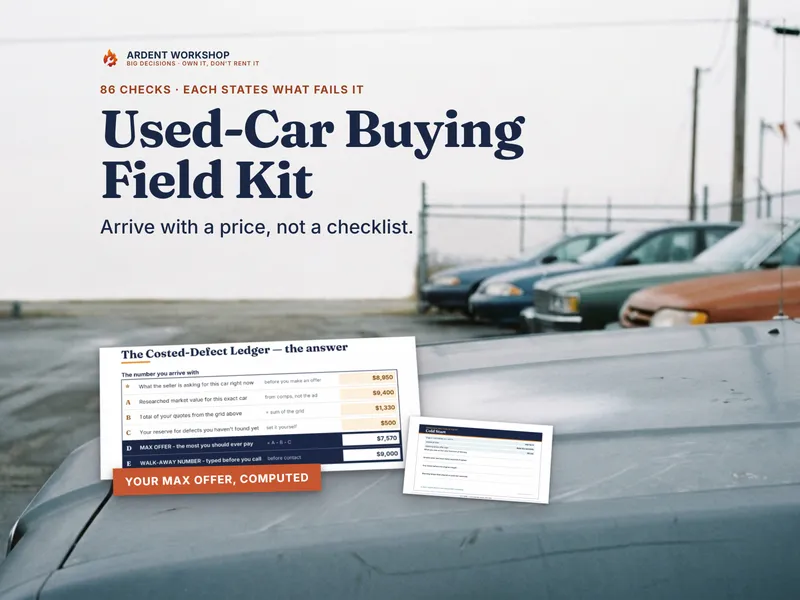
This is the general shape of the review; the depth is in the specifics — what a given fail actually costs to fix, and what to offer once you know. The Used-Car Buying Field Kit carries the full version: 64 checks in the printed field kit alone (86 with the EV/hybrid and classic/project pages), each one stating what counts as a fail, plus a pricing basis for every defect — the exact part-and-labor line to get quoted, never a guessed repair cost — and a fillable set that computes a max offer from the market value, the priced defects you found, and your reserve. The free Used-Car Inspection Checklist — the walk-around and cold-start cards — carries 20 of those checks onto a printable card set, with a worked example already filled in, if you want to try the shape of it before you buy anything. No email, no signup.
A note on what this is
This is general guidance for inspecting and buying a used car — it is not a mechanical inspection, and it is no substitute for a qualified pre-purchase inspection by an independent mechanic. Nothing here is legal advice about titles, liens, or bills of sale; those vary by state, and a branded title or lien question is worth a call to your state’s DMV or a lawyer before you sign anything. The listing, the car and every figure in the worked example above are invented for illustration.