What makes it an interview rather than a journal
Three things separate a keepsake interview from ordinary journaling, and all three are about discipline rather than effort:
- Fixed wording. The questions are frozen. "What was the hardest thing about this year?" is not improved into "What did you struggle with?" next time, because two answers are only comparable if the question was the same sentence.
- Fixed interval. Once a year, at the same point in the year — usually tied to something that recurs on its own, like the start of a school year, so the habit has a trigger rather than relying on memory.
- Verbatim transcription. The answer is written down as it is said: the grammar, the invented words, the wrong facts. Tidying an answer removes the only part of it that could not have been written by anyone else.
A second person usually holds the pen. A six-year-old handed a page usually writes far less than they would say out loud, so an interview taken by dictation tends to get the fuller answer.
Why the repetition is the whole point
A single keepsake interview is charming and largely interchangeable with a photograph. Its value is not linear — it compounds, and it compounds late. Year one is a nice page. Year four is where the first real change becomes visible. By year ten the same seven answers, read down a column, show something nobody in the family could reconstruct from memory: when a friend group turned over, when an ambition narrowed, the year the hard thing was named out loud.
It is also where the method usually breaks down. The common failures are changing the questions, skipping a year without marking it, and filing the answers where nobody will ever put them side by side. The fix is boring and reliable: freeze the wording, date every page, and keep a single index page per question where each year's answer gets copied across as soon as the interview ends.
Who a keepsake interview is for
Most commonly a parent or grandparent interviewing a child once a school year, from pre-K to the end of high school. The same method works looking backward — a grandparent asked the same set of questions about each decade of their life — and sideways, as a set of questions asked of every member of a family on the same day each year. What stays constant is the frozen wording and the dated record.
A keepsake interview is not an assessment
This is the distinction worth holding onto. A keepsake interview records what a child said on one day; it does not measure development, readiness, wellbeing, or progress, and the answers are not evidence of any of those things. Age-based notes in a keepsake book — the observation that nine-year-olds start editing their answers, or that eleven answers better without eye contact — are general observations about interviewing children, not milestones a child is expected to meet. Children differ enormously. If something about a child's development, mood, or schooling concerns you, that is a conversation for a pediatrician, a teacher, or a counselor, not for a printable book.
Where to start
Start with one year and see whether the habit takes. The free First-Day Interview page is a single printable year — seven questions, the rules for writing the answers down, and one worked example so you can see how much detail is enough. When you want all fourteen years and the read-across pages that make them comparable, the School-Years Keepsake Interview Book is the full set. Both are keepsake tools you own and print — not developmental, educational, psychological, or medical advice. For the method itself, see questions to ask your child every year; for where the words belong versus the images, see printable keepsake book vs photo book app.
Templates that implement this
Keepsake interview books and journals
3 templates
Printable books built around repeated questions — one for a child interviewed every school year, one for the letters written to them, and one for a grandparent's life story looking backward.
- $14.95 PDF
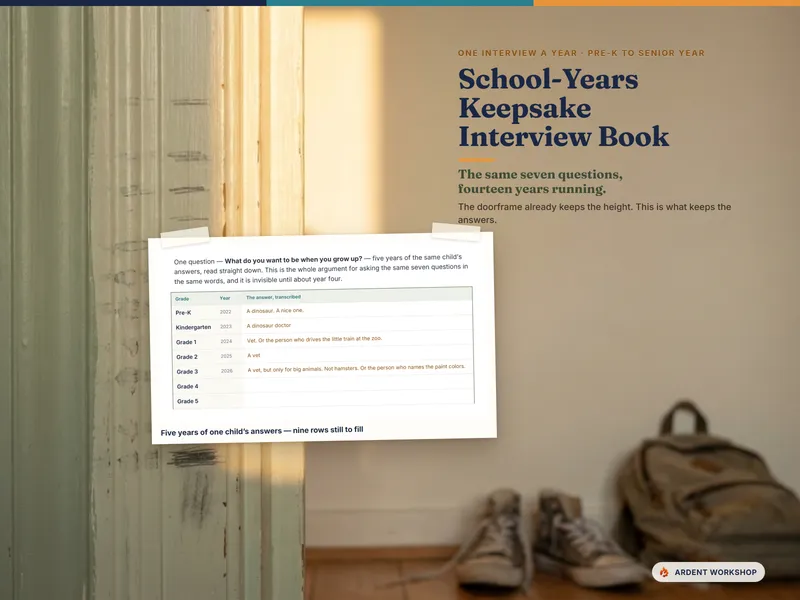
School-Years Keepsake Interview Book — 14 Matching Year-Sets, Pre-K to Grade 12, With Seven Questions That Never Change and a Read-Across Ledger
A printable keepsake interview book: 14 year-sets from pre-K to grade 12, with seven questions whose wording never changes and a read-across ledger.
Life AdminView details - $17.95 Spreadsheet

Letters & Milestone Time-Capsule Keepsake — 26 Milestone Letters to Your Child, Dated From One Birth Year (Excel + Google Sheets)
Write the letters you keep meaning to write. 26 milestones dated from one birth-year cell, 104 prompts, and a time-capsule index, for Excel & Sheets.
Life AdminView details - $19.95 Spreadsheet

Life-Story & Memory Keepsake Journal — 200 Interview Questions for a Parent or Grandparent (Excel + Google Sheets)
200 interview questions for a parent or grandparent, in a workbook that tracks which era of their life is still thin. Excel & Google Sheets.
Life AdminView details