Why one good question, asked once, is worth surprisingly little
Ask a five-year-old what they want to be when they grow up and you will get something you repeat for a decade. But an anecdote is a single data point, and it degrades: the wording drifts each time it is retold, and within a few years the family is no longer sure whether she said “a dinosaur” or “a dinosaur doctor,” or how old she was.
Ask the identical question every year and something different happens. The individual answers stay charming, but the column they form becomes the thing worth keeping — a record of a person working out who they are, at an interval fine enough to show the turns. Nobody in the family could reconstruct that from memory, and no photograph stores it.
That is the whole method. It is not about better questions. It is about the same questions, kept still.
The seven that are worth freezing
Any set works if it stays frozen, but a good set is answerable at four and still worth asking at seventeen. These seven meet that test:
- What is your favorite thing right now? — the fastest-moving answer, and the one that dates a year more precisely than a photograph does.
- Who is your best friend, and what do you do together? — friendships turn over faster than almost anything else a parent keeps track of. The second clause is what turns a name into something you can picture.
- What do you want to be when you grow up? — the question everyone asks once and nobody writes down fourteen times.
- What was the hardest thing about this year? — hard years are the ones a family later disagrees about. This settles it in the child’s own words, written at the time.
- What is the funniest thing that happened this year? — family jokes have a short shelf life unless somebody writes down what actually happened.
- What are you proud of? — the answer is almost never the one a parent would have guessed, which is exactly why it is worth having.
- What do you wish grown-ups understood? — the one question that gives the child the last word. Read across many years it becomes the most useful page in the record, and the hardest to read.
Change them to suit your family — then leave them alone. A set you altered in year six is two half-records rather than one whole one.
The questions that should change
A frozen set has one weakness: a question that works at four is not the most interesting thing you could ask a fourteen-year-old. So run a second, smaller set alongside it that is written for the age and asked once.
At four, concrete and imaginative: what is the best thing to do outside, what is something scary, which animal would you pick. At nine, the beginning of an inner life: what do you do when nobody is telling you what to do, what do grown-ups get wrong about kids your age. At twelve, the honest register is complaint: what is something adults say that makes no sense, what is the hardest part of a normal day. At sixteen: what is the plan right now, and how sure are you about it — the second clause being the part nobody else asks.
The two sets do different jobs. The frozen seven give you comparison; the age-specific ones give you the texture of a particular year.
What to expect, age by age
Knowing what a given age does when you sit down with them is most of the skill:
- Four to five — one or two words, answered with the last thing they thought of, and a different answer if you ask again in ten minutes. Take the first. Write down the invented words exactly; they are the first thing to disappear.
- Six to eight — the sweet spot. Old enough to give a real answer, young enough to still want to. Eight will correct you if you write it down wrong. If you only ever do this well once, do it well here.
- Nine to ten — this is often where the first edited answer shows up. Do not chase it. Ask the next question and let the silence sit; the fuller version often arrives about thirty seconds later.
- Eleven to thirteen — the hardest years and the most valuable ones. Expect shrugs and “I don’t know.” Ask sideways — in the car, on a walk, washing up — because many children this age answer more freely without eye contact. Leaving the page on the counter works surprisingly often.
- Fourteen to fifteen — the shortest answers in the book, and that is fine. Four words written down beat a paragraph you reconstruct three years later.
- Sixteen to seventeen — busy, and the easiest years to miss entirely. Put it in the calendar in September and hold the appointment. By seventeen it is usually an easier ask, because by then they know what it is.
These are rules of thumb for running the interview — not research findings, and not milestones any child is expected to meet. Children differ enormously, and none of this measures how one is doing.
The step that decides whether any of it gets read
Everything above produces a stack of dated pages. A stack is not a record anyone opens, because reading it means hunting through a hundred-odd pages for one question.
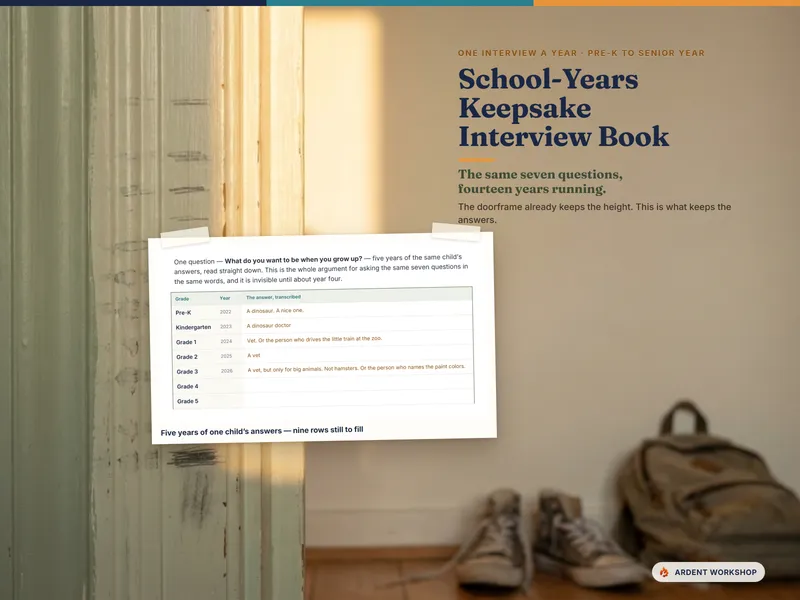
The fix is a single index page per question, with a dated row for each year, filled in the moment the interview ends. It takes two minutes and it is the step everybody skips — which is why so many half-finished versions of this exist in cupboards. When it is full, you read one question straight down and see the arc at once:
What do you want to be when you grow up?
| Year | The answer, transcribed |
|---|---|
| Pre-K | “A dinosaur. A nice one.” |
| Kindergarten | “A dinosaur doctor” |
| Grade 1 | “Vet. Or the person who drives the little train at the zoo.” |
| Grade 2 | “A vet” |
| Grade 3 | “A vet, but only for big animals. Not hamsters. Or the person who names the paint colors.” |
Starting late, and missing a year
Almost nobody starts in pre-K. Start at whatever age you are at, keep the earlier years in the binder blank in front of it, and reconstruct only the two or three you can genuinely source — a dated photo, a school report, a card they wrote, a message you sent somebody at the time. If the only source is your memory, leave the line blank, and mark anything reconstructed as reconstructed. Nine years of the same questions is nine more than anyone else has.
Missing a year works the same way: fill it in late, date it honestly, and note that it was late. A gap with an explanation is part of the history. A gap dated as though it were written on time is the one thing that damages the record.
Where to start this week
Print one year and see whether the habit takes before committing to fourteen. The free First-Day Interview page is exactly that — the seven questions with room to write, the rules for writing the answers down, and one worked year so you can see how much detail is enough. No signup.
If it takes, the School-Years Keepsake Interview Book carries all fourteen years, the age-specific questions for each grade, and the read-across pages that make the years comparable. See also what a keepsake interview is and printable keepsake book vs photo book app for why the words and the images need different homes.
This is a keepsake practice — not developmental, educational, psychological, or medical advice. If something about your child’s development, mood, or schooling concerns you, that is a conversation for a pediatrician, a teacher, or a counselor.