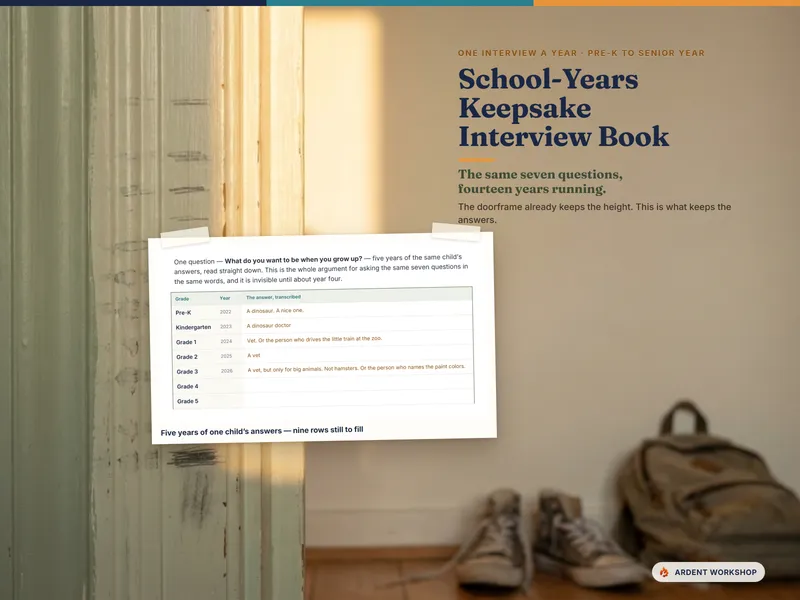
The framing that helps here is own it, don't rent it — but the sharper distinction is what each format is physically able to store. An image library is superb at what it looked like. It has no representation at all for what she said when I asked, and no way to place this year's answer next to last year's.
What each one is genuinely better at
- A photo book app is better at volume and at beauty. Thousands of images, automatic sorting by date and face, search, cloud backup, and a bound print job better than most home printers manage. If the goal is a handsome record of a childhood's appearance, that is what it is for, and this comparison is not an argument against using one.
- A printable keepsake book is better at words and at comparison. A fixed question set asked in identical wording, answers transcribed as spoken, a date on every page, and — the part no app offers — an index page per question where each year's answer is copied so all of them can be read down a single column. That is the whole reason to freeze the wording, and it is invisible until about year four.
The failure modes are opposite, which is useful
An app fails silently and administratively: a lapsed card, a discontinued print product, an acquisition, a storage tier that no longer includes originals. A binder fails physically and visibly: a spill, a move, a flood, a basement. Neither is safer in the abstract — but they do not fail at the same time, which is why the sensible arrangement is a binder on the shelf and a photograph of each filled page in the same cloud album as everything else. Four minutes once a year buys you the redundancy.
Cost, over the span this actually covers
A keepsake record for one child runs from pre-K to the end of high school — about fourteen years. A photo book app is usually priced per year (a storage plan) or per volume (a print), and both of those recur; over fourteen years and two children, that is a meaningful line item. A printable is bought once, and printing it again for a second child costs paper. The point is not that apps are expensive — many are excellent value for what they do — but that the two are priced on completely different clocks, and a keepsake is a long clock.
Use both, and give each the job it is good at
The arrangement that works: let the app hold the images and do the sorting; keep the words on paper in a binder you own; photograph the filled pages once a year so they live in the app's backup too. Start with the free First-Day Interview page — one printable year, seven questions, no signup — and if the habit takes, the School-Years Keepsake Interview Book carries all fourteen. See also what a keepsake interview is and why the repeated wording is the method rather than a quirk. These are keepsake tools — not developmental, educational, psychological, or medical advice, and nothing in them measures how a child is doing.
Frequently asked questions
- Is a printable keepsake book or a photo book app better for recording a child's school years?
- They record different things, which is why families often end up with both. A photo book app is hard to beat for the image itself: it holds thousands of them, sorts them by date and face automatically, and prints a bound volume that looks better than anything you could assemble at a kitchen table. What it does not hold is what the child said. A printable keepsake book is built around words — questions asked in fixed wording, answers written down verbatim in somebody's handwriting — and around comparison across years, which an image library has no way to express. If you want a beautiful record of what a childhood looked like, use the app. If you want a record of what a child thought, use the book. Neither is a developmental, educational, psychological, or medical tool, and neither measures how a child is doing.
- Will my photos still be there in fifteen years?
- That depends on decisions you have not made yet. A photo service can be acquired, change its storage tiers, retire its print product, or lose access when a card expires — and a family archive is exactly the kind of data whose loss is discovered years after it mattered. Printed pages in a binder have the opposite failure mode: they are vulnerable to fire and flood but immune to a billing failure and a terms-of-service change. The practical answer is to keep the artifact on paper and the backup in the cloud, rather than trusting either one alone.
- Can't I just add captions in the photo book app?
- You can, and the honest problem is that captioning is optional work done after the fact, on a screen, about a moment you already half-remember — which is why it so often does not happen. An interview page is the opposite: it is the reason you sat down, the child is in the room while you write, and there is a blank line that visibly wants an answer. The other thing a caption cannot do is line up: a caption lives with its photo, whereas a keepsake book with fixed questions collects fourteen dated answers to one question on its own read-across pages, to be read straight down.
- Do I need a subscription for a printable keepsake book?
- No, and that is most of the point. A printable is a file you download once and print as often as you like — again for a second child, again to replace a page a toddler drew on, again in ten years if the binder is lost and you still have the file. There is no account, no seat, nothing to renew, and nothing that can be discontinued out from under a record you have been keeping since pre-K.
- What about handwriting — is that worth anything?
- The argument for it is that a typed caption records the content of a sentence, while a handwritten page records the sentence plus who wrote it, how fast, and how old they were when their letters changed shape. It is also the thing that makes an interview page unmistakably not generated by anything. That is a preference rather than a rule, and a typed record is far better than no record — but it is a real difference between the two formats.