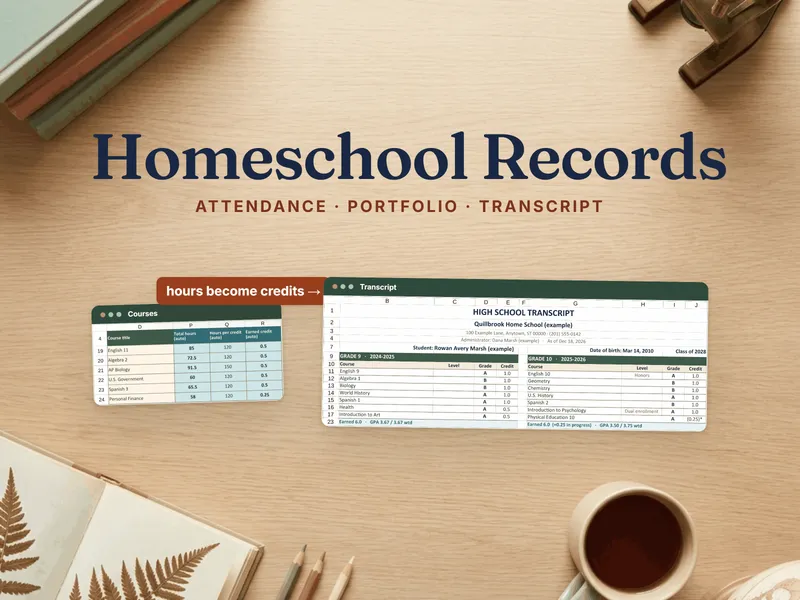
The two get treated as interchangeable because both end in the same sentence — "we showed the state our learner made progress" — but they get there by asking for different things all year. A portfolio review asks you to save the work as it happens, so someone else can look at it later and see growth. A standardized test asks the learner to sit down on a given day and produce a score. Homeschool rules vary by state, so check your own state's law or department of education for what applies to you; nothing on this page states what any state currently requires.
Portfolio review vs standardized testing: side by side
The rows below describe what each option generally involves, not what any particular state requires or how it must be documented — that's set by your own state's rules.
| What matters | Portfolio review | Standardized test |
|---|---|---|
| What it is | A reviewer looks over the learner's dated work and records | The learner sits a test and a score is reported |
| What it shows | Growth and range across the whole year, subject by subject | A score at one point in time, often against a norm group |
| What it needs, kept all year | Dated work samples across subjects, a reading list, often attendance records | Test registration on time, and the score kept once it's back |
| When it happens | Set by your state's rules or your reviewer | On a scheduled test date or window |
| Effort, in general terms | Steady, spread across the year — saving work as it's produced | Concentrated around test prep and the test day itself; light the rest of the year |
| Tends to suit | A learner whose progress shows better in the work than in a single score — a young writer, a project-based year, a learner who tests poorly | A learner comfortable with timed, standardized formats, or a family that wants a quick outside benchmark |
What a portfolio review actually involves
A homeschool portfolio review has a reviewer — often a certified teacher or evaluator, depending on the state — look over a learner's dated work samples, a reading list and attendance records to assess the year's progress, where a state offers that option. The work that makes a review straightforward is done all year: a sample saved and dated as it's produced, sorted by subject, so the folder that shows up at the review is a record of the year rather than a reconstruction of it.
What a standardized test involves, in a homeschool context
A standardized test asks the learner to sit for a test — administered according to your own state's rules and the test publisher's terms — and produces a score, often measured against a norm group. Where a state accepts this option, the family generally needs to register by a deadline, arrange the test itself, and keep the resulting score with the learner's other records. The Homeschool Portfolio, Attendance & Transcript Records Binder's Tests & Evaluations tab logs standardized tests, placement tests and portfolio evaluations together, as they happen — one place to find a score again later, whether or not the current year required one.
Which one fits your learner?
Where your state leaves the choice open, three questions tend to settle it:
- Does your state actually offer a choice? Some states offer more than one way to show progress; whether yours does comes from your state's law or education department, not from general guidance — check it before you plan around either option.
- Does the year's work show better as work, or as a score? A portfolio review can show growth a single test score can't — the same learner's work in September next to their May — which tends to favor learners whose year was project-based, or who test poorly under timed conditions. A standardized test gives a score in one sitting, which some families want as an outside check regardless of whether it's required.
- Can you actually keep the records either one needs? A portfolio review is only as good as what got saved along the way — a folder assembled the week it's due is a much thinner record than one built a page at a time. A test needs nothing saved except registering on time and keeping the result. If record-keeping has been the weak point some years, that alone can tip the choice.
Both need records kept all year, not assembled at the deadline
This is the part the two options share, and the part that is easy to leave until the deadline. A portfolio review needs work saved and dated as it's produced — not gathered from memory the week before. A standardized test needs a registration deadline caught and a score filed somewhere it can be found again next year, and the year after. Both also sit alongside the attendance record this binder tracks either way — days and hours logged against each learner's own target, whichever progress option a family ends up using.
If you haven't settled on homeschooling yet and are still weighing it against public, charter, private or hybrid schooling, the School-Path Decision Helper compares the paths side by side, including the true cost and the hours each one actually takes, before this page's question — portfolio or test — is even on the table.
One binder that logs both, without picking for you
The Homeschool Portfolio, Attendance & Transcript Records Binder doesn't ask a family to choose one option over the other — it logs whichever a state requires, or both. The Portfolio Index and Portfolio Coverage tabs date every work sample by subject and course and flag where a subject is thin for the quarter; the Tests & Evaluations tab logs standardized tests, placement tests and portfolio evaluations as they happen; and the Attendance tab tracks days and hours against each learner's own target. A Requirements page is left for the family to fill in from their own state's rules, with days-until status on whatever deadlines they enter — the workbook states no jurisdiction's law. It's one owned file across up to 6 learners, for Excel and Google Sheets — a one-time purchase, with no subscription to keep up.
Want to see the attendance and hours side before committing to the full binder? The free Homeschool Attendance & Hours Log is a one-learner version, pre-filled with a worked example term, no signup — the days-and-hours-to-target counter that a portfolio review and a standardized-testing year both still need kept. Or see every template for homeschool families.
Frequently asked questions
- Is a portfolio review or a standardized test better?
- Neither is better in general — where a state gives families a choice, the two options are different kinds of evidence, and which one fits depends on the learner and the year. A portfolio review looks at the actual work: dated samples, a reading list, sometimes a conversation with the reviewer, and it can show growth a single test score can't — a young writer's November paragraph next to their April one, say. A standardized test produces one number, scored the same way for every learner, which is exactly the strength when a family wants a quick outside benchmark and the weakness when a learner tests poorly or the year's work doesn't reduce to a single subject score. Where your state offers a choice, pick the one that fits the learner; where it doesn't, follow what your own state's rules ask for.
- Do I have to pick one option for the whole year?
- Whether the option can change from year to year is set by your own state's rules, not by anything general we can say here — check them before you plan the year. What doesn't change either way is the record-keeping: a portfolio review needs the work saved as it happens, and a test needs the learner prepared and the result kept, so the safest approach is to keep both kinds of records through the year and decide, or confirm, which one your situation actually requires.
- How do I find out what my own state requires?
- Check your state's homeschool statute or your state department of education directly, or a state-specific homeschool association that tracks the current rules — requirements vary by state and can change, so a general guide (including this one) is the wrong place to rely on for your specific state's current rule.
- Will a portfolio or a homeschool test score get my learner into college?
- Neither one guarantees anything on its own. Colleges set their own admissions requirements, and what a given school wants from a homeschooled applicant — a transcript, test scores, a portfolio, an interview, some combination — is set by that college, not by which progress-showing option your state required along the way. If college admissions is a goal, check the requirements of the specific colleges your learner is interested in, directly and early, rather than assuming either option here satisfies them.