Where the term comes from
BATNA was coined by Roger Fisher and William Ury in their 1981 book Getting to Yes, the foundational text of principled negotiation. Their core insight: the reason to negotiate at all is to do better than your alternative. So the strength of your position isn't your demands — it's how good your best alternative is if you walk away. Everything else follows from that.
Your BATNA vs your walk-away number
These two are related but not the same, and using both is what keeps a warm conversation from talking you into a bad deal:
- Your BATNA is the concrete alternative — "I accept the offer from the other company," or "I stay where I am and ask for a raise."
- Your walk-away (or reservation point) is the number that alternative sets — the point below which the deal in front of you is worse than your BATNA, so you decline. You decide it in advance, and you never state it out loud.
Put a dollar value on your BATNA and it becomes the true floor beneath the whole negotiation: you never have to accept less than what you can already get elsewhere.
How to use a BATNA in a salary negotiation
- Name it honestly. What will you really do if this offer falls through? Be specific — a vague "I'll keep looking" is a weak BATNA; "I have a written offer at $X" is a strong one.
- Value it. Work out the alternative's total compensation, so you know the real floor in dollars.
- Let it set your confidence, not your script. You rarely state your BATNA outright. It works by changing how you carry yourself — you can ask calmly and credibly because you're not desperate.
- Use a competing offer as a bridge, not a threat. "You're my first choice — I have another offer at $X, help me close the gap" beats "match this or I walk" every time. And only ever play an alternative you'd actually take.
What if your BATNA is weak?
If your honest alternative is thin — you need this offer and have nothing else going — your most valuable move isn't a better script, it's a better alternative. Even one more interview in the pipeline, or your current employer as a fallback, changes how you negotiate. Leverage is built before the conversation, not found during it. That's the practical lesson of BATNA: strengthen your alternatives, and your position at the table strengthens with them.
Beyond salary
BATNA applies to any negotiation: a home purchase (your next-best house), a vendor contract (the runner-up bid), a freelance rate (your other clients). Anywhere two parties are trying to reach a deal, the side with the stronger alternative sets the terms.
Related templates and concepts
The Salary & Job-Offer Negotiation Toolkit gives you a prep worksheet to fix your BATNA, target, and walk-away before you're in the room, a total-compensation calculator to value each alternative, and 11 scripts for the conversation itself. If your BATNA is a second job offer, the Job-Offer Decision Helper scores competing offers side by side so you know which alternative is actually best — and you can try the free Total-Comp Calculator to put a number on each one first.
Templates that implement this
Templates that put your BATNA to work
3 templates
A negotiation toolkit that fixes your target, walk-away, and BATNA before you're in the room, plus a scorer for weighing the alternatives themselves.
- $19.95 Spreadsheet

Salary & Job-Offer Negotiation Toolkit - Total-Comp Calculator & Counter Offer Scripts
Negotiate your job offer with a total-comp calculator, a prep worksheet, a counter builder, and 11 email & phone scripts — a workbook you own for Excel & Sheets.
Big DecisionsView details - $14.95 Spreadsheet
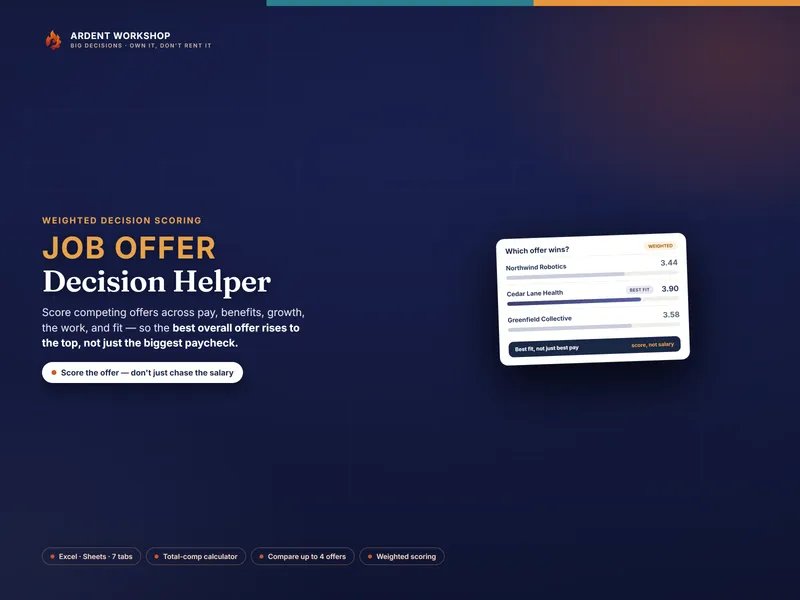
Job-Offer Decision Helper — Weighted Decision Matrix to Compare Job Offers (Excel & Google Sheets)
Compare competing job offers with a weighted decision matrix — score pay, benefits, growth, commute & fit, and rank offers by overall fit.
Big DecisionsView details - $19.95 Spreadsheet
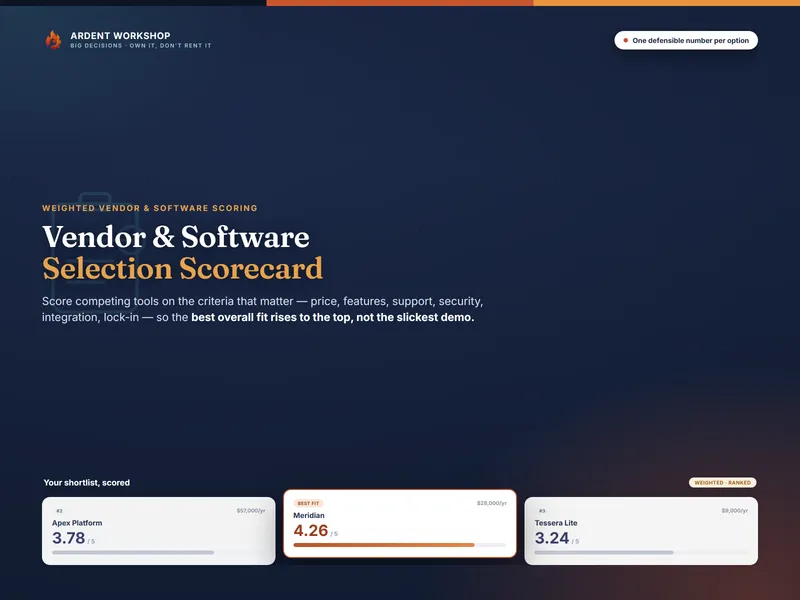
Vendor & Software Selection Scorecard — Weighted Decision Matrix to Compare Vendors & Score Software (Excel & Google Sheets)
Compare vendors & software with a weighted scorecard — score price, features, support, security & integration, and rank options by overall fit.
Big DecisionsView details