Everyone says it: “Looking for a job is a full-time job.” It gets repeated so often that it’s stopped meaning anything. So let’s take it literally. If job hunting really is a full-time job, then somewhere out there should be a job posting for it — duties, qualifications, compensation, the works.
There isn’t, so we wrote one. Below is the honest listing for the role you’re already working whether you applied for it or not. And because nobody hands you an onboarding packet for this position, the second half is the part that actually matters: how to do this job without it quietly consuming your entire life.
It is, for the record, a real position with real hours. The median spell of unemployment runs roughly ten weeks (opens in new tab), and more than a quarter of unemployed workers (opens in new tab) have been searching for six months or longer. This is not a quick errand. It’s a job with a start date, a brutal commute (the distance from your bed to your laptop), and an end date you can’t see yet.
The Job Posting You Didn’t Apply For
Position: Full-Time Job Seeker Department: Your Living Room Reports to: Yourself (see “Reporting Structure”) Employment type: Full-time, indefinite, unpaid Location: Remote (not by choice)
Position Summary
We are seeking a highly motivated, infinitely resilient individual to conduct an open-ended search for paid employment. The successful candidate will apply to dozens of roles, tailor every document, perform unpaid labor disguised as “assessments,” and maintain a cheerful disposition while being ignored by strangers. This is a high-stress, low-feedback environment. The right person thrives on uncertainty and rejection.
Key Responsibilities
- Sourcing. Scour job boards daily for listings that are real, open, and not reposted from 2024.
- Application production. Tailor your resume and write a “personalized” cover letter for each role, knowing a human may never read either.
- Data entry. Re-type your entire resume into an application portal that already asked you to upload your resume.
- Outreach. Message former colleagues you’ve avoided for three years and ask, casually, if they know of anything.
- Unpaid project work. Complete “quick” take-home assignments that take six hours and lead nowhere.
- Interviewing. Attend rounds one through seven. Be enthusiastic in all of them.
- Follow-up. Send thoughtful thank-you notes into a void that does not echo.
- Recordkeeping. Track every application, contact, and deadline so you don’t apply to the same job twice or blank on which company you’re talking to.
Required Qualifications
- Comfort with ambiguity bordering on the clinical
- The ability to be ghosted and show up the next morning anyway
- Tolerance for the phrase “We’ve decided to move forward with other candidates”
- Self-motivation strong enough to function with zero supervision and zero applause
- Willingness to describe yourself as “passionate” in writing, repeatedly
Preferred Qualifications
- Prior experience explaining a gap on your resume without apologizing for existing
- Demonstrated ability to sound excited about a company you learned about 40 minutes ago
- A LinkedIn presence you’ve made peace with
Compensation & Benefits
This role is unpaid. Compensation is deferred and contingent on successful placement, with no guaranteed timeline. There is no PTO, because there is no one to ask. Benefits include a flexible schedule (see below), an excellent commute, and the slow erosion of your sense of time.
Candidates are responsible for funding the role themselves until placement. Severance is excellent, but only arrives on the last day.
Hours & Schedule
Hours are “flexible,” which is the most dangerous word in this listing. In practice, “flexible” means the job can expand to fill every waking hour — checking listings at the dinner table, refreshing your inbox at 11 p.m., feeling guilty on a Saturday for taking an afternoon off from a job that doesn’t pay you. There are no defined start and stop times unless you create them.
Reporting Structure
You report to yourself. You are also your only direct report. This means you set the goals, evaluate the performance, hand out the warnings, and decide whether today counted. It is the loneliest org chart ever drawn, and the lack of a manager is exactly why this job is so easy to do badly.
How to Actually Survive This Job
Here’s the turn: the cure for a job that has no structure is to give it structure on purpose. The people who come out of a long search with their confidence intact almost never treat it as “applying when I feel like it.” They treat it like the job it is — with hours, a pipeline, and a Friday review. Here’s how.
Set hours, then clock out
The single most protective thing you can do is decide when this job is open and when it’s closed. Pick a start time, pick a stop time, and treat the stop time as real. A job search run from 9 a.m. to 2 p.m. with a hard stop will out-produce one that smears guiltily across all sixteen of your waking hours, because the smeared version is mostly anxiety wearing a productivity costume.
A workable default looks like this:
| Block | Time | What you actually do |
|---|---|---|
| Sourcing | 9:00–10:00 | Find and shortlist new roles worth a real application |
| Deep work | 10:00–12:00 | Tailor 2–3 strong applications (quality over volume) |
| Outreach & follow-up | 1:00–2:00 | Messages, networking, thank-you notes, check-ins |
| Development | 2:00–3:00 | Skill-building, portfolio, interview prep (a few days a week) |
Five focused hours beats twelve frantic ones. Then close the laptop and let the rest of your day belong to you.
Measure the right output
The trap is counting applications sent, because volume feels like progress. It isn’t. The metric that actually predicts an offer is conversations started — replies, screens, interviews — not applications fired into portals. Ten tailored applications that spark two conversations beat fifty copy-pasted ones that spark none.
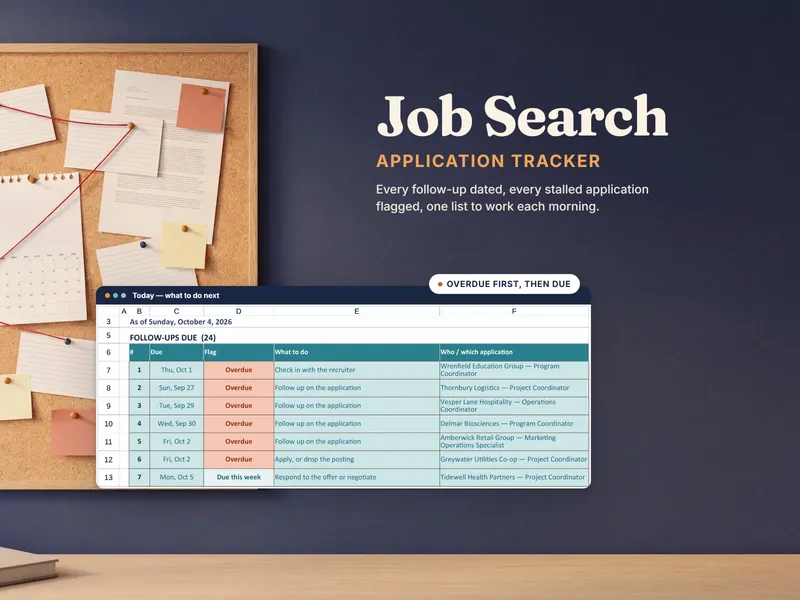
That only works if you can see your pipeline at a glance. This is the genuine reason “track everything” was in the responsibilities list — when you’re juggling 30 open threads, memory fails and good leads die from neglect. A dedicated job application tracker turns the chaos into a board you can read in ten seconds: who you’ve contacted, what stage each role is in, and which follow-up is overdue. A broader job search tool adds the planning layer on top — target companies, weekly goals, and the stats that tell you whether your funnel is healthy or leaking. (If you want the full setup, we walk through it in how to organize your job search.)
Schedule your own professional development
A real job gives you growth. This one will too, if you build it in. The downtime between applications is the best chance you’ll get to close the exact skill gaps that keep knocking you out of the running. The move is to make the gap visible: list the skills your target roles keep asking for, rate yourself honestly, and aim your study time at the widest gaps. A skills matrix does this in a single grid — it turns “I should probably learn that” into a ranked, finite to-do list, and doubles as proof of growth when an interviewer asks what you’ve been doing with your time.
Run a Friday performance review
Every job has reviews. Give yourself one, once a week, and keep it to ten minutes:
- What moved? Conversations started, interviews booked, skills practiced — the real outputs.
- What’s stuck? Applications with no reply after two weeks, leads gone cold, a resume that isn’t landing.
- What’s the plan for next week? Three concrete priorities, not a vague vow to “try harder.”
This is the manager you don’t have. It catches a broken strategy in week three instead of week ten, and it gives you evidence — on the bad days — that you are, in fact, working.
Protect the “salary” you don’t have
Because the role is unpaid, your real compensation is the runway that buys you time to find the right fit instead of the first desperate one. Treat protecting it as part of the job: know your monthly number, trim what you can, and check the balance without flinching. Financial breathing room is what lets you turn down a bad offer — which is its own kind of leverage. We cover the mechanics in stretching your money between jobs.
The Best Part of This Job: It Ends
Here’s what the posting leaves out. Unlike most jobs, this one comes with a guaranteed exit and outstanding severance — the offer itself. Every search ends. The only thing you control is whether you spend the middle of it frantic, formless, and on call 24/7, or clocked in for honest hours with a system doing the remembering for you.
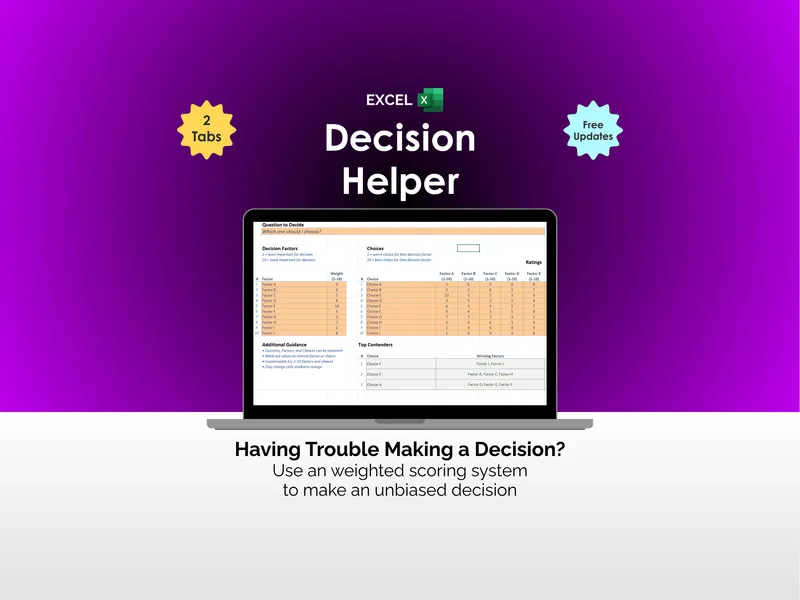
So take the cliché at its word. It is a full-time job. Give it a schedule, a pipeline, a weekly review, and a hard stop at the end of the day — and when the offers do come, run them through a clear-eyed decision framework instead of grabbing the first one out of relief. You didn’t apply for this position. But you can absolutely be the best person who ever worked it.