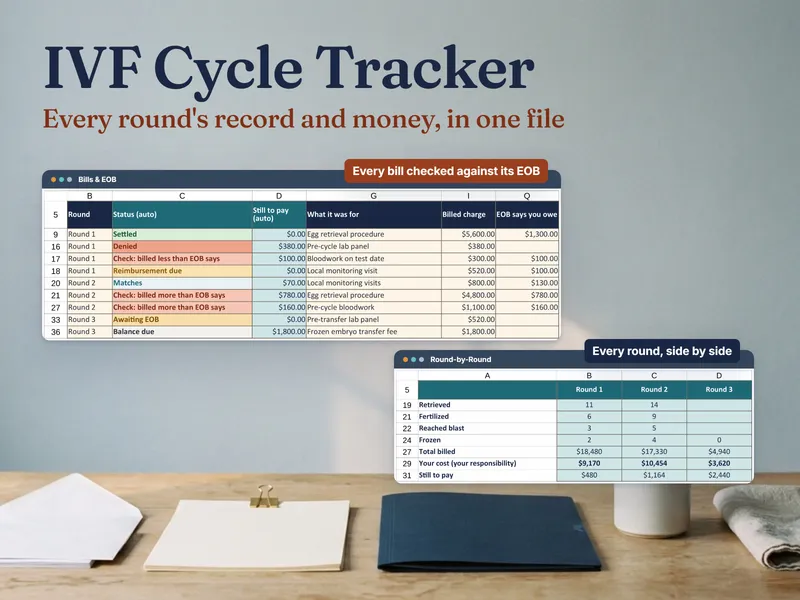
Fertility treatment asks a lot of you, and it also produces an unusual amount of paperwork. There are dose sheets that change, appointment times that move, lab results posted to a portal, bills from the clinic, the lab, the pharmacy and sometimes an anesthesia group, and insurance statements that rarely line up with any of them. When someone asks “what did that round actually cost?” or “when did we start that medication?”, the answer is often scattered across several places.
A single record fixes that. The short answer: keep one record per round, with the quote and plan figures, a medication log copied from the clinic’s sheet, monitoring and lab results as reported, and every bill matched to its insurance statement. The stage-by-stage table sums it up.
The record does not need to be fancy. It needs to be one place, kept as things happen, in the clinic’s own words for anything clinical. The IVF Cycle Tracker & Fertility-Clinic Decision Helper is a workbook built around exactly this method, and if you want to try the idea first, the free one-round IVF tracker and two-clinic scorer covers a single round. Either way, you keep a file you own, not an app subscription that holds your history.
What this guide is, and is not
It is a way to organize records. Everything clinical here means “write down what your clinic told you, as they told you.” Nothing below tells you what to take, when, or what a result means, and no record can do that. Your clinic’s instructions come first, and a call to them is the answer to any question about your care.
The same method works however your family is built. A solo path, donor eggs, donor sperm, donor embryos, a gestational carrier, a same-sex couple: each round is one record with whatever applies filled in and the rest left blank. Round types vary too. A fresh round, a frozen transfer, egg freezing, embryo banking and IUI can all be tracked the same way.
Before you start: the quote and the plan documents
The most useful records are the ones you save before the first appointment.
- The clinic’s written quote. Keep it, and go through it line by line. Quotes often cover monitoring, retrieval, lab work, medications, add-ons and storage differently from one clinic to the next, and a line that is not mentioned is not the same as a line that is free. Mark each line as included, extra, or unknown, and treat every unknown as a question to ask.
- Your plan documents. Note what the plan states for the deductible, the out-of-pocket maximum, any separate fertility benefit, and any limit on the number of covered rounds or procedures. Write down whether a limit is per plan year or lifetime, using the plan’s own wording. Your plan and your insurer decide what each of these means and what counts toward it.
- One row for the round. Give the round a type, a clinic and start date, and a status. Every later record points back to this row, so bills and results add up per round.
If you are paying yourself, you can skip the insurance parts entirely and still keep everything else.
During stimulation: the medication log and monitoring visits
The medication log. Give each dose its own entry: date, time, medication, injection site and any side effects. The one rule that matters is to copy the dose as text, exactly as written on your clinic’s sheet. Do not convert it, recalculate it or tidy it up. If the clinic changes the instruction, copy the new instruction and call them if anything is unclear. Your record then shows what the sheet said at the time.
If you want to keep track of supplies, count what was received from the box label and subtract what you use. That is simple counting from the label and nothing more. A site record is also handy, so you can see where each injection went and rotate as your clinic advised.
Monitoring visits. For each appointment, record the date, what was reported to you, and what the clinic said to do next. Store lab values and counts exactly as reported. Leave out normal ranges, color flags and your own commentary. What any number means for you is a conversation for your clinic, and a plain record of what was said keeps that conversation accurate.
Upcoming items. A planned dose, appointment or call with a date is easiest to manage when you can see what is due over the next few days in one place. A spreadsheet cannot buzz your phone, so if you rely on a timed alarm for a dose, keep using the one your clinic suggests, and use the record to show that it happened.
Retrieval and lab results
After a retrieval, write down the date and then each step the clinic reports, in the order it is reported, using the clinic’s wording for counts and grades. Keep a running list of anything in storage: what it is, where it is kept, and when storage fees are due. Do not rank, predict or interpret. Your clinic or lab owns that explanation, and your record’s job is to hold what they said.
Transfer and the two-week wait
Record the transfer date and whatever the clinic reports about it. If it helps, count the days since transfer so you can see where you are in the wait. Some people find a few lines of notes in their own words each day more useful than anything else in this stage. Write the notes whichever way the result goes. A round that does not work still belongs in the record as a finished round, with its costs and results intact, because it feeds the comparison later.
Bills and EOBs, as they arrive
This is the stage that gets away from people. A clinic bill and an insurance statement are two separate papers about the same service, and they can disagree.
An EOB (explanation of benefits) is the statement your insurer sends after it processes a claim. It is not a bill. It says what was billed, what the plan allowed, what the plan paid, and what the plan says is your share.
For each charge, enter the provider’s bill and, once it arrives, the matching EOB figures. Then each line falls into one of a few states, and each state tells you what to do:
- Awaiting EOB: the claim went to insurance and no statement has come back. Decide on a number of days you will wait before following up, and once they pass, ask the insurer where it is.
- Waiting on bill: an EOB says you owe something but the provider’s bill has not arrived. Check mail and the provider’s portal.
- Billed more than the EOB says: call the provider’s billing office with the EOB in hand and ask them to explain the difference before you pay.
- Billed less than the EOB says: ask whether a second bill is coming.
- Denied: read the reason on the EOB, ask the plan what an appeal involves, and ask the provider whether a correction is possible.
- Reimbursement due: you paid and the plan owes you. Follow up and keep the claim number with the entry.
- Settled: nothing is owed either way.
Write what you were told on each call in the row, with the date. To choose which call to make first, sort the unpaid items by amount, then by round or provider, and start with the largest. For the general process with any medical bill, see reviewing and appealing a medical bill.
After the round: compare it with the last
Once a round ends, put it next to the others using only your own numbers: the dates, the steps the clinic reported, the outcome in plain words, the total cost and the part you paid yourself. There is no outside benchmark in this comparison, and it should not say whether a result is good, typical or low. It shows your rounds against your rounds.
A one-page summary of the last round, what it cost and where your funding and benefits stand, is worth carrying into the next consult. The conversation then starts from facts you can point to and not from memory. If you plan to change something for the next round, write down the percentage change you expect in each cost group (a clinic fee up 10%, a medication cost down 25%) and let the arithmetic follow from your last round. That is an estimate of your own share, not a prediction.
What to record at each stage
| Stage | What to record | Where it comes from |
|---|---|---|
| Before you start | Round type, clinic, dates; the written quote with each line marked included, extra or unknown; plan figures and any covered-round limit | Clinic quote, plan documents |
| Stimulation | Date, time, medication, dose as text, injection site, side effects; supply counts from the label | Clinic's medication sheet, box labels |
| Monitoring visits | Visit date, what was reported, what the clinic said to do next | Clinic staff, patient portal |
| Retrieval and lab | Retrieval date; counts and grades exactly as reported; what is in storage and storage due dates | Clinic and lab reports |
| Transfer and the wait | Transfer date, what the clinic reported, daily notes in your own words, the result in plain words | Clinic, your own notes |
| Bills and EOBs | Provider, service date, billed charge, EOB figures, what you paid and from which source, status, call notes with dates | Provider bills, insurer EOBs |
| After the round | Total cost and your own cost, outcome in plain words, what you expect to change next time | Your own record |
Why the money record matters across rounds
It is easy to start with dates and appointments and only later find that the money is the harder part to reconstruct. A few reasons to keep the cost ledger from the first bill.
Bills come from several providers. The clinic, the lab, the pharmacy, an anesthesia group and a storage facility may all bill separately and on their own schedule. A ledger by provider and round lets you see what is open at any moment without opening several accounts.
Each bill needs its statement. The only way to know whether a bill is right is to put it next to the EOB for the same service. Two papers, one service: when they agree you can pay with confidence, and when they do not, you know which call to make.
Insurance counts by plan year. Deductible and out-of-pocket counters generally begin again when a new plan year starts, so a service in December and one in January land in different years. If you track by service date, the split happens on its own. A lifetime limit, by contrast, carries across years.
Also keep the figures your plan states for the deductible, the out-of-pocket maximum, any separate fertility benefit and any covered-round limit, and let a simple roll-up show what has been used and what is left.
If you paid a provider directly with no claim filed, ask the plan whether that payment counted toward your deductible or fertility benefit, and mark it yes, no or not sure instead of assuming.
A quote is not a price until the gaps are answered. A clinic quote that leaves out medications, tests or add-ons can look cheaper than one that lists them. Marking every unanswered line as unknown, and treating a quote with unknowns as a floor and not a total, keeps an incomplete quote from looking like a bargain. Lines that happen once, such as a one-time fee, should count once, and a multi-round package credit should count only if you plan more than one round.
The next round starts from what the last one cost. With each round’s total and out-of-pocket cost recorded, you can see the cost per round and for the number of rounds you plan, including travel and split care, if you do monitoring at one clinic and the procedure at another. You can also see where the gap sits between your funding (savings, loans, grants, benefits) and what is still to pay.
If you hold an HSA or FSA, a year-by-year record of what you paid from it keeps the figures in one place. What counts as eligible is a question for your plan administrator or a tax professional.
A note on comparing clinics
If you are choosing a clinic or deciding whether to switch, a written list of questions with each clinic’s answers, who you asked and when, keeps the comparison honest. Set your own weights for what matters (cost, location, communication, financing, results) and score each clinic against them. Someone who must travel will weight things differently from someone around the corner.
Be careful with published success rates. SART’s clinic report says: “The data presented in this report should not be used for comparing clinics.” It points to differences between clinics in patient selection and treatment approaches, which can make one clinic’s rates look higher or lower than another’s.
CDC says comparison of success rates across clinics “may not be meaningful,” and that clinic success rates “do not reflect any one patient’s chance of success.” CDC also calculates the two egg-source figures differently: rates for patients using their own eggs are cumulative, based on egg retrievals performed in the prior year, while rates for patients using donor eggs or embryos are noncumulative, based on transfers performed that year.
Sources: the SART Clinic Summary Report (sartcorsonline.com) and CDC, “How to Interpret ART Success Rates” (opens in new tab), both read November 9, 2026.
Given those cautions, if you record a published rate at all, record the source, the metric, the age band, the egg source and the data year alongside it, so you do not set two numbers side by side that were measured differently.
Keep it private
A record like this holds health and money details. Keep it in a file you control. If it lives in a Google Sheet, keep its sharing set to Restricted and think before you email the file or send its link. On a computer other people use, password-protect the file or sign out when you finish, and put printed pages somewhere private. Some days you will also want paper: a printable medication log, monitoring log and journal pages you fill in by hand, then copy into the file when you have a few minutes.
Do it the easy way
You can keep all of this in a notebook or a plain spreadsheet. The method matters more than the tool. The free one-round IVF tracker and two-clinic scorer gives you a place to start for a single round. When you want every round in one file, with bills matched to statements, plan-year benefits rolled up, rounds laid side by side and a one-page brief for your next consult, the IVF Cycle Tracker & Fertility-Clinic Decision Helper does the bookkeeping. It opens on a worked example with fictional clinics and generic medication names, includes printable pages, and works for self-pay with the insurance parts left blank. It is a file you own outright, not a subscription.
This is a records-organizing method. It is not medical, insurance or tax advice, and it does not tell you what to take, what a result means, or what your plan will pay. Follow your clinic’s instructions, call them with any question about your care, and confirm coverage questions with your insurer or plan administrator and anything touching your taxes with a qualified tax professional.