Everyone has a travel bucket list. Almost nobody has one written down in a way that actually moves. The trips live as a vague feeling — someday Japan, someday the northern lights — and someday keeps not arriving, because a feeling has no priority, no price, and no next step.
A good travel bucket list fixes that. It’s not a longer wish; it’s a plan with a top. In short: dump every dream into one list, split where you’ve been from where you want to go, give each a priority, attach a target year and budget, track your countries visited, and review it once a year. Here’s how to keep one — the same method the Travel Bucket-List & Countries-Visited Tracker uses, so you can build it in any spreadsheet or let the workbook build it for you.
Step 1: Dump every dream into one list
Start by emptying your head. Write down every place and experience you want to see — countries, cities, landmarks, festivals, a specific hike, a specific meal — into one list, without ranking or filtering anything. Machu Picchu at sunrise. The Serengeti in migration season. A gondola through Venice. The Great Wall on a quiet stretch.
You can’t prioritize a list you haven’t captured, and writing them all down is often the first time you see how much you actually want to do. Don’t judge the list yet. Just get it out.
Step 2: Split where you’ve been from where you want to go
Now sort the list into two piles: places you’ve Visited and places you Want to Go. The visited ones aren’t clutter — they’re your map so far, and counting them is half the fun. The rest are the true bucket list.
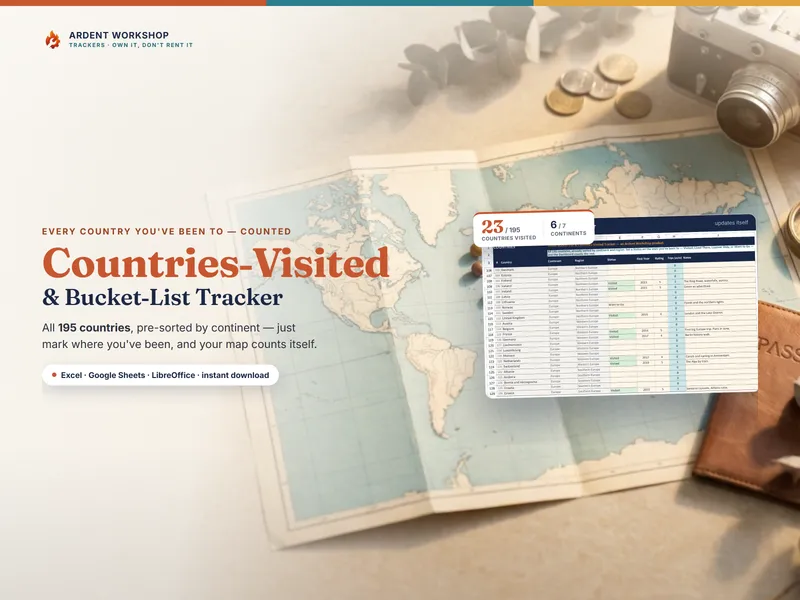
This is also where a good tracker earns its keep: instead of you researching and typing every country, the tracker comes pre-loaded with all 195, already sorted by continent, so you just mark the ones you’ve been to and the counting is done for you.
Step 3: Give each dream a priority
A bucket list where everything is equally important is a bucket list where nothing happens. Tag each dream with a priority:
- Must-Do — the handful of trips that would genuinely change your year. Keep this list short.
- High — you really want it, and it’s realistic in the next few years.
- Someday — the far-off, expensive, or logistically hard dreams. Still worth writing down.
Reserving Must-Do for a few trips gives the list a top. When you have time or money to plan a trip, you look at Must-Do first — not at forty undifferentiated wishes.
Step 4: Attach a target year and a rough budget
This is the step that turns a daydream into a plan. Give each Must-Do a target year and a rough budget. The budget isn’t there to discourage you — it’s there to make the dream real. “Someday, the northern lights” is a feeling. “About $3,500, next December” is a number you can save toward at a couple hundred dollars a month. (Do the same for your High dreams when you’re ready; the Someday ones can stay unpriced until they move up.)
Give each dream its own status as it gets real, too: Dreaming at first, Booked once it’s on the calendar, and Done the day you get home. Watching a dream move to Done is the whole reward.
Sort your list by budget sometime. The cheapest Must-Do on it is often closer than you’ve been telling yourself.
Step 5: Track your countries visited
The other half of a travel bucket list is the running tally of where you’ve already been. Keep a count of your countries visited out of 195, and break it down by continent — twelve of forty-four in Europe, two of fifty-four in Africa. That continent-by-continent picture shows you where your map is full and where it’s waiting, and it quietly nudges the next trip.
It’s also the most shareable thing in travel: “countries visited” is a life told in a single number, and it’s yours to post any time.
Step 6: Review it once a year
Once a year — New Year’s, or the anniversary of a big trip — read the list back. The trips you took. The countries you added. The dream you finally moved to Done. It takes two minutes and it’s the closest thing to a photograph of a year of travel. Then set a countries goal for the next year and start again.
The point isn’t to finish it
Almost nobody visits all 195 countries, and that’s not the goal. The goal is a life with more pins in it than last year — and a list that makes the next trip obvious instead of overwhelming.
If you’d rather not build the spreadsheet yourself, the Travel Bucket-List & Countries-Visited Tracker does all of this in one owned file: all 195 countries pre-loaded, a live dashboard that counts your map and your continent coverage, a bucket list that runs from Dreaming to Booked to Done, and a year-in-travel recap. Or start with the free places-I’ve-been starter — one tab, no signup.