Right now, at the end of August, the holiday season looks enormous. There are something like fifteen calendar weeks between here and the last box you’ll tape shut. Fifteen weeks is obviously enough time to launch the new line, do the three markets, say yes to the custom orders, and restock the shop twice.
It isn’t. It never was. And the reason you find that out in the second week of November is that the question never gets asked in a form that has an answer.
Holiday production planning is not a mood or a motivation problem. It’s a multiplication problem, and it has one output: the number of finished pieces you can physically make between today and your last ship date. That number exists whether or not you calculate it. The only choice you get is whether you learn it now, while it’s still a planning tool, or in December, when it’s just a description of what went wrong.
Reading this in October instead? Same five steps, fewer weeks — Step 1 gives you your own number.
What Holiday Production Capacity Actually Is
Holiday production capacity is the total number of finished, packable pieces your available making hours can produce before your last ship date — after you subtract everything that eats those hours but isn’t making.
That last clause is the whole thing. The error is rarely in how fast you work — that part you can time. It’s in how many hours are left over once the season’s non-making work has taken its cut: the messages, the packing, the market setup, the restock order that came in wrong, the four hours you lost to a printer.
This is capacity planning — the thing agencies and studios do with a resourcing spreadsheet before they say yes to a project — shrunk down to fit one person’s hands. The mechanics are identical. Committed work on one side, real available hours on the other, and a decision that gets made in advance instead of absorbed later.
Five steps. Do them in order.
Step 1: Count Your Real Making Weeks, Not Calendar Weeks
Start from your last ship date and count backward in weeks. Then take out the weeks you already know you’ll lose, so what’s left is making time rather than calendar time.
Your last ship date is not December 24th. It’s the last day you can hand a package to a carrier and still have it arrive in time, minus a safety day — and the later your customers order, the less that safety day is worth. The postal service publishes recommended send-by dates each fall (opens in new tab); check them when they post, but plan now on the assumption that your last ground shipment leaves around the third week of December.
So: roughly fifteen calendar weeks from now. Now take them apart. Start with the days you actually make on in a normal week — for anyone with a day job that’s rarely seven, so count yours — then subtract the whole days the season takes back:
| Subtract | Rough allowance |
|---|---|
| Market and fair days (setup, sell, teardown) | 1.5–2 days each, and you make nothing on them |
| Thanksgiving week | Half a week, minimum |
| Supply stalls (a material arrives late) | 2–4 days per season |
| Sick days, a broken tool, one genuinely bad week | 3–5 days |
These are planning allowances to argue with, not measured averages — replace each one with what actually happened to you last year.
Convert each allowance into your making days before you subtract — a market weekend only costs you the weekend days you’d otherwise have been making on. The maker in the example below works five days in a normal week (four weeknights and a weekend day), so fifteen calendar weeks starts life as 75 making days. One market weekend costs 1 of them, Thanksgiving week takes half of five, one supply stall costs 2 and three bad days cost 3 — 8.5 gone, leaving 66 and a half. Divide by that same five-day week: 13.3, rounded down to thirteen usable weeks.
That’s the number Step 4 starts from, and it’s the first place the calendar stops flattering you. Two weeks vanished before you made anything, and you haven’t touched a single hour of overhead yet.
Step 2: Find Your Honest Making Hours
Count the hours you have historically made in, not the hours you wish you had. Then subtract the work that is not making.
This is the step people skip, and it’s the one that does the damage. Our maker works four weeknights (2.5 hours each) and one weekend day (6 hours). That’s 16 hours a week — call it 208 hours across the 13-week run Step 1 just produced.
Except a meaningful share of that is not making. It’s packing the orders that arrive while you’re making. It’s photographing and listing. It’s replying to “would you be able to do this in blue?” It’s driving to the supplier because the shipment didn’t come. That overhead eats a bigger share of the bench in the holiday season than the rest of the year, because order volume — the thing generating all of it — is exactly what’s going up.
If you’ve never measured it, start from a 30% deduction and replace it with your own number after one tracked week. The point is that the deduction exists, not that it’s exactly thirty: nearer 20% if you don’t ship, closer to 40% if you’re running markets — planning allowances to argue with, not measured averages. Take 30% off the top and 208 hours becomes about 146 hours of actual making.
If that feels harsh, track one week honestly before you argue with it. If your guess is wrong, it’s more often wrong low than high — the overhead you can’t recall is the overhead you never counted.
Step 3: Measure One Piece From Start to Packed
Time one finished piece, end to end, the way you’ll actually make it in November — batched. Include everything between raw materials and a box with a label on it.
Two traps here, and both of them inflate your capacity if you’re not careful:
- Timing the fun part only. The pour, the stitch, the decorating — that’s the part you remember. The trimming, curing checks, labeling, wrapping, and boxing are the part that actually eats the clock. Time the whole span.
- Timing one piece instead of a batch. If you make in batches of 24, don’t time a single unit made alone — you’ll capture all the setup and cleanup in one piece and get a wildly pessimistic number. Time the whole batch, then divide. Batch size is often the largest single driver of your per-piece number, because setup and cleanup amortize across the whole batch instead of landing on one item.
Do not use cure time, dry time, proof time, or rest time. Those are calendar constraints, not labor constraints — they belong in your scheduling, not your capacity math. Twelve hours of curing costs you nothing if you’re asleep for eight of them and making something else for the other four.
The output of this step is one number: minutes of your hands per finished piece. If you sell a mix of items, do this for your top two or three sellers and use a weighted average.
No timed batch yet? Use last season’s total pieces divided by your total making hours as a placeholder, and replace it the first time you batch this month. If you have never costed a piece this precisely before, the same measurement is what underpins how to calculate recipe cost — you’re just measuring labor minutes instead of ingredient dollars, off the same batch.
Step 4: Multiply, Then Subtract the Reserve
Convert your real making hours to minutes, divide by your per-piece time, then hold back 20% of the result.
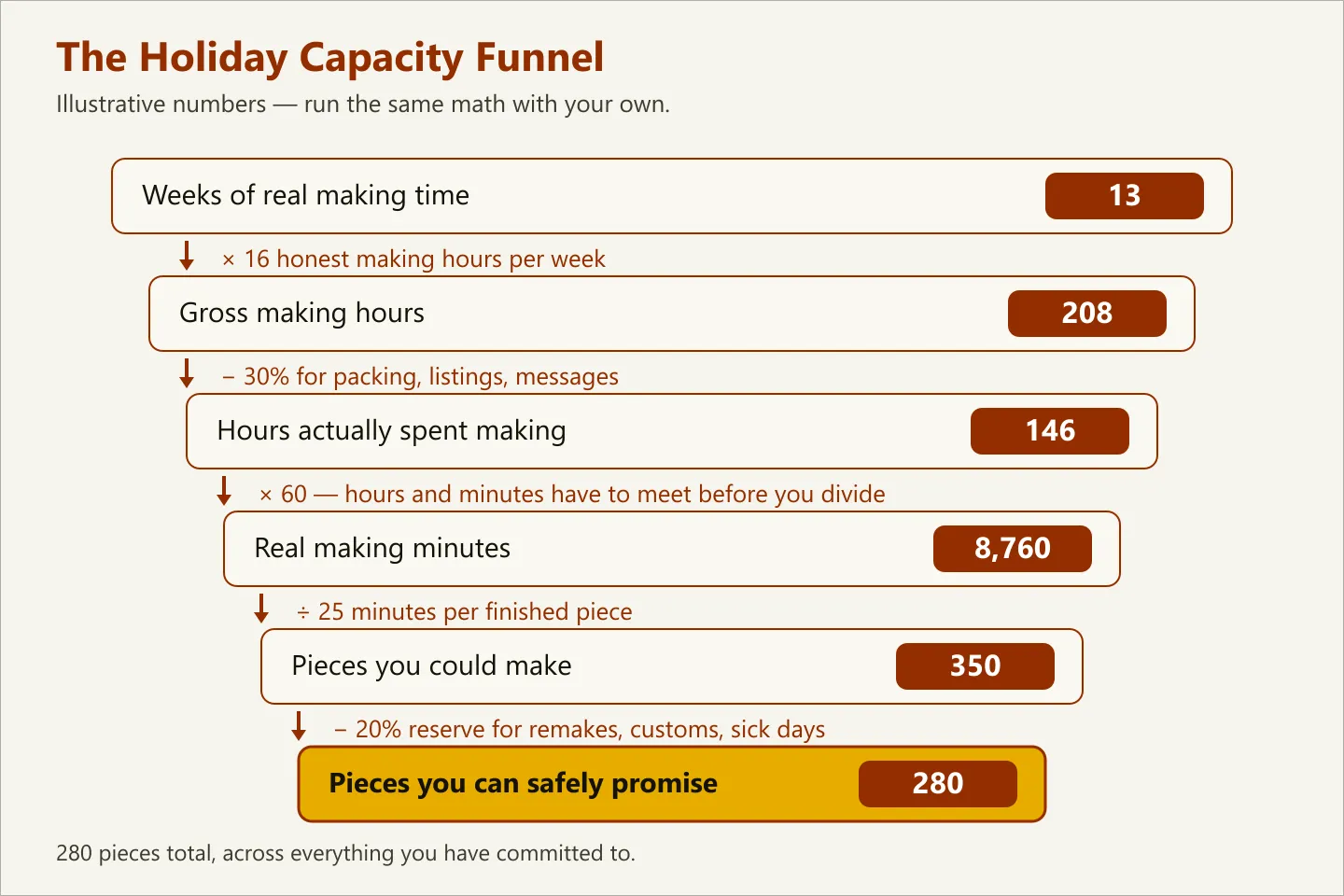
Here’s the whole calculation with illustrative numbers — a maker with a day job, working evenings and one weekend day, making a piece that takes 25 batched minutes. The three bolded input rows are what you supply yourself; the bolded final row is your answer, and everything between them is arithmetic:
| Line | Illustrative number |
|---|---|
| Weeks of real making time (Step 1) | 13 |
| × honest making hours per week (Step 2) | 16 |
| = gross making hours | 208 |
| − 30% for packing, listings, messages, restocking | 146 hours |
| × 60 to get minutes | 8,760 |
| ÷ minutes per finished piece (Step 3) | 25 |
| = pieces you could make | 350 |
| − 20% reserve | 280 pieces |
That unit change in the middle is where most back-of-envelope versions of this go wrong: Step 3 hands you minutes while Steps 1 and 2 hand you hours, so the two have to meet before you divide.
The reserve is not pessimism, it’s the cost of being a real business in December. It covers remakes when something ships broken, the custom orders you’ll take despite your rule, the week you lose to a cold, and the market that sells out on Saturday morning and leaves your shop empty for a week.
And it covers the shape of holiday demand, which is not a gentle ramp. A record 202.9 million consumers shopped over the five-day stretch from Thanksgiving through Cyber Monday in 2025 — up from 197 million the year before, and past the previous record of 200.4 million set in 2023, according to the National Retail Federation’s annual survey (opens in new tab). Whatever share of that lands on you arrives as a spike, not a trickle. The stock has to already exist when it hits. You cannot make your way through a spike; you can only sell through it.
So: 280 pieces. Not 280 pieces plus the new line, plus three markets, plus wholesale. 280 pieces total, across everything you’ve committed to. That’s the sentence that changes decisions.
Step 5: Close the Order Book on Schedule
Work backward from your last ship date. Every one of these is a date, not an intention, and each exists to protect the number you just calculated. Start from these defaults and pull each one earlier if your suppliers or your season say so.
| Milestone | Count back from your last ship date | Why |
|---|---|---|
| Last supply order of the season | 8–10 weeks | Supplier lead times are least predictable in Q4, and you need room for one failed delivery |
| Last new-product launch | 6 weeks | A new design needs photos, a listing, and a first batch before it can earn anything |
| Close custom and personalized orders | 4 weeks | Each one carries hidden hours — messages, mockups, a revision — that aren’t in your per-piece time |
| Stop making, start packing | 5–7 days | Packing a December backlog is a full-time job on its own |
| Last day for standard orders | 0 days — this is your last ship date | Everything above exists to make this date survivable |
Put all five in your phone calendar now, with a reminder two weeks ahead of each. The dates only work if you meet them without deliberating, and you will absolutely deliberate the first time someone asks for a custom order eleven days out.
What to Do When the Number Comes Back Too Small
It often does, the first time. That’s the point — it’s a number you can act on now, with the whole runway still ahead of you. You have five real levers, roughly in order of how much they return for what they cost you:
- Cut SKUs before you cut anything else. Every additional design multiplies setup, materials, photography, listing time, and packing variation — so a season run on five designs instead of twelve buys back hours in every one of those columns at once. It’s the highest-return move on this list and it costs you nothing but the fear of missing out.
- Deepen the batch. If 24 at a time gives you 25 minutes a piece, 48 at a time might give you 18. Find out before November, because it changes the whole calculation upstream.
- Pre-make components, not finished goods. Cut, pour, blank, base — do the parts that don’t expire or go out of style now, and leave assembly and personalization for later. This converts September hours, which are cheap, into December capacity, which is not.
- Buy back hours you’d otherwise spend on non-making. Pre-printed labels, pre-folded boxes, a scheduled-post batch, an hour of help on packing nights. Every hour you buy back goes straight into that 146.
- Raise the price and make fewer. The last lever, and the one that feels riskiest — even though it’s the only one that increases what the season is worth without increasing what it costs you. More on that below.
Notice what isn’t on the list: work more hours. You can try. It is the lever with the worst return and the highest cost, and it’s the reason the season has a reputation.
Your Capacity Number Is Also a Pricing Number
Once you know you have 280 pieces and not an unlimited supply, one thing follows immediately: each piece is worth more than you’ve been charging.
That’s not a motivational statement, it’s arithmetic. A fixed supply meeting a seasonal demand spike is the classic condition for raising a price, and gift buying is plausibly less price-sensitive than buying for yourself. Selling out at your old price isn’t a triumph — it’s evidence that the price was wrong and that you gave away the difference. If that lands uncomfortably, how to price handmade goods is the longer version of the argument.
The capacity number is what makes the decision safe. Without it, raising prices feels like a gamble against demand. With it, you already know the ceiling on what you can supply, so the only question left is what those pieces should be worth.
Where the Number Lives After Today
A number you calculate once on the back of an envelope is worth roughly one afternoon. The value comes from the number moving — because it will. You’ll lose a week. A material will double in price. A market will get cancelled. The capacity figure that was right in August is wrong by the second week of October, and the whole point is knowing that in October rather than assuming August still holds.
That means it has to live somewhere connected to the rest of your operation: the same file that knows your per-piece times, your materials, your open orders, and what’s already made and sitting in a bin. When those things live in four different places, the capacity number silently goes stale and you’re back to guessing — knowing what’s actually in the bins is its own discipline, and one usually learned the expensive way — see craft business inventory management.
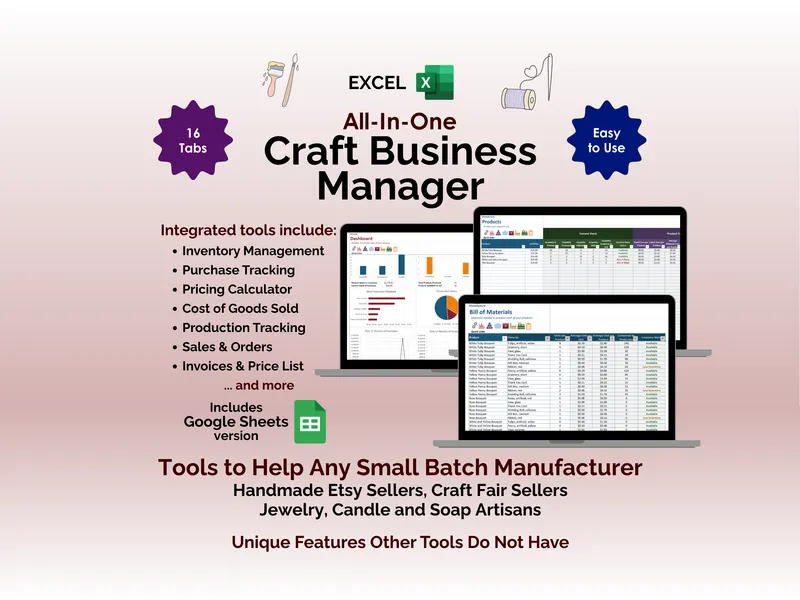
- The Craft Business Manager ties production, costing, inventory, and sales together across one connected workbook, so recording a batch updates your materials, your costs, and what’s actually left in the bins.
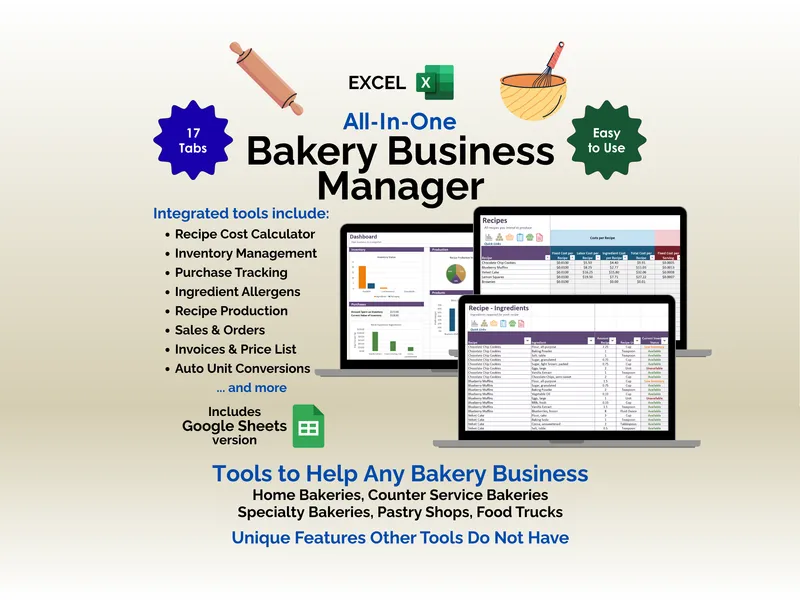
- Bakers running the same math on trays instead of batches want the Bakery Business Manager, which carries recipe costs, ingredients, and per-serving costing through to profit.
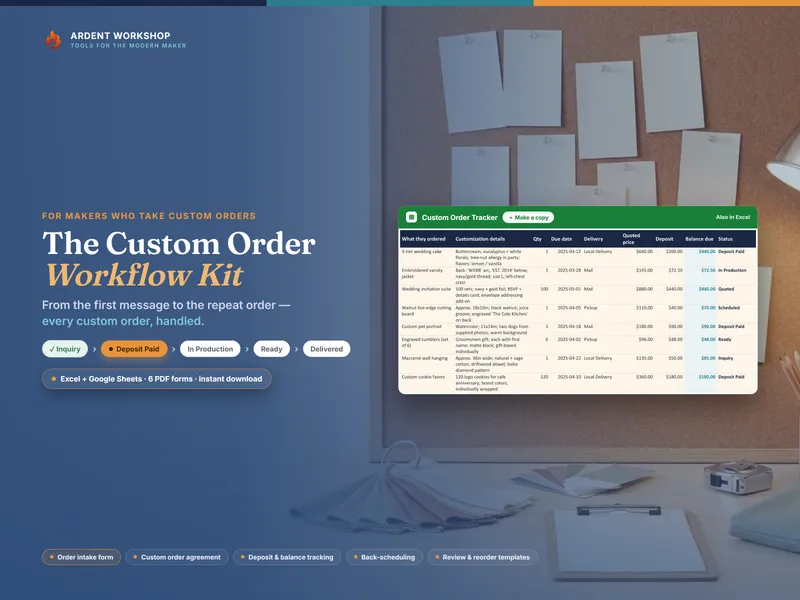
- If the pressure point is the orders themselves — intake, deposits, proofs, and a production schedule you can actually sequence — the Custom Order Form & Tracker is built for the part of the season where custom work quietly eats the reserve.
The files are yours to keep — one purchase, no subscription, no monthly seat fee, and your whole operating history stays in your hands. If you do one thing after reading this, open the Craft Business Manager and put today’s number in it, so the next version of that number updates itself instead of waiting for another envelope.
And when a spreadsheet genuinely stops being the right tool — multiple makers, real wholesale accounts, stock moving faster than one person can reconcile — Ardent Seller (opens in new tab) is the next rung up, and the number comes with you.
Common Questions About Holiday Production Planning
How many hours a week should I plan for holiday making?
Whatever you actually hit last year. If you don’t know, track this coming week before you plan anything around it — planning on twenty hours and making twelve is how the December crunch starts, and the fix is never working harder in week eleven, it’s planning on twelve in week one.
When should I stop taking custom orders for the holidays?
Four weeks before your last ship date, and earlier if a custom piece needs a proof, an approval, or a material you don’t stock. Set that date before anyone asks, because the request that breaks the rule always arrives with a good reason attached — and if you do say yes past the cutoff, price it as a rush and take the deposit up front instead of quietly absorbing it into your reserve.
What if my capacity number is smaller than last year’s sales?
Then last year you either worked hours you didn’t plan for, or you sold things you’d already made. Both are worth knowing in September rather than November. The number isn’t telling you the season will be worse; it’s telling you where the extra came from, so you can decide whether to spend it again on purpose.
Do I need to do this if I only sell at one or two markets?
Yes, and it’s faster — a market has a fixed date, so your last ship date is just the night before setup. The count matters more at small volume, not less, because one weekend of lost making is a much larger share of your total.
The Takeaway
The season doesn’t get harder in December. It gets visible in December. Everything that makes November brutal was decided quietly in August and September, by a series of small yeses made against a calendar that looked infinite.
Your real making weeks. Your honest hours in each one. Your minutes per piece. Twenty minutes of arithmetic — once you’ve timed a single batch — before the first yes.