What the plan actually compares
Every capacity plan is a balance between two quantities, read forward over the weeks or months ahead:
- Demand — the hours the work you've committed to will require: projects sold, projects likely to land, and the standing internal work that never goes away.
- Supply — the hours your people can actually give in the same period, once you subtract time off, holidays, part-time schedules, and non-billable commitments.
Where demand exceeds supply you have over-allocation — more booked than the team can deliver without overtime or slipped deadlines. Where supply exceeds demand you have slack — capacity you're paying for that isn't turning into client work yet. Capacity planning is simply making those two numbers visible, per person and per period, before the month begins.
The resourcing decision it exists to answer
The reason to plan capacity isn't the spreadsheet — it's the decision. "Can we take this on?" is the most expensive question a service business answers on instinct. Say yes when you're already full and you pay in overtime, rushed quality, or a missed deadline; say no when you had room and you leave revenue on the table. A capacity plan replaces the flinch with a look: drop the prospective project's hours onto the people who'd staff it and see whether they still fit, or which week they stop fitting.
The same view answers the questions downstream of that one: do we need to hire, or just move work between people? Which month does the team first run tight, so we can start recruiting or pushing back timelines now instead of in a panic? Who has room this week to pick up the overflow from someone who doesn't?
Spotting over-allocation and slack
- Over-allocation hides in averages. A team that looks comfortably booked overall can still contain one person at 130% and another at 50%. The plan that only shows a team total misses exactly the imbalance you can fix; the useful plan is per person.
- Slack isn't failure — until it's chronic. A little unbooked time is healthy headroom for the unexpected and for chasing new work. Persistent, large slack is a sales problem or an over-staffing one, and worth naming early.
- The first tight month is the signal that matters. Knowing the team is fine now tells you little. Knowing that March is the month the commitments outrun the hours tells you when to hire, subcontract, or renegotiate a date — while there's still time to do any of them.
Capacity planning vs. project scheduling
They're often confused. Project scheduling sequences the tasks inside one project — what happens in what order, and by when. Capacity planning sits a level up: it looks across all the projects at once and asks whether the people exist to do them at all. You can have a flawless schedule for every project and still be badly over-committed as a team — because no single project's plan can see the other projects competing for the same people. Capacity planning is the view that can.
How often to do it
Capacity planning is a rhythm, not a one-off. A monthly or biweekly look a couple of months out is enough for most small teams — often enough to catch a tight month while you can still act, not so often it becomes busywork. The point is to always be looking a little further ahead than your current commitments, so the crunch is something you see coming rather than something you survive.
Common mistakes
- Planning against gross hours. Treating everyone as a full week of available time ignores PTO, holidays, and non-billable work — and every plan built on it is quietly over-optimistic. Net the time off out first.
- Only looking at the team total. The average conceals the overloaded person and the idle one, which are the two things you'd actually do something about.
- Planning too late. A capacity plan that only shows this week is a status report. Its value is entirely in the months ahead.
- Confusing being booked with being profitable. A full team working on underpriced projects is efficiently losing money. Capacity is about fit; pricing is a separate question.
Capacity and utilization, together
Capacity planning looks forward — will the hours add up? — while utilization rate reads how fully people are being used right now. They're two views of the same underlying data: available hours netted against booked work. Plan capacity and you get utilization almost for free, which is why a single workbook can carry both.
Own the plan, don't rent it
Capacity planning doesn't require a per-seat resource-management app. Between a blank spreadsheet you'd build from scratch and a monthly platform sized for a bigger company sits an owned workbook that already does the netting for you. The free Team Capacity Starter is an ungated way to feel it — book a few people and watch the tight weeks light up. The full Team Capacity & Utilization Planner books people onto projects, nets every assignment against available hours, and surfaces per-person-per-month utilization with Over / Low / OK flags, team utilization versus target, spare capacity, and the first month the team runs tight — for Excel and Google Sheets, yours to keep. See how it stacks up against a subscription in capacity-planning spreadsheet vs. resource-management software, or browse the templates for agencies & studios hub.
Templates that implement this
Plan capacity in an owned workbook
2 templates
Book people onto projects, net every assignment against available hours, and see over-allocation, spare capacity, and the first tight month — one file you own, not a per-seat platform.
- $24.95 Spreadsheet

Team Capacity & Utilization Planner — Resource Planning for Excel & Google Sheets
A team capacity and utilization planner for Excel & Google Sheets: book people onto projects and see who's over-allocated and who has room, by month.
Team & TalentView details - $19.95 Spreadsheet
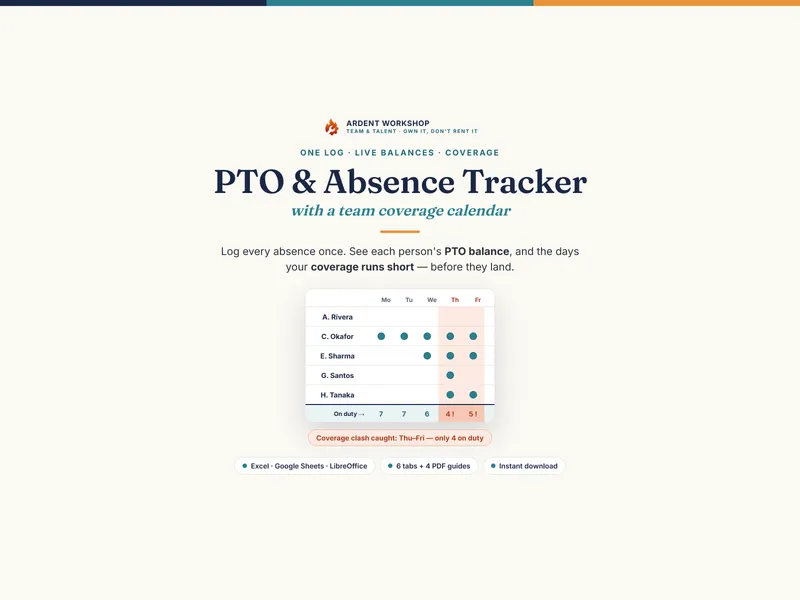
PTO / Absence & Coverage Tracker — Employee Leave & Vacation Tracker with a Team Coverage Calendar (Excel + Google Sheets)
A PTO and absence tracker for Excel & Google Sheets — log leave once, see each person's balance, and a team calendar that flags coverage clashes.
Team & TalentView details