What retirement actually means
A set is retired when the manufacturer stops making it. Nothing about the sets already in the world changes — the boxes on shelves and in closets are exactly what they were the day before. What changes is the supply of new ones: once retail stock sells through, the only way to get that set is from someone who already owns it.
That's the whole mechanism. Retirement doesn't make a set valuable. It removes the price ceiling that retail was quietly providing. While a set is in production and in stock, few people pay much more than list price, because they don't have to. After retirement, the price is whatever two strangers agree on.
Why sets get retired
- Shelf space is finite. A retailer's aisle holds a fixed number of boxes, and every new release has to displace something. Ordinary retirements are usually just this — a set aging out to make room.
- Licenses end. Sets based on a licensed film, show, or game exist only for as long as the licensing agreement does. When it lapses, those sets go, sometimes with little warning.
- Seasonal and anniversary sets are built to be temporary from the start.
- Slow sellers leave early; strong sellers can run for years. Popularity cuts both ways — it keeps a set in production and it means more copies exist when it finally goes.
What retirement does — and doesn't — do to value
Retirement is the most misunderstood word in collecting, so it's worth being blunt about what it does not guarantee.
The most-cited research on this — Dobrynskaya and Kishilova, "LEGO — The Toy of Smart Investors" (Research in International Business and Finance, 2021) — looked at 2,322 sets from 1987 to 2015 and found retired sets returned around 11% a year on average, with prices typically starting to rise two to three years after retirement. That's the bull case, and it's real. But the same study found annual returns ranging from −50% to +600%, and that spread is the part that matters to you:
- An average is not a promise. With a range that wide, plenty of retired sets sit at or below their old retail price for years. A set that sold in huge numbers is still common after retirement — there is no scarcity to price in.
- Scarcity, not the retirement date itself, is what collectors point to. The same research found the strongest appreciation at the extremes — small sets with unusual parts, and very large sets produced in low volumes for adult buyers — rather than tracking the retirement date.
- Condition and completeness dominate. A sealed box, an intact set with its instructions, and a bag of loose bricks are three different objects at three very different prices.
- Paper value isn't money. A listing price is an asking price. What you'd actually realize is that number minus marketplace fees, minus shipping a heavy box, minus the afternoon you spend packing it — and minus the fact that you probably don't want to sell it anyway.
None of this is investment advice.
How collectors read the signals
Start with the official one, because it exists and it's free: LEGO flags sets as retiring soon in a Last Chance to Buy category on its own store, and fan sites publish expected retirement waves ahead of them. What you generally won't get is a firm per-set date committed to in advance — and sets often sell through before the flagged window closes.
Because the official flag tends to arrive late, once stock is already thinning, collectors also lean on rules of thumb. The honest framing is that these are heuristics, not forecasts:
- Time on shelf. Most collectors carry a rough sense of how long a set typically stays in production before it goes. Whatever number you personally believe, the useful move is applying it consistently across everything you're chasing — so the set you've been putting off for three years stops hiding among the ones you added last week.
- Stock thinning out. When a set gets hard to find at normal retailers and starts appearing only at odd ones, its window is closing — often before anything official says so.
- Licensed sets carry an extra clock — the license itself.
The practical version
You don't need to predict retirement. You need to stop being surprised by it. That's a tracking problem, not a forecasting one: write down the sets you want, record when each was released and whether it's still available, and look at the list before you're standing in a store.
That's exactly what the wishlist in our Set Collection & Build Tracker does. You set one number — how long you reckon a set stays on shelves — and every set you're hunting gets measured against it, so the ones whose window is closing surface instead of sinking down the list. It's your own judgment, applied evenly. It predicts nothing, and it doesn't pretend to.
If you just want to start cataloging what's on your shelf, the free set-shelf starter is one tab, no signup — log a set per row and see how much of your collection is still sealed in the box.
Own the record, don't rent it
A collection outlasts the apps built to track it. A blank spreadsheet is free but computes nothing; a collector app means an account, someone else's server, and someone else's roadmap. An owned workbook sits between the two: structure and real formulas, in a file you keep, that opens in Excel, Google Sheets, or LibreOffice and will still open in ten years.
LEGO® is a trademark of the LEGO Group, which does not sponsor, authorize, or endorse this page or our products. This article is general information about collecting, not an appraisal, a price guide, or investment advice.
Templates that implement this
Track your shelf, and the sets you're still hunting
3 templates
Catalog every set, work out what each one cost you per piece, and keep a wishlist that reads your own retirement rule of thumb back at you — in one owned spreadsheet.
- $6.95 Spreadsheet
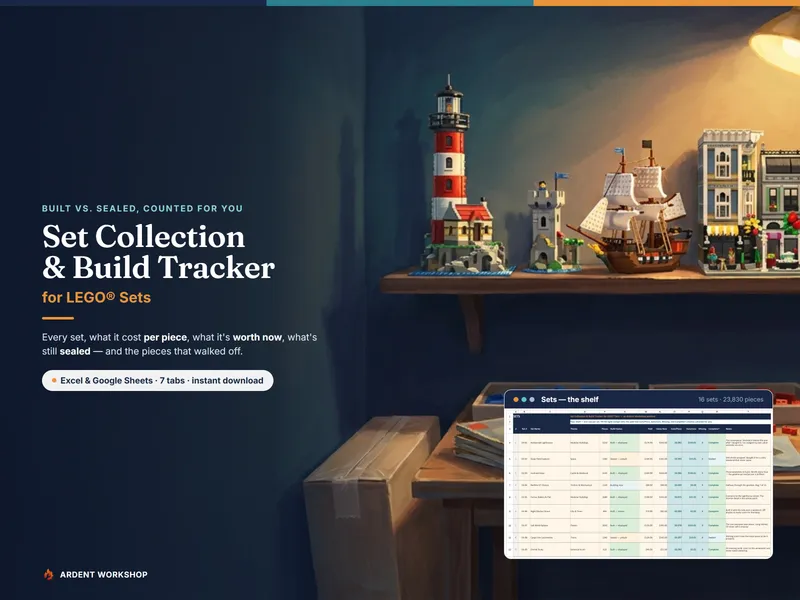
Set Collection & Build Tracker for LEGO® Sets — Excel & Google Sheets
A LEGO set collection tracker for Excel & Google Sheets — catalog every set, compute cost per piece and gain/loss, and count what's still sealed.
TrackersView details - $6.95 Spreadsheet
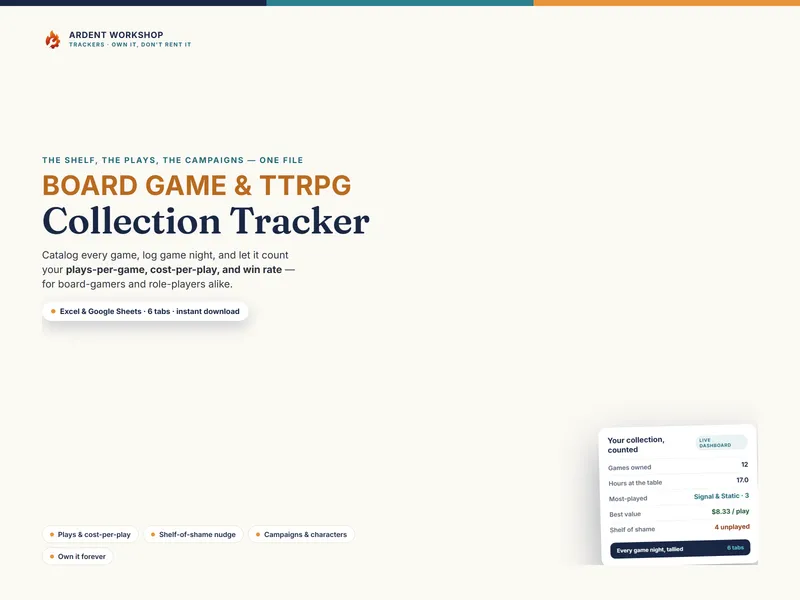
Board Game & TTRPG Collection Tracker — Excel & Google Sheets
A board game & TTRPG collection tracker for Excel & Google Sheets — catalog your shelf, log plays, and track cost-per-play, win rate, and campaigns.
TrackersView details - $6.95 Spreadsheet
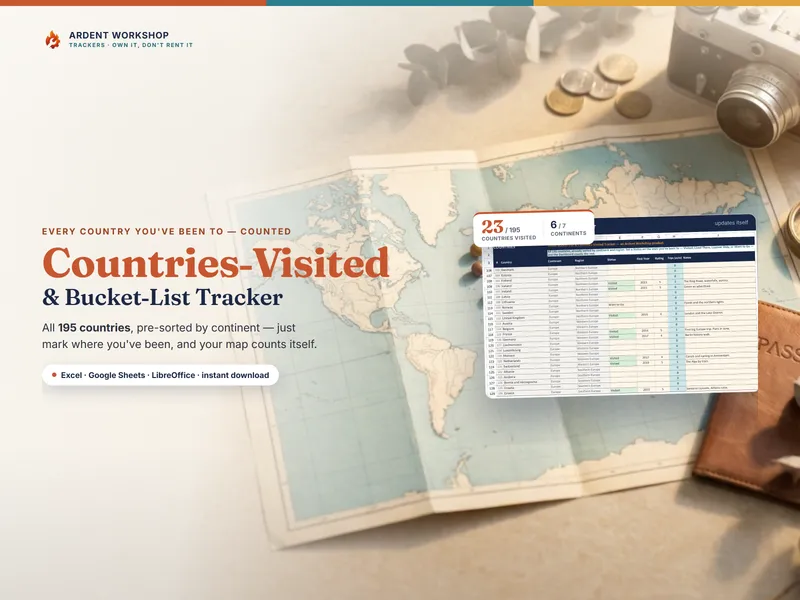
Travel Bucket-List & Countries-Visited Tracker — Excel & Google Sheets
A travel tracker for Excel & Google Sheets — mark the countries you've visited on a pre-loaded list of all 195, then count your map, continents & bucket list.
TrackersView details