
What is scope creep on a retainer?
Scope creep is out-of-scope work that slips into a retainer without a change in the fee. A retainer is a flat monthly fee for an agreed block of your time and services. Scope creep is everything the client gets from that block that the agreement never described: a sales-tax question to a bookkeeper, a website edit or a travel booking to a virtual assistant, a "quick" custom report to anyone.
It is different from a client who simply uses all their hours. Using the block is the deal. Scope creep is the block quietly changing shape while the price stays put.
To see it in your own numbers, the free Retainer Rate Calculator checks one client for one month, and the Bookkeeping & VA Retainer Workbook prices scope creep for every client, month after month.
How does scope creep show up for bookkeepers and virtual assistants?
Because the fee is flat, nothing on the invoice signals that the work grew. The pattern is usually a run of small, reasonable-sounding requests. Common examples for solo bookkeepers, VAs and online business managers:
- Advice and filings outside the service. "Can you tell me how to handle sales tax and file the return?" Recording tax collected is bookkeeping; advising on and filing it is a separate service.
- Projects disguised as tasks. Cleaning up prior years of messy books, or moving the books to different software. Each has a start and an end, unlike a monthly block of time.
- Time-consuming extras. Joining a call with the client's lender, booking travel, researching vendors or software, or building extra custom reports.
- Work from another trade. Small website edits, or designing graphics for an event or promotion.
- Speed and availability. Rush or same-day requests, and messages that arrive after hours and expect a fast answer.
There is a second, quieter kind: unbilled admin. Chasing receipts, invoicing and check-in calls are not out-of-scope requests, but they are time the client costs you that no line item pays for. The two together are why a retainer that looked fine at signing pays less per hour every month.
How do you measure scope creep in hours and dollars?
You can only measure what you log, so the first step is a time log that records every hour, including the five-minute favors, with two labels on each row: retainer work or unbilled admin, and in scope or out of scope. From that log you get three numbers.
- Out-of-scope hours. The hours logged as out of scope in the month.
- Scope-creep dollars. Out-of-scope hours not already counted as overage that month, multiplied by your target hourly rate. Overage hours are excluded because they are already billed (or billable) at the overage rate, and counting them twice would overstate the leak.
- Effective hourly rate. What the client's fee really pays per hour once every hour behind it is counted: retainer work (out-of-scope requests included, since they are logged as retainer work) plus unbilled admin. See effective hourly rate for the general formula.
A worked example (illustrative arithmetic)
These are made-up round numbers to show the steps, simplified to a month with no overage and no hours carried in. Say a client pays $1,000 a month for 10 included hours, and your target rate is $100 an hour.
- You log 10 hours of retainer work, 3 of them out-of-scope favors and 7 in scope, which uses the block exactly, plus 2 hours of unbilled admin: 12 hours in all.
- Effective hourly rate: $1,000 ÷ 12 hours = about $83 an hour, against a $100 target.
- Scope-creep dollars: 3 out-of-scope hours × $100 = $300 of work absorbed for free that month.
The quoted rate on this retainer was $100 an hour. The client paid about $83. The favors were each small, and they took 3 of the 10 hours the fee was meant to spend on the agreed work.
How do you respond to scope creep?
The most useful decision is made once, in advance: for each common request, is it out of scope, and what is the move? The moves are few. Quote it as a one-time task with an hour estimate. Add it to next month if it is truly small and the block has room. Change the scope so it becomes a named service with its own included hours. Or decline or refer it, as with tax advice or payroll paperwork. What you should not do is absorb it silently, because then the month looks over-budget when the real cause is the extra work.
When a request lands, a short script keeps it friendly. Adapted from the retainer playbook's "naming out-of-scope work in the moment" script:
- "I can help with that. It is outside what your retainer covers, so I want to be clear before I start."
- "I would estimate [ESTIMATED HOURS] hours at [OVERAGE RATE] per hour. Would you like me to quote it or add it to next month?"
- "If you would rather change the scope so this becomes part of the monthly work, I can send you a revised agreement."
- "Tell me which you prefer and I will get started as soon as I have your yes."
Two related habits keep scope creep from turning into a surprise. Send a near-cap heads-up before the block is used up ("we have used [HOURS USED] of the [HOURS AVAILABLE] hours available this month"), so the client chooses whether to approve extra hours or pause work. And when overage does happen, put a plain note on the invoice saying how many hours, at what rate, and under which section of the agreement.
If the same request keeps coming back, treat it as information. Either add it to the scope with its own hours, or raise the fee and included hours at renewal using your recent real usage as the evidence.
Why write the boundaries down first?
Scope creep is hardest to handle in the moment, with a client waiting and a relationship to protect. An agreement that names what is included, how overage is billed and approved, and what happens to unused hours gives you something to point to instead of something to argue. The Bookkeeping & VA Retainer Workbook ships an 11-page Retainer Terms & Renewal Playbook PDF with sample clauses, a list of common out-of-scope requests with the move for each, and the scripts above.
How the Bookkeeping & VA Retainer Workbook measures it per client
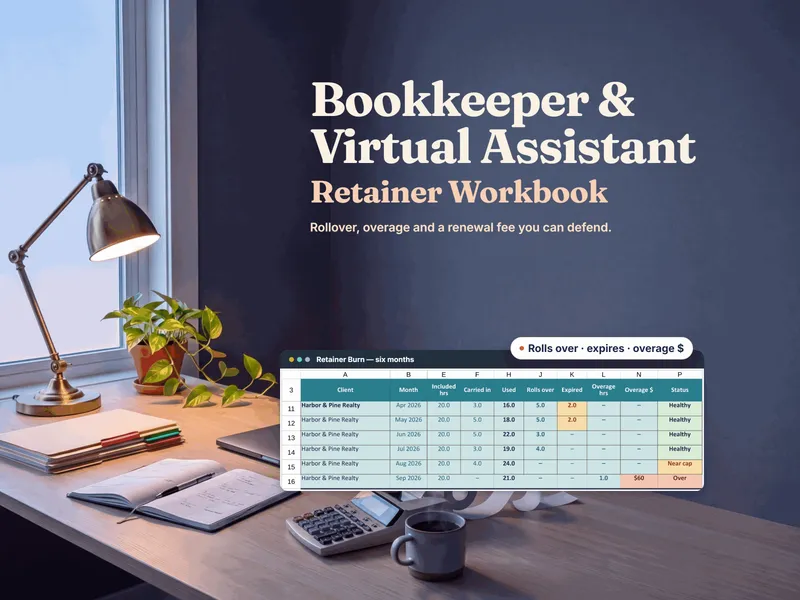
Doing this by hand for every client is the chore that never gets done. The Bookkeeping & VA Retainer Workbook is one 12-tab workbook for Excel, Google Sheets and LibreOffice. You log each hour once in the Time Log, typed as retainer work or unbilled admin and as in scope or out of scope. The Client Profitability tab then shows each client's effective rate, the scope-creep dollars, a Healthy, Watch or Reprice verdict, and a next move. It tracks each client's unused and overrun hours month to month under that client's own rollover rule, prices the overrun in dollars, and turns your recent real usage into a renewal fee and included hours you can defend, so a renewal never cuts what an included hour costs.
Want to try the math on one client first? The free Retainer Rate Calculator takes one client and one month: fee, included hours, and hours worked split into retainer work in scope, retainer work out of scope, and unbilled admin. It returns your effective rate against your target and a Healthy, Watch or Reprice verdict. It has no rollover, no roster and no renewal planner. Those are what the paid workbook adds, bought once and kept, with no subscription.
Common scope-creep mistakes
- Not logging the small favors. Leave them out and the client always looks more profitable than they are.
- Absorbing work to keep the peace. It teaches the client that the fee covers it, and it hides the real cause when the month runs over.
- Confusing scope creep with overage. One is work the agreement did not cover; the other is hours past the block. Price them separately and never count the same hour twice.
- Starting before you have a yes. An estimate and a written reply cost a minute and settle the question.
- Waiting for renewal to raise it. A near-cap heads-up mid-month is far easier than a surprise conversation at the end.
Related templates and concepts
Scope creep is the reason a retainer's effective hourly rate falls below its quoted rate, and it is one of the main things to check before agreeing to any retainer. To set the fee so the favors are priced in from the start, see how to price a monthly retainer. For the broader freelance version of the same tracking, see the Freelancer Business Manager, or browse the templates for freelancers hub.
Templates that implement this
The workbook that prices scope creep per client
1 template
A retainer workbook that logs every hour, flags out-of-scope work, and prices it against your target rate, client by client.
Frequently asked questions
- What is scope creep on a retainer?
- Scope creep on a retainer is out-of-scope work that slips into the monthly arrangement without a change in the fee. The client asks for one small favor after another, each sounds reasonable, and the flat fee quietly absorbs all of them.
- How do you measure scope creep in hours and dollars?
- Log every hour and mark it in scope or out of scope. The hours are your out-of-scope total for the month. The dollars are those out-of-scope hours, not already counted as overage that month, multiplied by your target hourly rate. The effective hourly rate (fees divided by hours worked) shows the same leak from the other side.
- Is scope creep the same as overage?
- No. Overage is hours beyond the hours available in a month, billed at the overage rate under the agreement. Scope creep is work the agreement never covered at all. Counting the same hours as both would double-count them, which is why the workbook prices scope creep only on out-of-scope hours not already counted as overage.
- How do you say no to out-of-scope work without losing the client?
- Name it as outside the retainer, give an hour estimate at your overage rate, and offer a choice: quote it, add it to next month, or change the scope so it becomes part of the monthly work. Then wait for a yes before starting. You are giving the client a decision, not a refusal.
- What if the client keeps asking for the same extra thing?
- A repeat request is a signal that the scope is wrong, not that the client is difficult. Add it to the agreement as a named service with its own included hours, or reprice the retainer at renewal so the fee covers the work as it really runs.