
Quoted rate vs effective rate — the number that lies to you
Most freelancers can recite their rate without thinking: a day rate, an hourly rate, a flat fee they've settled on. That's the quoted rate — the price you name. Your effective hourly rate is different: it's the money a client actually paid divided by every hour you actually spent earning it.
The two only match when the work takes exactly as long as you assumed — which it rarely does. A flat fee that felt generous when you quoted it pays a poor effective rate the moment the project runs long, and nothing on your invoice ever tells you. That gap is where freelance income quietly leaks.
- Quoted rate is the price you set — $95/hour, $1,500 for the project, $2,000/month on retainer.
- Effective hourly rate is what that price became: revenue ÷ the hours it actually took. It's measured after the fact, from real hours, not before it from optimism.
How to compute your effective hourly rate
At the level of a single client or project, the arithmetic is simple — you just need to have logged the hours:
- Effective hourly rate = revenue ÷ hours worked. A $2,000 flat-fee project that took 25 hours pays 2,000 ÷ 25 = $80/hour, no matter what the quote implied.
- Count every hour, not just the billable ones. A fixed fee has to absorb the revisions, the emails, the scope creep and the "quick call." Those hours are why the effective rate drops below the quote.
A quick look at how a flat fee translates to an effective rate as the hours creep up:
| Flat project fee | Hours it took | Effective hourly rate |
|---|---|---|
| $2,000 | 15 | $133 |
| $2,000 | 20 | $100 |
| $2,000 | 25 | $80 |
| $2,000 | 27 | $74 |
| $2,000 | 33 | $61 |
Same fee, wildly different pay. If your target is $120/hour, the same $2,000 client is a win at 15 hours and a loss at 25 — and without logging the hours, you'd never know which one you signed.
Utilization — the whole-practice version of the same idea
Zoom out from one client to the whole business and a second layer appears. You don't get paid for every hour you work: you also sell, invoice, chase payment, do admin, and market — none of it billable. The share of your working hours that you actually bill is your utilization.
As a rough rule of thumb, many freelancers bill only around half to two-thirds of the hours they work — the rest goes to the unpaid overhead of running a business. So your whole-practice effective rate — your total income divided by all the hours you put in, billable or not — sits well below your quoted rate even before a single project runs long. That's not a failure; it's the reality a rate has to cover. A quoted rate that ignores utilization sets a floor you can't actually live on.
Why effective hourly rate matters
- It exposes the unprofitable client an invoice hides. Two clients can pay you the same total and earn you wildly different amounts per hour. The effective rate is the only number that tells them apart.
- It turns a rate change into a decision, not a fear. "This client pays me $75 an hour against a $120 target" is a reason to raise, re-scope, or step away — backed by data, not a bad feeling.
- It prices your next flat fee honestly. Once you know what similar work actually took, you quote a fee that hits your target rate instead of hoping it does.
- It catches the retainer that drifts. A $2,000/month retainer for "up to 15 hours" pays $133 an hour — until the month it quietly becomes 25 hours and pays $80.
How the Freelancer Business Manager computes it per client
Doing this math by hand for every client is exactly the chore that never gets done, which is why the number stays invisible. The Freelancer Business Manager does it for you. You log each piece of work once — the client, the hours, the amount — in the Work & Invoice Log, and the Client Roster pulls it into a live column showing, per client, the hours logged, revenue billed, what's collected, what's outstanding, and the effective hourly rate on them. In the worked example, two flat-fee clients that look fine on paper turn out to pay about $75 and $80 an hour against a $120 target — the exact clients you'd otherwise keep by accident.
The Rate Setup tab works the other direction: it builds a recommended rate up from your overhead, the salary you want to draw, and the hours you can honestly bill — so your target rate accounts for utilization instead of ignoring it. And the Dashboard rolls every client into one blended effective rate against your target, with a count of how many clients sit below your floor.
Want to try the approach before you buy? The free Project Pipeline Tracker is a no-signup, single-tab starter — a real slice of the full workbook.
On a monthly retainer the division is the same: the fee over every hour the client cost you. The Bookkeeping & VA Retainer Workbook divides each client's fee by their retainer work (out-of-scope requests included) plus unbilled admin, tracks unused and overrun hours month to month under that client's own rollover rule, and flags who to reprice. For a single client, the free Retainer Rate Calculator runs the one-month version.
Common effective-hourly-rate mistakes
- Trusting the quoted rate. The number you named tells you nothing about what you earned. Only the logged hours do.
- Not logging non-billable hours. The revisions, the calls, the admin — leave them out and the flat-fee client always looks better than it is.
- Ignoring utilization when you set a rate. Pricing as if every working hour is billable sets a rate that can't cover the unpaid hours behind it.
- Judging a client by total revenue. Your biggest client by invoice can be your worst by the hour.
Related templates and concepts
Effective hourly rate is the freelancer's version of knowing your profit margin — the number that says whether the work actually paid. To decide when a workbook is enough and when a monthly app earns its keep, read spreadsheet vs a freelance-management app, or browse every tool on the templates for freelancers hub.
Templates that implement this
The workbook that computes it per client
2 templates
A connected freelance workbook that pulls your effective hourly rate from your own work log — per client, and blended across the whole practice.
- $29.95 Spreadsheet

Freelancer Business Manager — Per-Client Profit, Effective Rate Calculator, Pipeline & Retainer Tracker (Excel + Google Sheets)
A workbook for freelancers & consultants — track per-client profit, effective hourly rate, pipeline, retainers, and invoices in Excel or Sheets.
Operator OSView details - $24.95 Spreadsheet
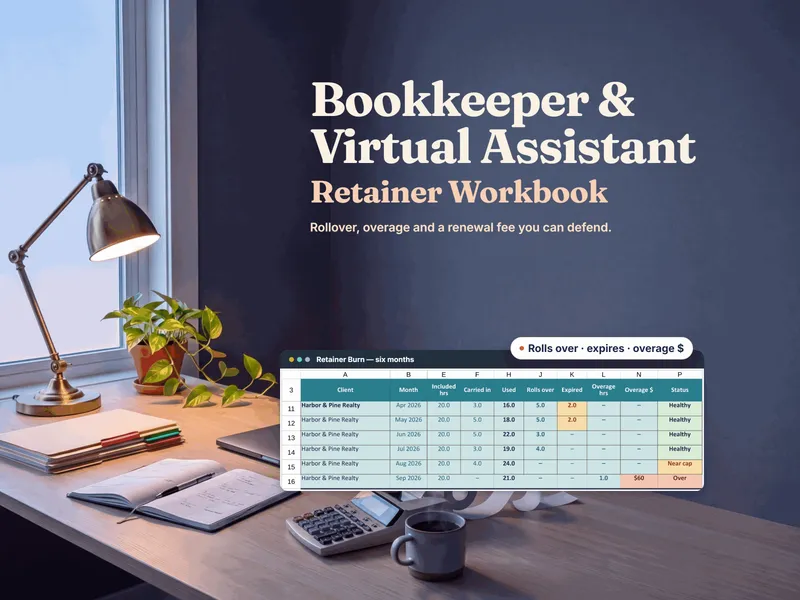
Bookkeeping & VA Retainer Workbook — Client Hours Rollover, Overage, Effective Rate & Renewal Planner (Excel + Google Sheets)
A retainer tracker for bookkeepers & virtual assistants. Roll over or expire each client's hours, price overage, and plan renewal fees in Excel or Sheets.
Operator OSView details